How to Make Set Changes During a Workout

The best time to change a set is when the workout gives you a clear reason: the first few reps were only preparation, a planned working set needs a drop, or a set no longer belongs in the session. Make the smallest accurate change, log what happened, and keep the rest of the workout moving.
A training plan is useful because it gives the session a shape. It should not force you to pretend that every warm-up, equipment change, and on-the-fly adjustment was planned perfectly in advance. The important distinction is between a useful correction and random tinkering.
In Steady, Quick Set Actions makes those small corrections available from the set number during an active workout. You can switch a set between Working Set and Warmup Set, add a drop, or delete a set. The feature is there to keep the record honest when the real session differs from the outline—not to turn every workout into an editing project.
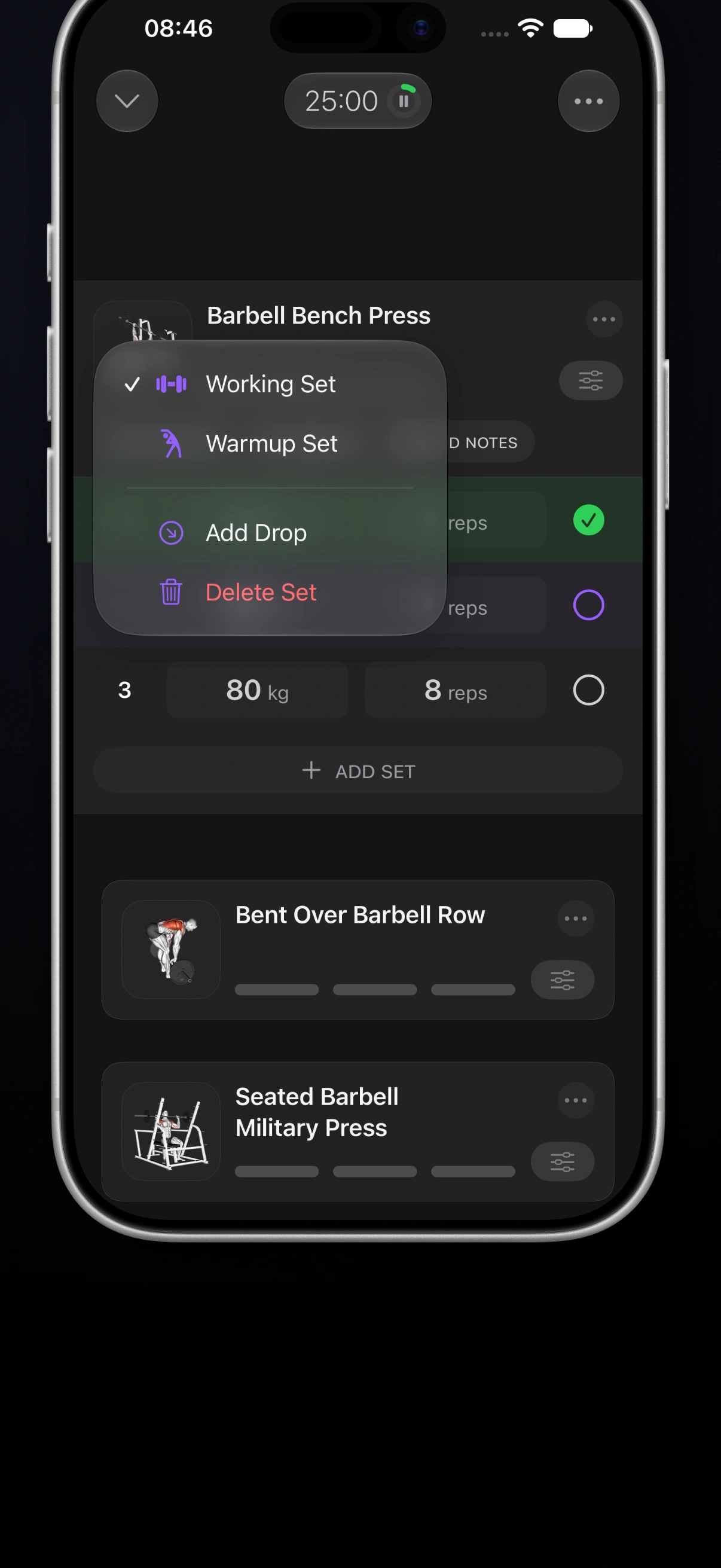 Tap a set number during an active workout to open the actions for that specific set.
Start with the question: what actually happened?
Before changing anything, name the reason in plain language. Usually it is one of four situations:
- Preparation: the set helped you warm up but was not meant to count as hard work.
- A planned effort changed shape: you added a lighter stage after a hard set and want the log to reflect that.
- A set is no longer relevant: you added it by accident, duplicated it, or decided it did not belong in the session.
- The plan itself needs changing: the exercise, target, or workout order needs a larger rethink.
Quick Set Actions is ideal for the first three. The fourth deserves a little more care: change the exercise or routine deliberately, then make a brief note if the reason will matter next time. A clean log is not one that never changes; it is one where the changes still explain the workout.
When a working set should become a warmup
Turn a set into a warmup when it prepared you for the work but was not a meaningful hard set for the exercise.
For example, you may have planned three working sets on a machine press, then taken a light first set because the machine feels different from the one you usually use. If that set was simply a check of the seat position and range of motion, calling it a working set can make the session look like you did more hard work than you did.
That does not make the set unimportant. Warm-ups are valuable preparation. They just serve a different purpose from the sets you want to compare for performance, effort, and progression.
Use the change sparingly. If every working set is becoming a warmup, the issue is probably your setup before the first hard set, not the label after it. Add a little more preparation next time rather than repeatedly rewriting the same session.
When adding a drop is useful
A drop set is a continuation of one hard effort with less load, usually to add focused work after the main portion of the set. It is not just another normal set with a lighter number.
Add one when you actually perform a drop after the parent set and want the log to preserve that relationship. For instance, you finish a hard cable row, reduce the pin, and immediately continue with controlled reps. Logging the drop makes it clear that the lighter work was part of the same extended effort.
 A drop set is one extended effort with a deliberate reduction in load, not an excuse to make every set more complicated.
Do not add drops just because a session feels short or because a workout app offers the option. They increase local fatigue and can make performance harder to compare if you use them inconsistently. A good rule is simple: use a drop when it has a clear place in the session, then keep it in the log as the specific choice it was.
If you are deciding whether that structure suits your goal, Drop Sets vs. Straight Sets is a useful next read.
When deleting a set is the honest choice
Deleting a set makes sense when it should not be part of the record at all: it was created by accident, duplicated, or never happened.
It is not a way to hide an imperfect set. If you attempted a real working set and it went badly, that is still useful training data. A missed rep, a bad day, or an early stop can help you make a better decision next session. Removing it only makes your history look cleaner, not more accurate.
The same principle applies when a session gets shortened. If you decide not to do the final planned set because the gym is closing or you need to leave, leave the unperformed set out. If you did the set but it was rough, log it honestly and add context if necessary.
A simple mid-workout decision sequence
When something changes, avoid editing on impulse. Use this quick sequence instead:
- Finish or stop the set safely. Do not make an app decision while your attention should be on the lift.
- Identify the set’s job. Was it preparation, a hard working set, part of a drop, or an accidental row?
- Make the smallest matching change. Switch to warmup, add a drop, or delete only when the set truly fits that label.
- Preserve useful context. If equipment, pain, time pressure, or a setup change affected the result, add a short note.
- Return to training. The adjustment should take seconds, not become a new planning session.
This keeps your training record useful without asking you to predict every real-world detail before you enter the gym.
If pain, dizziness, or unusual symptoms caused the change, stop the set rather than trying to edit your way through it. Rest and seek appropriate medical guidance when needed.
Keep the log useful for the next session
The goal of in-workout editing is not a perfect-looking history. It is a history you can trust when you come back to the exercise.
Mark preparation as preparation. Keep a genuine drop attached to the hard set it followed. Remove rows that do not represent work you performed. And leave difficult but real sets in the record, because those are often the sessions that explain the best next decision.
Steady’s Quick Set Actions gives you that control right where it matters: at the set, while the workout is still in front of you. Use it to make the record match the work, then get back to the next rep.
Ready to start applying progressive overload?
Ditch the spreadsheets and complex notes. Join thousands of lifters who use Steady to focus on the workout, track their progress, and automatically know when to add weight.
Download Free for iPhone