How to Track Body Measurements for Muscle Growth
Body measurements are useful for muscle growth when you take the same few measurements under similar conditions and read the trend over months—not when you react to every single entry. A gradually larger chest, arm, thigh, or shoulder measurement can add context that body weight and gym performance cannot provide alone.
The aim is not to turn a tape measure into a weekly verdict on your physique. It is to build a small, repeatable record that helps you see whether your training, nutrition, and recovery are moving in the direction you intended.
What body measurements can tell you
The scale is one signal, but it cannot tell you where a change came from. Body weight can move with food, hydration, glycogen, digestion, and normal day-to-day variation. Measurements add another view:
- During a gaining phase, a rising arm, chest, or thigh measurement alongside stable-to-rising strength can support the case that your training is productive.
- During a cut, a smaller waist measurement can be useful context when the scale stalls for a week.
- When body weight rises quickly but waist measurements rise much faster than the areas you care about, it may be a reason to slow the rate of gain.
- When everything is flat for a long stretch, the record gives you a better starting point for reviewing calories, training quality, and recovery.
None of these signals proves a specific amount of muscle or fat change. Tape measurements have normal error, and different body parts change at different rates. Their value comes from a consistent process and a long enough time horizon.
Pick a small set you will actually repeat
For most lifters, three to five measurements are enough. Choose them around your current goal instead of logging every possible circumference out of obligation.
A practical starting set
| Goal | Useful measurements |
|---|---|
| Muscle gain | body weight, waist, chest, upper arm, thigh |
| Fat loss while lifting | body weight, waist, hips or abdomen, one limb measurement |
| General physique tracking | body weight, waist, chest, upper arm, thigh |
Measure the same side for a single-limb measurement, such as the right upper arm. If you want to compare left and right, log both deliberately; do not alternate sides from one check-in to the next.
There is no prize for tracking calves, forearms, neck, and every other option if you will stop after two weeks. Start with the areas that would genuinely influence a training or nutrition decision.
Make each check-in boringly consistent
Take measurements under roughly the same conditions: at the same time of day, with similar hydration, before training, and without a pump. Many people find a morning check-in after using the bathroom and before breakfast easiest to repeat.
Place the tape in the same spot each time, keep it snug without compressing the skin, and use the same posture. You do not need laboratory precision. You need a method you can recreate next month.
A repeatable check-in beats a perfect-looking number taken under different conditions every time.
Once every two to four weeks is a sensible rhythm for many lifters. Weekly can work if the process feels easy, but daily circumference checks usually create more noise than insight. Use the same cadence long enough to see a trend.
Read the pattern with your training log
Measurements are most useful when they sit beside the work that produced them. A bigger arm measurement means more when curls, rows, presses, and other relevant work have been progressing or becoming more consistent. A smaller waist means more when you also understand the direction of your body weight, food intake, and training performance.
Ask a few simple questions at each review:
- Is this a change that has persisted across more than one check-in?
- Does it match what has happened with body weight and performance?
- Does it support the goal of my current phase?
- Is there an action worth taking, or do I simply need more data?
For example, a lifter in a slow gaining phase might see body weight and upper-arm measurements trend upward while the waist barely changes. That is not proof of a perfect bulk, but it is usually more useful evidence than body weight alone. On the other hand, one larger waist entry after a salty meal or poor sleep is a reason to wait for the next consistent check-in—not to rewrite your whole plan.
If body weight is one of your signals, pair measurements with a body-weight trend instead of comparing isolated weigh-ins. And keep your workout record honest: progressive overload without spreadsheets is easier to judge when your performance history is clear.
How to use Body Measurements in Steady
Steady’s Measurements area is built for this kind of small, repeatable record. You can choose the measurement types that matter to you, group them by general, torso, arms, or legs, then log selected values together on a chosen date. Each measurement has its own history and chart, so a waist trend does not get mixed into your body-weight view.
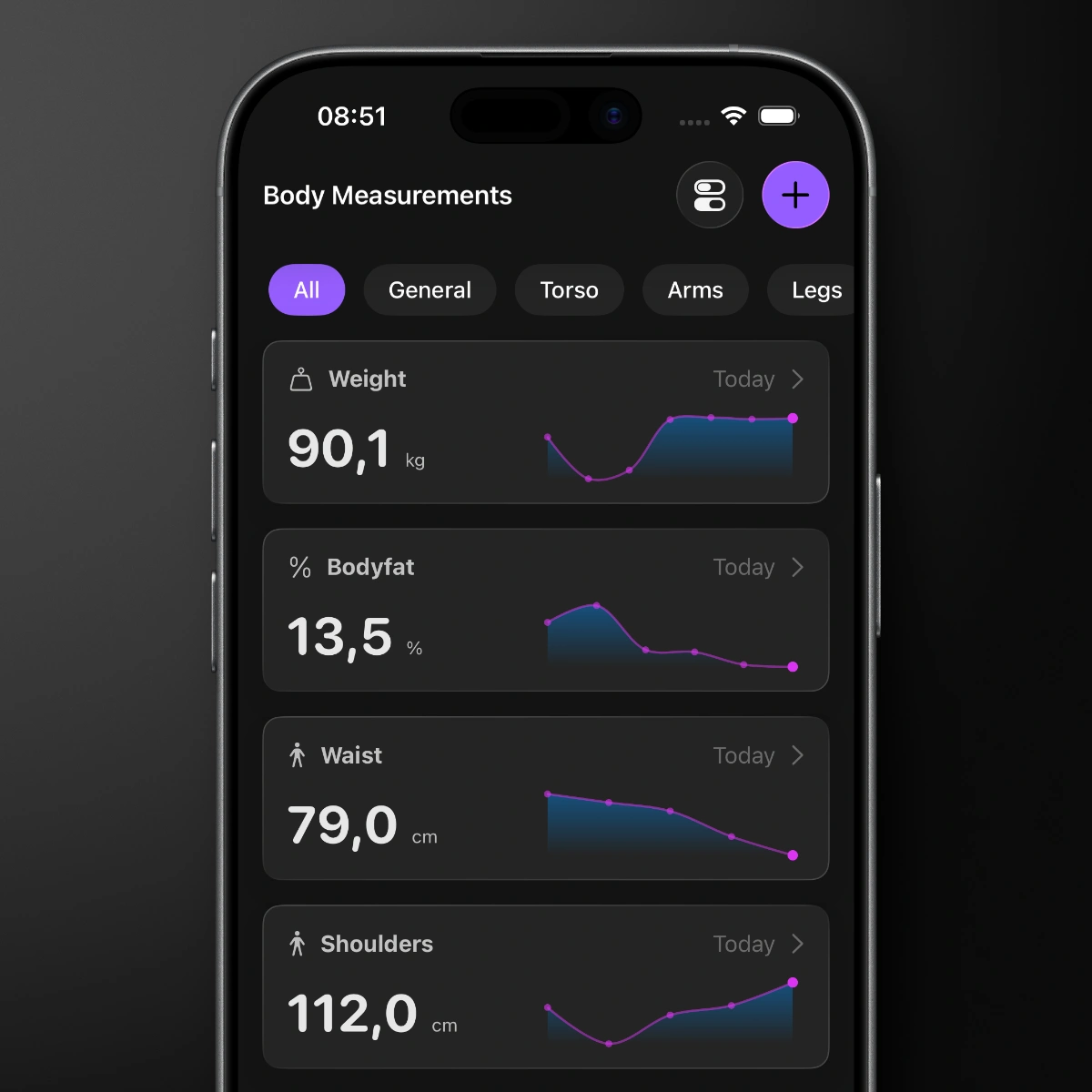
The grouped view keeps weight, body-fat percentage, waist, shoulders, and other chosen measurements easy to scan separately.
Keep the setup simple. Add the same handful of measurements at each check-in, then review them after several entries rather than trying to interpret every change in real time. If consistency is the harder part, Steady also supports recurring measurement reminders—use one as a neutral prompt to collect data, not as pressure to chase a particular number.
Avoid the common measurement traps
The biggest mistake is changing the method every time. Measuring an arm flexed one month and relaxed the next, or taking your waist after a large meal one week and first thing in the morning the next, makes the comparison weak.
Other traps are just as common:
- Treating one entry as a verdict instead of waiting for a pattern.
- Measuring too many areas to maintain consistently.
- Letting a number override how you feel, perform, and recover.
- Making a drastic food or training adjustment before the trend has had time to develop.
Your measurements should make decisions calmer, not more anxious. When the record is stable and repeatable, it becomes another helpful training signal—alongside performance, body weight, recovery, and how your clothes fit.
Build a record you can use
Pick a small set of measurements, keep the conditions consistent, and check the trend every few weeks. That is enough to turn a tape measure from a source of noise into useful feedback for a gaining phase, cut, or long-term strength plan.
Steady keeps those check-ins beside the rest of your training history, without turning them into a social feed or a complicated body-composition dashboard. Log the data, give it time, and let the pattern—not a single number—guide the next adjustment.
Ready to start applying progressive overload?
Ditch the spreadsheets and complex notes. Join thousands of lifters who use Steady to focus on the workout, track their progress, and automatically know when to add weight.
Download Free for iPhone