How to Compare This Week's Training to Your Usual

The useful way to judge this week’s training is to compare it with what you normally do, not with an ideal week on paper. A lower total can be a needed recovery week; a higher total can be productive or simply a sign that your schedule changed. Context turns a number into a decision.
It is tempting to see a low weekly total on Friday and assume you are falling behind. Or to see a big number and assume you have found a better plan. Neither conclusion is reliable by itself. The better question is: how different is this week from my recent, normal training—and why?
Start with a useful baseline
A baseline is a recent average that gives a number some scale. For weekly training, four weeks is often long enough to smooth out one unusually short session while still reflecting your current routine.
That does not mean a four-week average is a verdict. It is a reference point. Use it to notice a pattern, then check the reason behind it.
For example, 20% less volume than usual might mean:
- you deliberately reduced work before a hard event;
- you missed a session because travel disrupted the week;
- you trained the same number of days but cut a few accessory sets;
- you logged less carefully than usual.
Those situations can produce a similar total but call for very different next steps.
Look at volume, duration, and calories as separate signals
Three weekly numbers can describe different parts of the same training week.
Volume shows how much load you moved. It is useful when you are watching workload across comparable lifting weeks, but it does not tell you whether every rep was high quality.
Duration shows how much time training took. A longer week can mean more work, but it can also mean longer rests, a busier gym, or more time between sessions.
Calories burned can add context when your activity changes, especially if you also use conditioning. It is not a score for how good a strength workout was, and it should not be used to earn extra food or punish a quiet day.
When all three rise together, the change is worth noticing. When only duration rises, your training may simply have become less time-efficient. When volume falls while duration stays normal, look at exercise selection, working sets, or load before assuming recovery is the problem.
Compare the right kind of weeks
Your baseline works best when the weeks have a similar purpose. Do not compare the first week of a return from vacation with a normal hypertrophy block and call the difference a failure. Do not compare a planned deload with a hard accumulation week and decide the deload is not working.
Before changing your plan, ask:
- Was this week intended to be different?
- Did the number move because of training, scheduling, or logging?
- Did recovery, performance, and motivation move in the same direction?
- Has the same difference shown up for more than one week?
That last question matters. One unusual week is information. A repeating pattern is a reason to adjust.
 A weekly total is most useful when you pair it with the reason it changed.
What to do when this week is above or below usual
Use the comparison to make a small, practical call—not to rebuild your whole routine.
When you are above usual
Ask whether the extra work was intentional and recoverable. If you added a session, pushed more hard sets, or increased conditioning, watch for poorer performance, unusually persistent soreness, or a drop in enthusiasm next week. If everything still feels steady, you may simply be handling more work well.
When you are on par with usual
That is often the least exciting and most useful result. It tells you your routine is behaving as expected. Keep progressing individual lifts, rather than changing a plan just because the dashboard looks familiar.
When you are below usual
Do not automatically try to make up the difference on Sunday. If the lower week came from poor sleep, illness, travel, or accumulated fatigue, resuming the next planned session is usually smarter than cramming in missed work. If it happened because you repeatedly ran out of time, create a shorter fallback version of that session instead.
How this works in Steady
In Steady’s Trends tab, the Volume, Duration, and Calories Burned widgets compare the current week with a trailing four-week average. The cards show the week’s total, the baseline, and a simple above-usual, on-par, or below-usual read. The daily bars add useful context: a partial week should be read as a week in progress, not as a completed one.
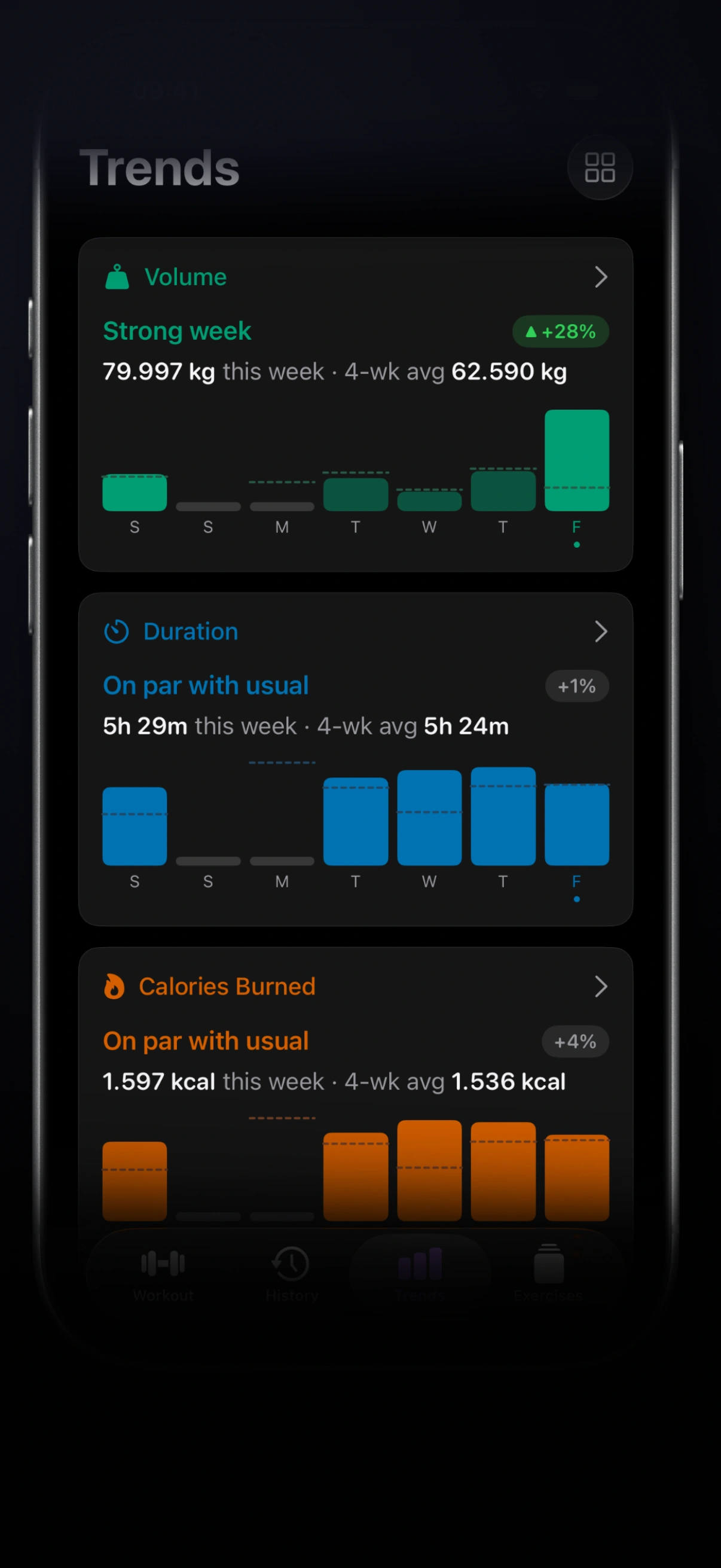 The widgets make the comparison visible without turning one total into a judgment.
The feature is most helpful after you have logged enough ordinary weeks for “usual” to mean something. A recent change in schedule, a new training block, or several missed sessions can make the baseline less representative. That is not a flaw in the data; it is your cue to interpret it with the rest of your training history.
Steady keeps that history focused: detailed set logging when you need it, and a calm overview when you want to zoom out. Open Trends at the end of the week, find the signal that changed, write down the likely reason, and make only the next adjustment your training actually needs.
Ready to start applying progressive overload?
Ditch the spreadsheets and complex notes. Join thousands of lifters who use Steady to focus on the workout, track their progress, and automatically know when to add weight.
Download Free for iPhone