How to Adjust a Workout on Low-Energy Days

The best way to adjust a workout on a low-energy day is to keep the session’s purpose, reduce the least important stress first, and log what actually happened. Do not turn every tired day into a max-effort test. Start by lowering load slightly, trimming extra sets, extending rest, or simplifying exercise order while keeping the main movement pattern intact.
A low-energy day does not automatically mean you should skip the gym. It also does not mean you should force the exact plan no matter how the warm-ups feel.
The useful middle ground is simple: train the parts of the workout that still make sense, scale the parts that are no longer productive, and leave yourself better positioned for the next session.
First, decide whether you are tired or under-recovered
Not every low-energy workout has the same meaning.
You might just be tired today because you slept poorly, trained later than usual, ate less than normal, or had a stressful day. In that case, a small adjustment is usually enough.
Under-recovery is different. If performance has been dropping for several sessions, joints feel beat up, motivation is unusually low, and warm-ups feel heavy across multiple workouts, you may need a deliberate deload or a short reduction in volume.
Use this quick check:
- If only today’s warm-ups feel off, make a same-day adjustment.
- If the last few sessions also dropped, reduce more aggressively.
- If pain changes your movement, stop treating it as a normal fatigue problem.
This keeps you from overreacting to one rough day while still respecting clear warning signs.
Keep the main goal of the workout
Before changing anything, ask: what was this workout supposed to do?
If it was a heavy strength day, the main goal may be practicing the top movement with good technique. If it was a hypertrophy session, the goal may be getting enough quality sets near the target muscle. If it was a lighter pump day, the goal may simply be movement, blood flow, and consistency.
Once you know the goal, adjust around it.
For example:
- On a squat day, keep squatting, but reduce load or total sets.
- On an upper-body hypertrophy day, keep the important presses and rows, but skip redundant finishers.
- On a return-from-break workout, keep the routine familiar, but avoid chasing previous bests.
The mistake is changing everything at once. If you reduce load, cut sets, swap exercises, shorten range of motion, and rush rest, you will not know what helped.
What to reduce first
When energy is low, reduce training stress in this order.
1. Reduce load slightly
A 5% to 15% reduction can turn a grind into a productive workout. This is especially useful when technique is still solid but the planned weight feels heavier than expected.
Do not think of this as “losing progress.” You are keeping the movement pattern, getting useful reps, and avoiding a sloppy session that creates more fatigue than stimulus.
2. Keep load, but reduce reps
If the weight still moves well, you can keep it and stop each set a rep or two earlier. This works well for strength practice because the load stays familiar without forcing ugly final reps.
For example, instead of 3 sets of 8 at a planned weight, you might do 3 sets of 6 with cleaner speed and better control.
 A low-energy day is usually a signal to manage the dose, not a reason to turn every set into a fight.
3. Cut the least important sets
If the main lifts are done but accessories feel unproductive, cut the optional work. Most lifters are better off doing two good accessory sets than four half-hearted ones.
Good candidates to trim:
- redundant isolation work
- extra pump sets
- exercises added only because you “usually do them”
- conditioning tacked on after a hard lifting session
Keep the work that has a clear purpose. Remove the filler.
4. Extend rest periods
Sometimes the workout does not need less weight. It needs more time between sets.
If you are rushing because the gym is busy or the day is stressful, add another 30 to 90 seconds before judging the load. Short rest can make normal weights feel like a problem.
5. Simplify exercise order
If equipment is open, do the most important movement while you still have attention and coordination. Save less technical work for later.
On low-energy days, exercise order matters more because your margin for error is smaller.
What not to do
Avoid these common reactions.
Do not chase the planned numbers at any cost
The plan is a guide, not a contract. If the warm-up tells you the target is unrealistic today, adjust before the first bad working set.
Do not rewrite the whole program because of one bad day
One weaker session is data. It is not proof your routine stopped working.
Look for patterns before changing exercise selection, weekly volume, or progression rules.
Do not hide the adjustment from your log
If you reduced weight, skipped sets, or needed longer rest, log it honestly. Future you needs that context.
A clean training history is not a list of perfect workouts. It is a record accurate enough to help you make better decisions next time.
How to use this in Steady
Steady’s Recovery Mode is designed for this exact situation: you want to train today, but you do not want today’s fatigue to distort the program.
From a workout, you can choose Recovery Mode, set how much lighter the session should be, and preview the adjusted targets. The app keeps your program the same, pauses auto-progression for that session, and still logs the workout to your history.
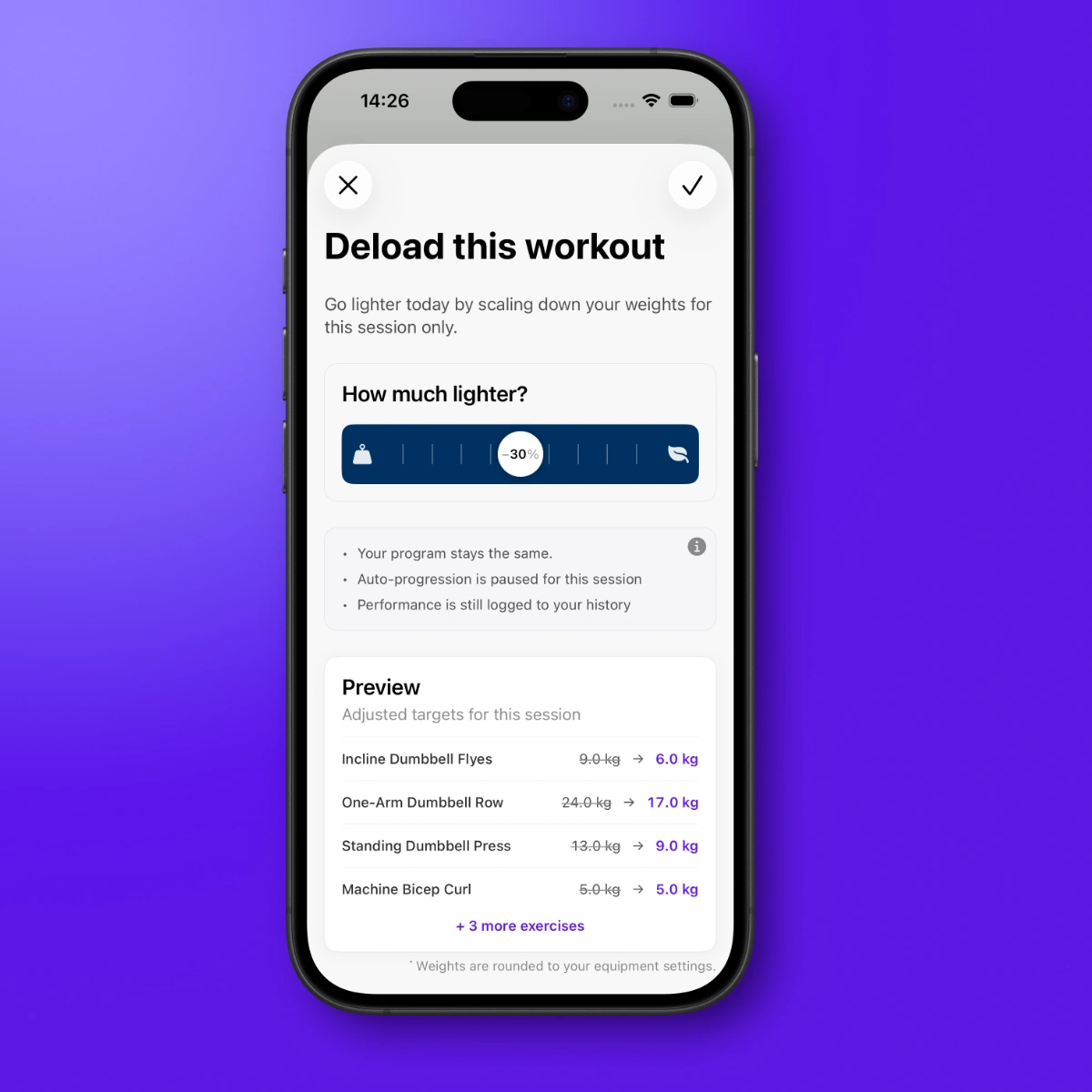 Recovery Mode lets you scale today’s targets without rewriting the routine you plan to come back to.
That distinction matters. A lighter session can be useful training data, but it should not automatically tell your progression system that you failed the original plan. Steady treats that lower-stress workout as intentional, which keeps the log honest without punishing the next session.
You can also add a short note like “low sleep,” “travel day,” or “kept two reps in reserve.” Small notes make future decisions much easier when you are looking back at a dip in performance.
A practical low-energy adjustment
Imagine your planned workout starts with bench press:
- planned: 3 sets of 8 at 185 lb
- warm-up: 155 lb feels slower than usual
- first working set option: force 185 and hope
A better adjustment:
- Try 175 lb for the first work set.
- Stop at 7 or 8 clean reps.
- Rest a little longer than usual.
- Do two or three quality sets depending on how the second set feels.
- Trim one accessory exercise if pressing performance continues to drop.
That is still a real workout. It is just not pretending to be your best day.
Bottom line
Low-energy workouts should be adjusted, not ignored or forced. Keep the main goal, reduce the least important stress first, and log the change clearly.
Progress is not built only on perfect sessions. It is built by making useful decisions on average days, tired days, and the days when the plan needs a small edit. Steady helps by keeping those edits visible, intentional, and connected to the workout history you will use next time.
Ready to start applying progressive overload?
Ditch the spreadsheets and complex notes. Join thousands of lifters who use Steady to focus on the workout, track their progress, and automatically know when to add weight.
Download Free for iPhone