How to Adjust a Workout When Equipment Is Taken
The best way to adjust a workout when equipment is taken is to swap the exercise for the closest available movement that trains the same main muscle, uses a similar movement pattern, and fits the same set and rep target. Do not replace a squat with random cardio or a cable row with whatever machine is open. Replace the job, not just the exercise name.
Busy gyms are normal. The rack is taken, the cable station has a line, the dumbbells you need are missing, or someone is doing a long superset across half the room. A good workout plan should survive that without turning into a different workout.
The goal is simple: keep the training stimulus close enough that your session still makes sense, then log the change clearly so next week is easy to read.
First, decide whether to wait or swap
Waiting is fine when the exercise is central to the workout and the wait is short. If today is built around heavy squats and the rack will open in three minutes, stay close, warm up, and take the rack when it frees up.
Swapping is better when the wait will wreck the pace of the session, when the exercise is an accessory, or when another movement can do nearly the same job.
A quick rule:
- Wait for main lifts when load specificity matters: squat, bench press, deadlift, overhead press, or a key machine lift you are tracking closely.
- Swap accessories when the goal is mostly muscle work: curls, lateral raises, rows, flyes, leg curls, triceps work, calf raises, and similar movements.
- Reorder the workout when the equipment will open soon and the next exercise does not interfere with the main lift.
- Skip only when the substitute would be poor and you are already near the end of the session.
You are not being lazy by swapping. You are keeping the session productive.
Match the movement pattern first
The best substitute is usually the one that keeps the pattern close.
Think in categories:
- Horizontal push: bench press, dumbbell bench press, machine chest press, push-up
- Vertical push: overhead press, dumbbell shoulder press, machine shoulder press
- Horizontal pull: seated cable row, chest-supported row, dumbbell row, machine row
- Vertical pull: pull-up, pulldown, assisted pull-up
- Squat pattern: back squat, front squat, hack squat, leg press, goblet squat
- Hip hinge: Romanian deadlift, stiff-leg deadlift, hip thrust, back extension
- Knee flexion: lying leg curl, seated leg curl, standing leg curl
- Isolation: cable fly, pec deck, dumbbell fly; cable curl, dumbbell curl, machine curl
If the cable row is taken, a machine row is usually a better swap than a pulldown. Both train the back, but one is a horizontal pull and the other is vertical. That difference may matter if your program already has pulldowns elsewhere.
 A useful swap keeps the same training job in the session, not just the same general body part.
Keep the target muscle honest
After movement pattern, check the main muscle.
If your planned exercise is a cable lateral raise, the point is side delts. A dumbbell lateral raise is a good substitute. An overhead press is not the same thing, even though shoulders are involved, because it shifts more work to the front delts and triceps.
If your planned exercise is a leg curl, the point is knee-flexion hamstring work. Romanian deadlifts train hamstrings too, but through a hip hinge. That can be useful, but it is not a direct one-to-one replacement if your program needs knee-flexion volume.
This is where many gym substitutions go wrong. The replacement is not terrible, it is just different enough that the program slowly drifts.
Adjust the load and reps
Do not expect the same weight to carry across substitutions.
A 70 kg barbell row, a 70 kg cable row, and a 70 kg machine row are not interchangeable numbers. Different machines, leverages, cable stacks, grips, and stabilization demands change the feel of the exercise.
When you swap:
- Keep the same set count unless the replacement is much more fatiguing.
- Keep the same rep range when possible.
- Choose the load by effort, not by matching the old number.
- Leave one or two reps in reserve on the first substituted set.
- Log the actual exercise you performed.
Example: your plan says Cable Row: 3 x 8-12, but the cable station is taken. You swap to Chest-Supported Machine Row: 3 x 8-12. Start with a load that feels like the same target effort, then progress that machine separately if you keep using it.
Do not let swaps erase your progression
Substitutions are useful, but they can make progress harder to track if every week becomes a different movement.
Use a simple hierarchy:
- Same exercise, same equipment when available.
- Close variation when the original is taken.
- Different pattern for the same muscle only when needed.
- Skip or move on if every substitute would change the workout too much.
If you swap the same exercise often, make that substitute part of the plan. For example, if the barbell bench is always busy at your gym, use dumbbell bench as your normal first press instead of fighting the same battle every Monday.
Consistency beats theoretical perfection.
Good swap examples
These are not universal rules, but they are good starting points:
- Barbell bench press taken: dumbbell bench press, machine chest press, weighted push-up
- Squat rack taken: hack squat, leg press, goblet squat, front squat if another rack opens
- Cable row taken: chest-supported row, machine row, one-arm dumbbell row
- Lat pulldown taken: assisted pull-up, pull-up, kneeling single-arm pulldown if another cable is open
- Leg curl taken: another leg curl machine, stability ball leg curl, Nordic curl variation
- Cable triceps pressdown taken: dumbbell skull crusher, machine dip, overhead cable extension if another station is free
- Cable lateral raise taken: dumbbell lateral raise, machine lateral raise
The best option depends on what equipment you have, what you can perform well, and what your program is trying to train.
How to use this in Steady
Steady supports this exact situation with Exercise Alternatives. In an active workout, you can replace an exercise before completing its sets, choose a substitute from the exercise list, and keep the session moving. Steady also has suggested alternatives and your own saved alternatives, so the swap can be a planned decision instead of a rushed search.
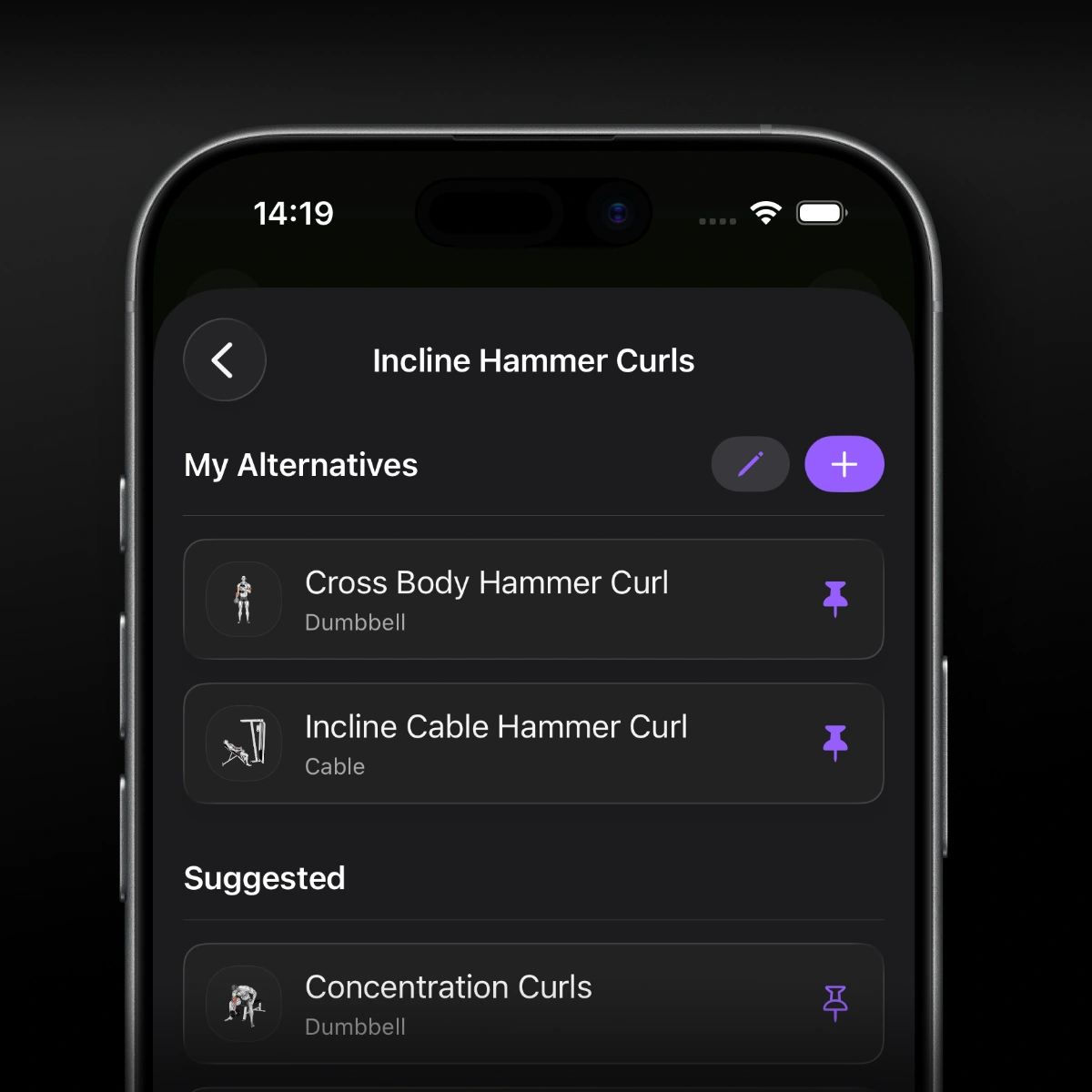 Exercise Alternatives help you keep the workout moving when the planned station is not available.
When you replace an exercise, log the exercise you actually performed. That keeps your history honest. If the swap was temporary, add a short note like “rack taken” or “used machine row today.” If the substitute felt better and you want to keep it, make that decision after the workout, not while you are irritated in a crowded gym.
This is where a focused workout tracker helps: the plan stays structured, the log stays accurate, and the substitution does not turn into a full program rewrite.
Common mistakes
The biggest mistake is treating any exercise for the same body part as equivalent. It is not. A leg press, Romanian deadlift, leg extension, and lunge all involve the legs, but they create different training stress.
Other common mistakes:
- changing the rep range for no reason
- matching the old weight instead of matching effort
- swapping main lifts too casually
- forgetting to log the replacement exercise
- turning one crowded gym day into a complete program overhaul
- using the same “temporary” swap every week without updating the plan
The cleaner your rule, the easier it is to stay consistent.
The bottom line
When equipment is taken, swap by training purpose: same main muscle, similar movement pattern, similar rep target, and realistic load. Wait for the big lifts when specificity matters, reorder when the delay is short, and swap accessories when another option can do the same job.
Then log what actually happened. Steady is built for that kind of practical training: clear routines, fast exercise replacement, useful history, and enough structure to keep a busy gym from derailing the workout.
Ready to start applying progressive overload?
Ditch the spreadsheets and complex notes. Join thousands of lifters who use Steady to focus on the workout, track their progress, and automatically know when to add weight.
Download Free for iPhone