How to Choose Exercises for a Workout

The best way to choose exercises for a workout is to start with the goal of the session, cover the main movement patterns for the muscles you want to train, then pick exercises you can perform consistently and progress over time. A good workout does not need every good exercise. It needs the right few exercises in the right roles.
That sounds simple, but exercise choice is where many lifters accidentally make their program messy. They add movements because they saw them online, because the machine was free, or because the workout feels too short without one more finisher. The result is a session that is busy without being focused.
Here is a practical way to choose exercises that actually belong in your workout.
Start with the job of the workout
Before picking exercises, decide what the workout is supposed to accomplish. You do not need a complicated answer. You just need a clear one:
- Build strength in one main lift
- Train a muscle group for hypertrophy
- Practice a movement pattern
- Get a full-body session done efficiently
- Add accessory work around a sport or existing routine
The job determines the first exercise. If the workout is built around squat strength, the squat goes first. If the goal is chest hypertrophy, a stable press or fly that lets you load the chest well should lead the session. If it is a quick full-body day, you probably want one lower-body movement, one push, one pull, and maybe one focused accessory.
This step prevents a common mistake: choosing exercises first, then trying to invent a purpose for them afterward.
Cover movement patterns, not random muscles
A useful workout usually includes exercises that cover movement patterns. A movement pattern is a category of motion, like pushing, pulling, squatting, hinging, or carrying.
For most lifters, these are the big buckets:
- Squat pattern: back squat, front squat, leg press, split squat
- Hip hinge: deadlift, Romanian deadlift, hip thrust, back extension
- Horizontal push: bench press, push-up, machine chest press
- Vertical push: overhead press, dumbbell shoulder press, landmine press
- Horizontal pull: barbell row, cable row, chest-supported row
- Vertical pull: pull-up, chin-up, lat pulldown
- Isolation: curls, tricep extensions, lateral raises, leg curls, calf raises
You do not need every pattern in every workout. A lower-body day may only need a squat pattern, a hinge, and one or two accessories. A pull day may be mostly rows, pulldowns, rear delts, and curls. But thinking in patterns keeps the workout balanced and makes gaps obvious.
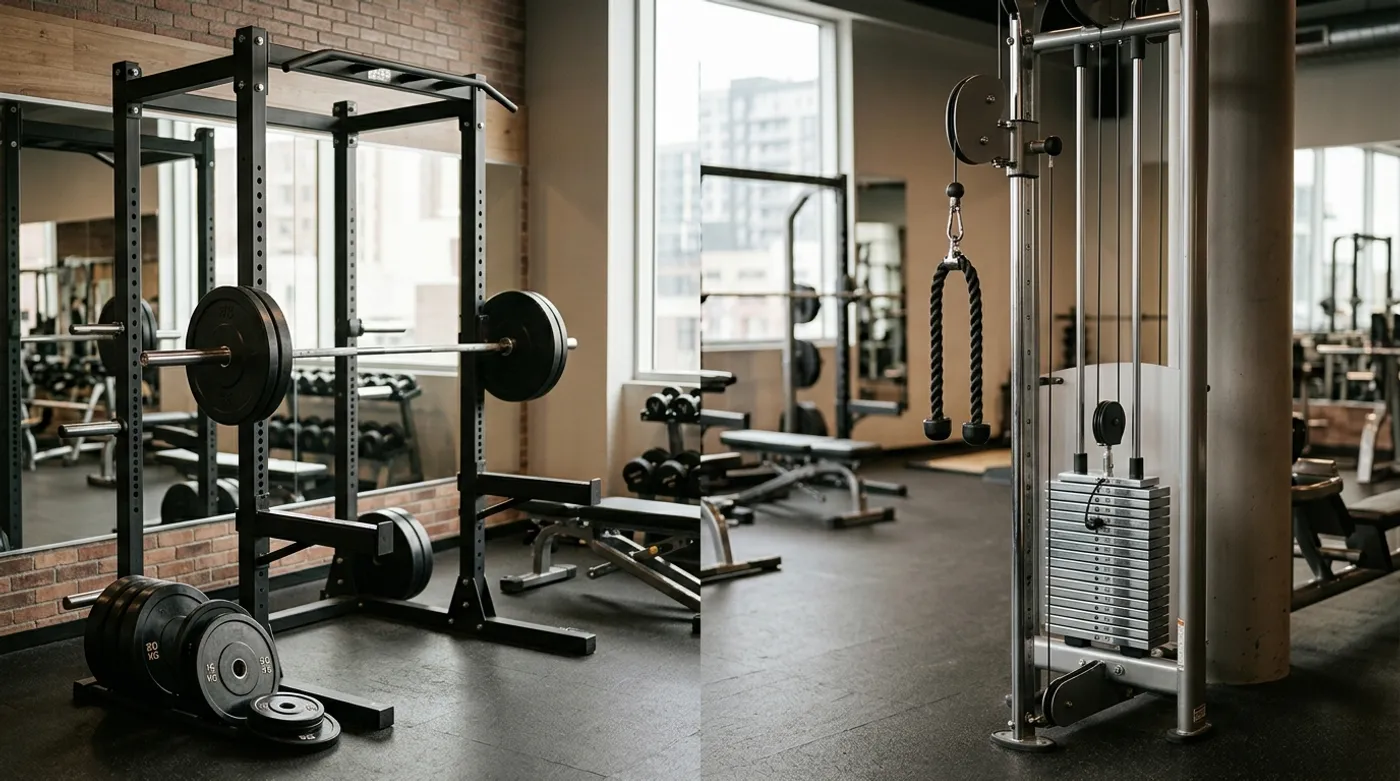 Exercise selection gets easier when you think in roles: the rack, cable stack, and dumbbell area each solve different training problems.
Pick exercises that fit the role
Once you know the pattern, choose the version that best fits the job.
For a main lift, choose an exercise that is stable enough to load, repeatable enough to track, and important enough to deserve fresh energy. That often means a barbell squat, bench press, deadlift variation, overhead press, pull-up, or heavy row.
For a secondary lift, choose something that supports the main work without demanding the same recovery. If your main lower-body lift is a back squat, a Romanian deadlift or leg press may make sense next. If your main press is a barbell bench, an incline dumbbell press or machine press can add useful volume.
For isolation work, choose the exercise that lets the target muscle do the work cleanly. A cable lateral raise may be better than a heavy swinging dumbbell raise. A seated leg curl may be better than forcing another hinge if your lower back is already tired.
This is where machines, cables, dumbbells, and barbells all have a place. The question is not which tool is more legitimate. The question is which tool solves the problem in front of you.
Use a simple exercise-selection checklist
When you are choosing between two good options, use this checklist:
- Can I do it with good technique today? If form breaks early, the exercise is probably too advanced, too heavy, or poorly placed.
- Can I progress it clearly? Load, reps, tempo, range of motion, and control should be trackable.
- Does it train the muscle or pattern I actually care about? If another muscle gives out first, pick a better variation.
- Does it fit my recovery? A hard deadlift variation after heavy squats may be too much, even if it looks good on paper.
- Is the equipment reliably available? A perfect exercise you can never access will not build consistency.
The best choice is often the boring one you can repeat for months. Boring is not a weakness in training. Boring is how your logbook becomes useful.
How many exercises should you choose?
Most workouts only need 4 to 7 exercises. Fewer than that can work if the lifts are big and well chosen. More than that usually means the session is drifting.
A simple structure:
- One main exercise for the highest-priority lift or muscle group
- One or two secondary exercises that add useful volume
- Two or three accessories for smaller muscles, weak points, or joint balance
- Optional finisher only if it supports the goal and does not wreck recovery
For example, a focused upper-body pull workout could be:
- Weighted pull-up
- Chest-supported row
- Lat pulldown
- Rear-delt fly
- Dumbbell curl
That is enough. Adding three more back exercises would probably add fatigue faster than it adds progress.
Common exercise-selection mistakes
Changing exercises too often. Variety feels productive, but progress needs repetition. Keep your main lifts stable long enough to compare performance across weeks.
Choosing exercises because they are difficult, not because they are useful. A movement can be hard and still be a poor fit. Difficulty is not the same as stimulus.
Stacking exercises that all stress the same joint. Bench press, dips, skull crushers, and overhead tricep extensions in one session may be too much elbow and shoulder stress for many lifters.
Ignoring setup time. If a workout requires five busy stations at peak gym hours, it may look smart in a spreadsheet and fail in real life.
Using novelty as a fix for poor progression. If a lift stalls, first check sleep, recovery, technique, volume, and realistic loading jumps. Do not swap exercises every time a week feels flat.
Track the reason behind each exercise
Your workout log should tell you more than what you lifted. It should make the purpose of each exercise obvious over time.
In Steady, that means keeping your routine focused, logging the sets that matter, and watching whether the exercises you chose are actually moving. If your main lift is progressing, your accessories feel targeted, and recovery is manageable, your exercise selection is working.
You do not need a giant exercise library or a cluttered workout store to build a good session. Choose exercises with a job, repeat them long enough to learn from the data, and adjust when your training gives you a real reason.
Ready to start applying progressive overload?
Ditch the spreadsheets and complex notes. Join thousands of lifters who use Steady to focus on the workout, track their progress, and automatically know when to add weight.
Download Free for iPhone