How to Compare Planned and Performed Weekly Sets
Planned weekly sets only help when you compare them with the working sets you actually complete. If the two do not match, first find out whether the gap came from a deliberate choice, a scheduling problem, or a plan that no longer fits—then change the smallest thing that solves the real problem.
It is easy to look at a routine and assume every muscle is getting the intended work. But a written program is only a forecast. A skipped accessory, a swapped movement, a rushed Friday session, or an extra set added because you felt good can all shift the week away from that forecast.
That does not make the week bad. It gives you a useful comparison.
What planned versus performed weekly sets means
Planned sets are the working sets your current program assigns to each muscle group across its week. Performed sets are the working sets you logged recently. The comparison asks a practical question: did your real training week resemble the workload you meant to run?
This is not a score for perfect adherence. It is a way to spot a pattern before it becomes a surprise.
For example, your program may plan 12 weekly chest sets. If you complete 10 after one short session, that can be completely fine. If you land at 6 for several weeks because the final workout is always rushed, the issue is probably not effort. The plan may be asking more of your schedule than it can reliably get.
Likewise, 16 performed sets are not automatically better than 12 planned sets. Extra work can be useful, but it can also make recovery harder or hide the fact that other muscle groups keep being skipped.
Compare like with like
Start with working sets, not every movement that happened to involve a muscle. Warm-up sets, easy practice work, and incidental effort do not carry the same training role as challenging work you intended to progress.
Then compare the week to the same type of week. A planned deload, a holiday, or a return after illness should not be judged against a normal hard block. The comparison is most useful when the program, schedule, and goal are broadly stable.
 The comparison becomes useful when it connects the program on paper to the work that actually made it into the week.
Three questions keep the review honest:
- Which muscle groups regularly come in below plan?
- Which groups keep accumulating extra work?
- Is the difference intentional, or is it the same constraint repeating?
Those questions are better than trying to force every missing set into Sunday evening.
What to do when the numbers differ
When performed work is below plan
Do not automatically add everything back. First identify the reason. A one-off missed session may only need a normal return to the plan. A repeated shortfall calls for a design change: fewer weekly sets, a shorter session, a different exercise order, or a more realistic training frequency.
If the same smaller muscle group is always missed at the end of a long workout, move one or two of its sets earlier. If an entire session repeatedly disappears during busy weeks, a shorter fallback version may protect more progress than an ambitious catch-up day.
When performed work is above plan
Extra sets can be productive when they are intentional, recoverable, and consistent with the goal. They are less helpful when they appear because every session turns into an unplanned test.
Before adding the extra work permanently, ask whether performance, sleep, soreness, and motivation still look steady. If they do, you may have found useful capacity. If not, the written plan may already be enough.
When one muscle group is out of balance
An imbalance is a prompt to investigate, not a diagnosis. Maybe substitutions changed which muscles received the work. Maybe one exercise was removed from the routine. Maybe the program has a priority that is no longer yours.
Use the comparison to choose one adjustment, then give it several comparable weeks before deciding whether it worked. For a broader guide to changing volume deliberately, see When to Add More Sets.
How Planned vs Performed works in Steady
Steady’s Planned vs Performed view in Trends compares each muscle group’s planned weekly work from your selected program with the working sets you have completed in the last seven days. The main card keeps the highest-signal muscle groups easy to scan; opening it shows the fuller comparison. You can also set a weekly target range for a muscle when you want an additional reference beyond the program.
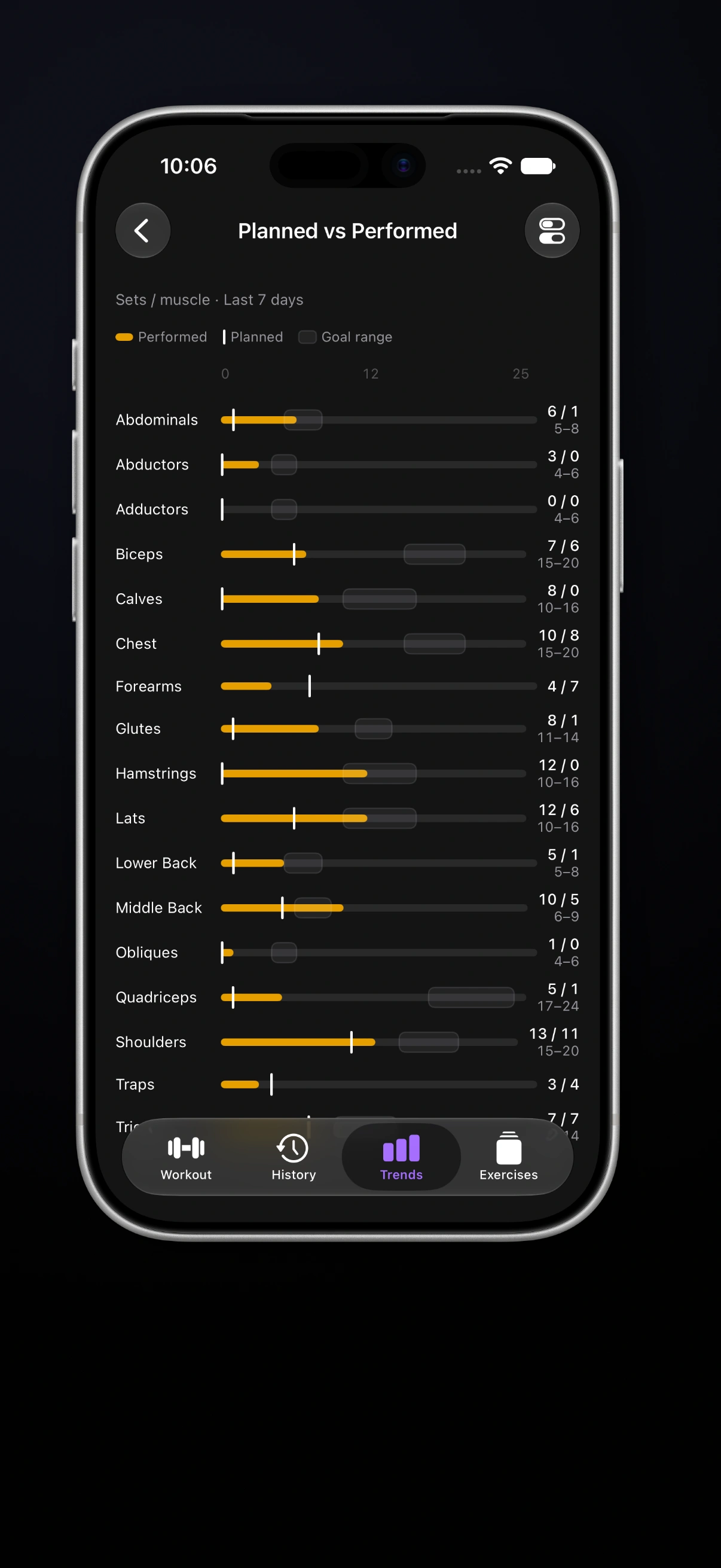 The view makes a missed or extra block of weekly work visible without turning it into a judgment.
There are useful limits. The comparison needs a selected program to establish the plan, and it only reflects the sets you log. It also uses a recent seven-day window, so it is a check on current training behavior—not a verdict on a whole month. Planned vs Performed is available with Steady Pro.
That makes it most useful at the end of a normal training week: open Trends, notice the largest meaningful difference, name the reason, and decide whether the next week needs a small change or simply a repeat.
Keep the plan connected to real life
Weekly volume is not something to win. It is a tool for putting enough useful work in the right places while leaving room to recover and show up again.
Steady keeps the plan, the completed sets, and the longer training record close together without burying them beneath feeds or a crowded workout marketplace. Compare the week you planned with the week you trained, then let the next decision be as practical as the data.
Ready to start applying progressive overload?
Ditch the spreadsheets and complex notes. Join thousands of lifters who use Steady to focus on the workout, track their progress, and automatically know when to add weight.
Download Free for iPhone