Which Workout Changes Should You Keep?

Keep a workout change when it solves a repeatable problem or makes the next session clearer. Keep it temporary when it only solved today’s problem. A lighter load after poor sleep, a substitute because a station was busy, or an extra rest period can be the right call without becoming the new plan. The useful skill is separating a one-day adjustment from evidence that your routine should change.
That distinction protects both sides of good training. You stay flexible enough to finish a productive session when real life interferes, and structured enough that your routine does not drift every time the gym is busy or a set feels off.
Treat the workout as an experiment, not a rewrite
In-session changes are normal. You may need to use a different machine, reduce a target, reorder exercises, add a set, or pair movements differently. None of those choices is automatically a verdict on the program.
Before you carry a change forward, ask three questions:
- Was the original plan the problem? If the same exercise repeatedly causes a setup issue, does not suit your equipment, or creates a predictable bottleneck, the routine may need attention.
- Did the change improve the result? A substitution that lets you train the intended muscle with control is more persuasive than one made only to save a few minutes.
- Would you make the same change next week under normal conditions? If the answer is no, it belongs to the session—not the routine.
A cable row swapped for a chest-supported row because every cable station was occupied is useful information, but it is not necessarily a new exercise selection. If you consistently get better loading, comfort, and progression from the chest-supported row, that is a different story: you have a pattern worth testing in the plan.
Changes that usually stay temporary
Some changes are sensible precisely because they are temporary. Let them do their job, log them honestly, then avoid turning them into a rule after one appearance.
- A low-energy adjustment. Reducing load, reps, or total work after a rough night can keep the session productive without proving that the original target was wrong.
- An equipment workaround. Taking another movement because the rack or machine is taken solves a crowded-gym problem, not automatically a programming problem.
- A pain-aware detour. Stop or modify a movement if pain changes the picture, but do not use one difficult session to guess at a permanent fix. Get appropriate professional guidance when pain persists or is significant.
- An unusually long rest period. More rest may be smart on a hard day; it does not mean every future session needs the same rhythm.
The log should still reflect what happened. Honest history makes it easier to spot whether a supposedly one-off change is becoming a trend.
Changes that can earn a place in the routine
 A short note about why a change worked can be more useful than trying to remember the session next week.
Look for repeatability, not novelty. A change is a good candidate to keep when it improves the workout across comparable sessions.
For example, an exercise may consistently be unavailable at your training time, a preferred order may make a key lift stronger, or a different superset may keep the session moving without hurting performance. You might also find that the routine target is consistently too aggressive or too conservative. In each case, the evidence is stronger when the pattern appears more than once and the comparison is fair: similar setup, rest, effort, and recovery.
Do not confuse a more difficult workout with a better one. Adding volume, shortening rest, or choosing a tougher variation only earns a permanent spot if it serves the goal and you can recover from it. A routine is useful because it is repeatable, not because every session becomes more complicated.
Use a simple decision rule after training
At the end of a session, sort changes into one of three buckets:
Keep it for this session only
Use this for crowding, travel, a time limit, a low-readiness day, or anything you would not choose under ordinary conditions. Record enough context to understand the result later, then return to the plan next time.
Test it again
Use this when a change looks promising but you only have one data point. Repeat it deliberately once or twice under comparable conditions. This is especially helpful for substitutions, different exercise order, and small target changes.
Save it to the routine
Use this when the change has a clear reason and you would be comfortable seeing it the next time the routine opens. Save the exact thing that earned its place—an exercise change, a new order, a superset, or next-session targets—rather than making several unrelated edits at once.
Review routine changes in Steady before they become permanent
Steady is designed to let workout-day flexibility stay flexible. Changes to today’s targets can apply to the active session first, and after a routine-based workout the summary can offer Review Changes. That gives you a separate moment to decide what should update for the next time you use that routine.
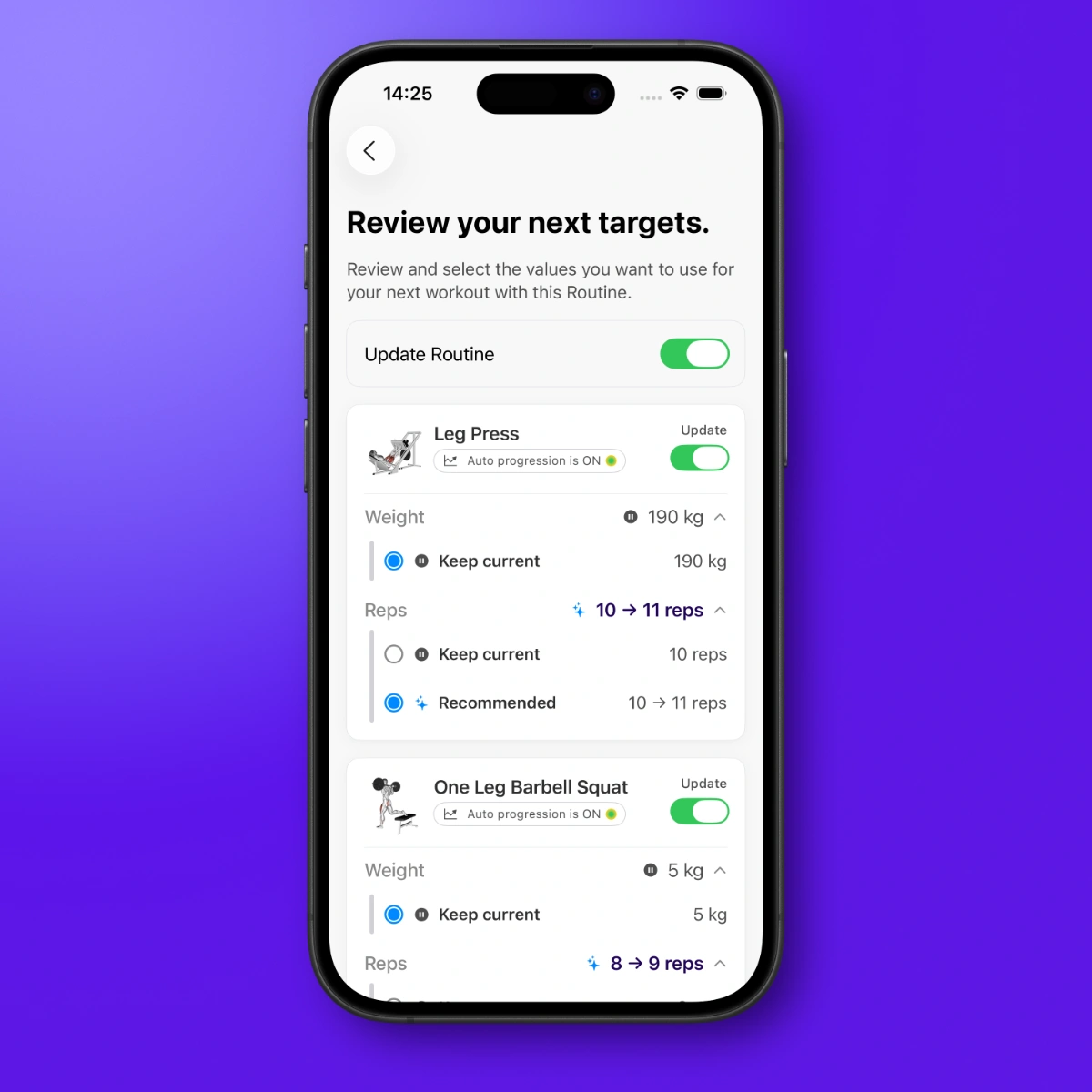 Review Changes keeps the decision at the end of the workout, when the session is still clear but the pressure of the set has passed.
In that review, you can keep the routine untouched or choose the changes that deserve to persist. The flow can cover next targets, exercise changes, supersets, and a changed exercise order when applicable. The app’s Update Routine control makes the choice explicit: logging a change is not the same as committing it to the plan.
That is particularly valuable after a mixed session. Maybe you want to keep a better exercise order but not the lower targets from a tired day. Or you want to accept a next-target recommendation for one exercise while leaving the rest alone. Treat the review as a small edit pass, not an obligation to optimize every detail.
Keep the routine stable enough to teach you something
The point of tracking is not to make every workout identical. It is to know why a change happened and whether it helped. When a pattern earns its way into the routine, save it with confidence. When it was simply the best call for today, let it remain a useful note in your history.
Steady keeps that decision close to the completed session: log what you did, review the changes that matter, and start the next workout with a plan you can trust.
Ready to start applying progressive overload?
Ditch the spreadsheets and complex notes. Join thousands of lifters who use Steady to focus on the workout, track their progress, and automatically know when to add weight.
Download Free for iPhone