How to Log Form Cues

The best way to log form cues is to write only the cue that changes your next set or next workout. Keep it short, attach it to the exercise it belongs to, and separate permanent technique reminders from one-day observations. A useful cue should help you repeat better reps later, not turn your workout log into a diary you never reread.
Form cues matter because progress is not only weight, reps, and sets. If your squat feels better because you found the right stance, or your bench press is stronger when you keep your shoulder blades set, that information is part of your training history. The trick is capturing it without making logging feel like homework.
What is a form cue?
A form cue is a short reminder that helps you perform an exercise with better technique. Good cues are specific, physical, and easy to act on while lifting.
Examples:
- “Ribs down before each rep.”
- “Pause one second in the stretch.”
- “Keep elbows slightly in front of the bar.”
- “Set feet wider than last week.”
- “Stop two reps before hip shift starts.”
Weak cues are vague. “Better form” is not a cue. “Control the first half of the eccentric” is.
Log cues at the right level
Not every note belongs in the same place. Before writing anything, decide whether the cue is always true, specific to this routine, or only relevant to today’s session.
Exercise-level cues
Use these for reminders you want every time you perform the exercise, regardless of the routine.
Example: “Dumbbell row: start each rep by pulling the shoulder blade back, then drive elbow.”
This kind of note helps when an exercise has one technical point you keep forgetting. It should stay short enough that you can scan it before the set.
Routine-specific cues
Use these when the same exercise has a different intent in different workouts.
Example: you might bench press heavy on one day and use a paused bench press on another. The exercise name is similar, but the cue is different:
- Heavy bench: “Strong leg drive, touch lower chest.”
- Paused bench: “Dead stop on chest, no bounce.”
That distinction matters. If the cue belongs to the way this routine uses the exercise, attach it to the routine context instead of making it a permanent exercise rule.
Session notes
Use these for what happened today.
Example: “Right shoulder felt tight until set 3; wider grip felt better.”
This note may be useful next week, but it should not become a permanent instruction unless the pattern repeats.
 The cue worth saving is usually the one you discovered during the set, not the one you remembered afterward.
What to write during the workout
During a workout, keep cues brutally short. You are there to train, not write a coaching textbook.
Use this simple format:
- Problem: what broke down?
- Cue: what fixed it?
- Context: when did it happen?
For example:
- “Set 3: hips rose early. Think chest up before drive.”
- “Last two reps: left knee caved. Use slightly wider stance.”
- “45 lb DBs: better lat stretch when elbow tracks low.”
- “Paused reps felt cleaner than touch-and-go.”
Each note gives future-you something usable. It does not need full sentences. It does not need perfect grammar. It only needs to be clear when you see it again.
Do not log every cue you hear
The fastest way to ruin workout notes is to collect every cue from every video, coach, or article. Most lifters only need one active cue per exercise at a time.
If you stack five reminders on a squat, you will think about all five and execute none of them well. Pick the cue that solves the biggest current problem.
A good rule:
- if the cue changed the set today, log it
- if the cue is still relevant next week, keep it
- if the cue no longer changes anything, delete or replace it
Your log should evolve as your technique improves.
Review cues before the first working set
The best time to read technique notes is not after the workout. It is before the first hard set of the exercise.
Warm-up sets are perfect for this. Read the cue, test it with lighter weight, and decide whether it still applies. If it does, keep it visible. If not, update it.
This is especially useful for exercises where small setup changes make a big difference:
- bench press grip width
- squat stance and bracing
- Romanian deadlift range of motion
- lateral raise arm path
- cable row torso angle
- split squat foot position
Small cues keep these exercises repeatable. Repeatability makes progress easier to trust.
How to use this in Steady
Steady’s exercise notes are built around the same idea: different notes for different jobs.
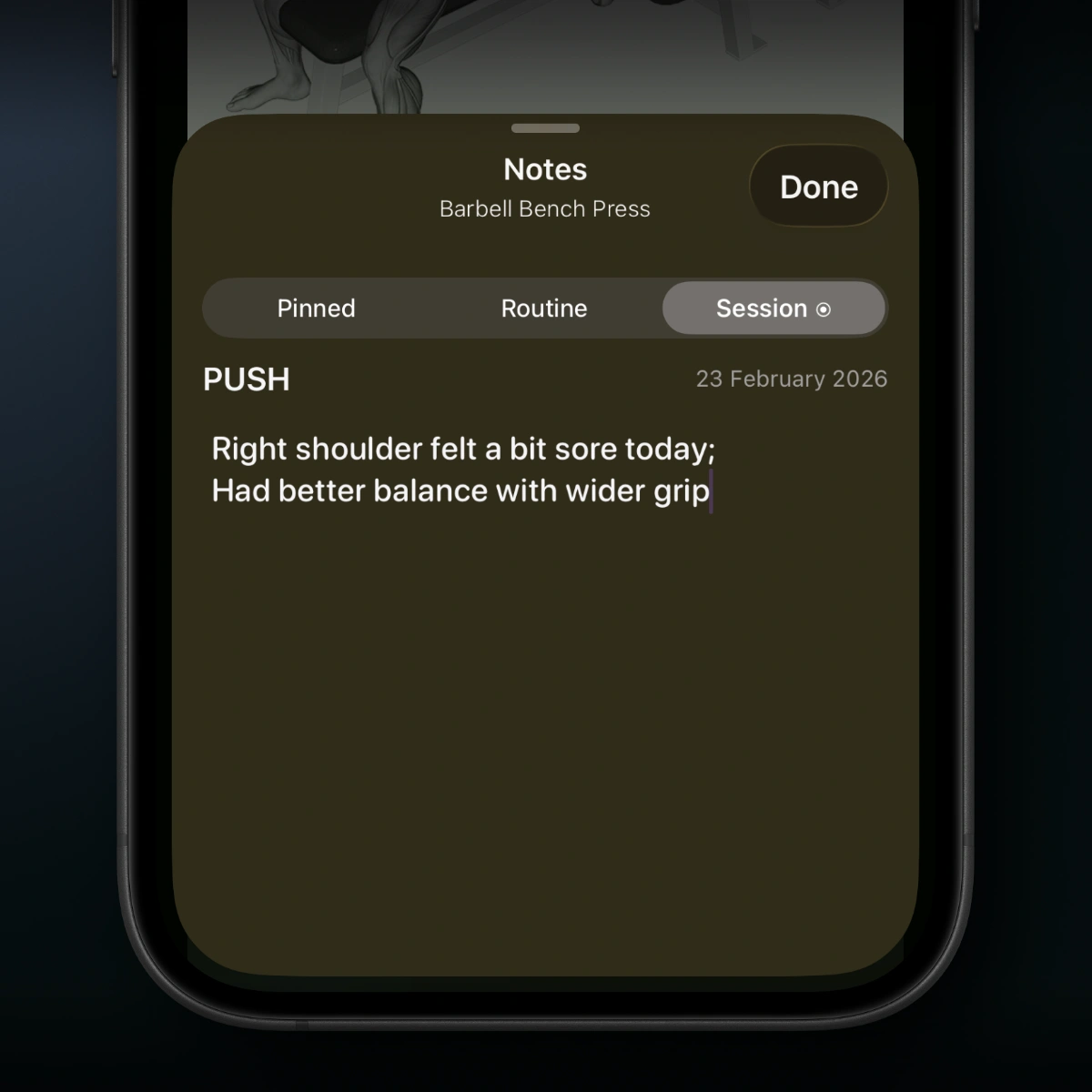 Pinned, routine, and session notes let you keep broad technique cues separate from one-workout observations.
Use a pinned note for a cue you want attached to the exercise everywhere, such as “ribs down, neutral spine” or “slow, controlled eccentric.” Use a routine note when the exercise has a specific purpose in that routine, such as a paused variation, a target RPE, or a tempo focus. Use a session note for what happened today: soreness, setup changes, missed cues, or anything you want to remember next time.
That separation keeps the useful information close without cluttering the set log. It also pairs well with a focused approach to workout notes: write the detail that will change a future decision, then move on.
Common mistakes
Writing cues that are too broad
“Use better form” will not help next week. Write the physical action: “brace before unrack,” “pause at bottom,” or “keep wrist stacked.”
Keeping stale cues forever
A cue that fixed your squat six months ago may not be the cue you need now. If it no longer changes how you lift, archive it mentally and replace it with the next useful reminder.
Mixing pain notes with technique goals
“Left shoulder sore” is not the same kind of note as “elbows 45 degrees.” Keep pain, soreness, and unusual discomfort as session context. If pain persists or changes how you train, treat it seriously and get appropriate help instead of trying to cue your way through it.
Writing during every rest period
You do not need a note after every set. Most good sessions produce zero to three useful notes. If your log has twenty new cues, most of them probably do not matter.
A simple form-cue checklist
Before saving a cue, ask:
- Will this help me perform the exercise better next time?
- Is it specific enough to act on during a set?
- Does it belong to the exercise, this routine, or only today’s session?
- Can I shorten it without losing the point?
If the answer is yes, save it. If not, skip it.
Good tracking should make training clearer, not heavier. Steady gives you a simple place to keep the cues that matter, separate the ones that belong to different contexts, and get back to lifting without turning your workout into paperwork.
Ready to start applying progressive overload?
Ditch the spreadsheets and complex notes. Join thousands of lifters who use Steady to focus on the workout, track their progress, and automatically know when to add weight.
Download Free for iPhone