Workout Tonnage: What the Total Tells You

Workout tonnage is the sum of load multiplied by completed reps across the sets you count. It helps you track how much loaded repetition work you recorded, especially when comparing the same workout under similar conditions. A higher total alone does not prove you got stronger, trained harder, or built more muscle.
That distinction matters when a workout summary says you lifted several thousand kilograms. The number can be useful without becoming a score you need to beat every session.
How to calculate workout tonnage
For one set, multiply the recorded load by the completed repetitions. Then add the sets together. If every set uses the same load and rep count, the shortcut is sets × reps × load.
For three sets at 60 kg:
| Set | Completed reps | Load × reps |
|---|---|---|
| 1 | 10 | 600 kg |
| 2 | 9 | 540 kg |
| 3 | 8 | 480 kg |
| Total | 27 | 1,620 kg |
Use the reps you actually completed. A target of three sets of ten would produce 1,800 kg, but that is the prescription, not the result above.
Despite the name, you can report tonnage in kilograms or pounds. Keep the unit and counting convention consistent. Changing from one dumbbell’s weight to the combined pair, for example, doubles the total on paper without changing the workout.
The total is useful when the comparison stays similar
Suppose the next session uses the same exercise, equipment, load, three working sets, and similar rest and effort. You complete 10, 10, and 9 reps. The total becomes 1,740 kg. You can trace the increase to two additional reps under comparable conditions.
That is a useful improvement in repeated performance. It is still worth opening the individual sets: the total cannot tell you whether those reps came from steadier performance across the exercise or a single unusually strong set.
Research also supports treating volume load as a practical estimate rather than a complete measurement of work. A 20-week study of eight trained weightlifters found that totals with and without barbell travel distance followed similar trends, while the size of some changes differed. This small study concerns workload measurement; it does not establish a tonnage target for muscle growth.
Three ways a bigger number can mislead
 The recorded load contributes to the total; it does not describe everything that made a set challenging.
Adding a set changes the amount before it proves improvement
Three sets of ten at 60 kg total 1,800 kg. Four total 2,400 kg. That is 33% more recorded volume from an extra set. You performed more repetitions, but the result alone does not show that your capacity improved or that the extra work was needed.
Heavier training can produce a smaller total
Three sets of eight at 70 kg total 1,680 kg. Three sets of five at 80 kg total 1,200 kg. The second session used a heavier load and fewer reps. Its lower tonnage cannot settle whether you gained or lost strength: the tasks differ.
The exercise mix can dominate the session total
A workout with substantial leg-press volume can produce a much larger total than one built around upper-body accessories. Machine mechanics, movement distance, and the muscles involved differ. Adding those loads creates a bookkeeping total, not a universal comparison of training difficulty.
The same caution applies to comparisons with another person. Body size, equipment, exercise selection, and logging conventions can all change the result.
Reading the Volume card in Steady
Steady’s workout summary and history details include a Volume card. Its session total adds recorded weight × reps across completed working sets; warm-up sets and incomplete sets are excluded.
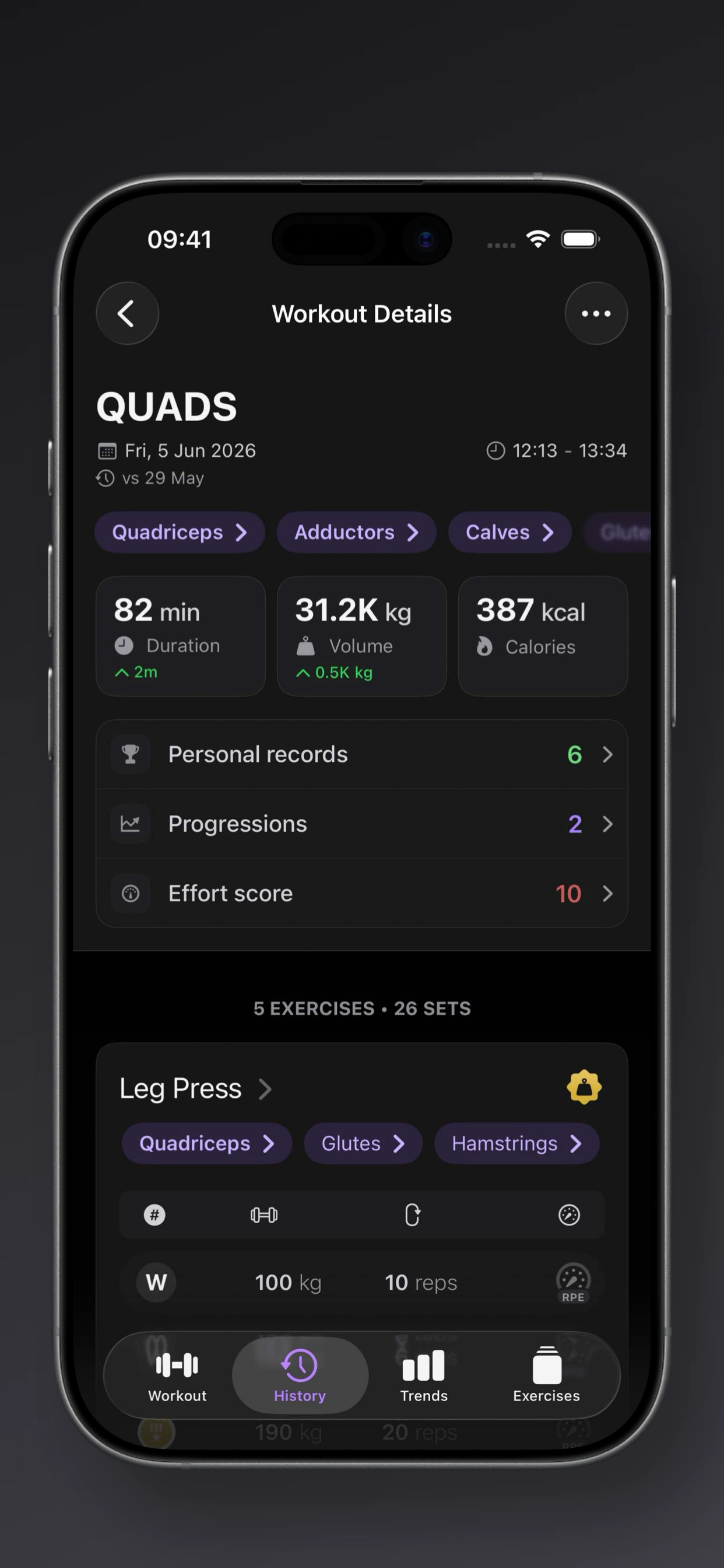 Steady shows Volume beside other session information. Use the surrounding context when interpreting the total.
Because the calculation uses recorded weight and reps, a bodyweight set logged at zero added load contributes zero to that calculation. That does not mean the set had no training value. Timed work also deserves its own duration-based comparison.
Start with the session total to notice a change, then check the exercise records to explain it. More completed reps, an extra exercise, and a changed load convention deserve different responses even when each raises the number.
What to check before changing your next target
When tonnage moves unexpectedly, ask:
- Did I compare the same kind of session? Check exercise selection, equipment, and the number of working sets.
- Did the recorded performance improve? Look at load and reps alongside effort and execution.
- Was the change intentional? A lighter week or a shift toward heavier, shorter sets can lower the total on purpose.
For a muscle-building goal, also review challenging sets for the muscles you want to train. Our guide to training volume explains that separate use of the word “volume.” For strength comparisons across rep ranges, read what to track when your rep range changes.
Let tonnage help you ask a better question about the workout. Log the completed work in Steady, keep your conventions stable, and use the individual sets to decide what comes next.
Ready to start applying progressive overload?
Ditch the spreadsheets and complex notes. Join thousands of lifters who use Steady to focus on the workout, track their progress, and automatically know when to add weight.
Download Free for iPhone