How to Track a Deload Week

The best way to track a deload week in Steady is to start it as a deload, let the app preserve that context in your history, and compare your return-to-training sessions with the hard sessions that came before it. A deload is useful data, but it is not a failed attempt at your normal plan.
That distinction is what keeps a deliberate recovery week from making your progress look worse than it is. Steady marks the session as a deload and later shows a Deload badge beside every exercise performance from it, so a lower number has its reason attached. You can see the real story: training stress came down on purpose, then readiness either improved or it did not.
For the basics of when to take one and how much to reduce, start with what a deload week is. This article is about making that week useful when you look back at your log.
Start the deload before the first session
Do not wait until Sunday to decide that a lighter week “kind of counted” as a deload. Start the first reduced session as a deload in Steady. There is no need to add a manual label to explain it later: the session keeps its deload status and each exercise performance from that session carries a Deload badge in history.
That built-in context answers three questions later:
- Why were the loads or total sets lower?
- Were those changes planned or forced by poor performance?
- When did the next hard training block begin?
Keep the main exercises familiar whenever possible. A deload is usually a poor time to replace every movement, test a new variation, or chase a personal record. Familiar lifts give you cleaner before-and-after comparisons.
What to log in a deload session
You do not need a complicated recovery score. Four pieces of context are usually enough.
1. The planned reduction
Steady saves the chosen deload adjustment with the session. If you also change volume or effort on the day, add a concise note such as “two work sets instead of four” or “stopped with three reps in reserve.” That is more useful than trying to reconstruct the plan from weights alone.
2. The work you actually did
Still log sets, reps, and weight. A deload is not a blank space in your history. It tells you which movements you practiced, how much work you tolerated, and where you restarted from.
3. How the warm-ups and joints felt
Use a short note, not a diary entry: “elbows calmer,” “bar speed normal,” “sleep still poor,” or “back tight on the first set.” These cues can explain a return that is stronger, flat, or still under-recovered.
4. Whether the session felt easy enough
A deload should lower fatigue, not turn into a hard session with prettier numbers. If you still pushed close to failure, rushed rest, and left wrecked, record that honestly. It may explain why the next week does not feel refreshed.
Sharp, worsening, or persistent pain is not a signal to work around: stop that movement and seek qualified guidance if needed.
 The point of a deload log is context: less training stress by design, not a mysterious drop in performance.
Keep deload data separate from progression decisions
The most common tracking mistake is treating a lighter session as evidence that your normal target was too heavy. It usually is not.
Say your normal bench press target is 3 sets of 8 at 80 kg. During a deload, you do 2 sets of 8 at 60 kg and leave plenty in reserve. That session should not tell you to lower the next normal target to 60 kg. It should tell you that you completed a planned recovery dose.
For the same reason, avoid comparing a deload session directly with a hard session when judging strength. Compare hard sessions with other hard sessions, and use the deload as the bridge between blocks. The useful comparison is what happens when you return: does the old working weight move more cleanly, do reps recover, and does the same effort feel more manageable?
Review the first two sessions back
Do not expect a dramatic rebound on the first set after a deload. Look for a small pattern across one or two familiar workouts instead.
Good signs include:
- the usual warm-up weights feel more normal
- technique stays solid deeper into working sets
- you reach previous reps without a grind
- soreness and joint irritation settle between sessions
- motivation to train is back without needing a big push
If the return still feels flat, do not immediately add more work to “make up” for the easy week. Check sleep, food, life stress, illness, and the size of the previous block. The log has done its job when it helps you make the next decision calmly instead of guessing from one workout.
How Steady handles a deload
In Steady, start a deload from the active workout and choose the weight reduction that fits the week. The app reduces the weights while keeping your planned sets and reps in place, and it leaves your program unchanged. The session is saved as a deload automatically—there is no separate log label to remember.
That status continues to do useful work after the session ends. Every exercise performance from a deload session shows a Deload badge in your history, so you can tell why the load was lower when you review a lift later. Automatic progression is disabled for that deload session only, which means the lighter performance does not rewrite the next normal target.
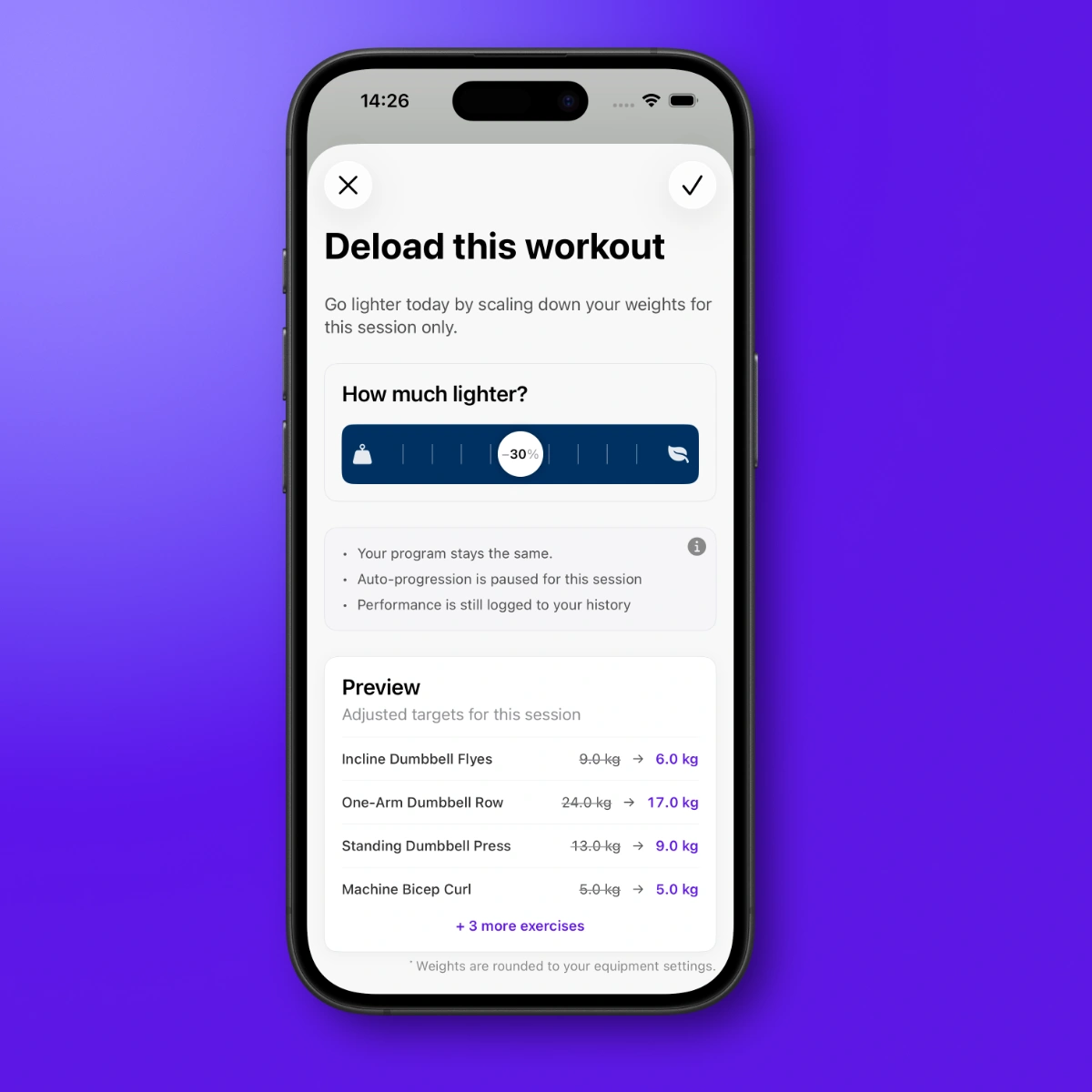 Steady retains the deload context, so lower exercise performances are not mistaken for a normal regression.
Steady also lets you set a default deload intensity. If you use automatic recommendations, you can choose whether signals such as time off, accumulated fatigue, or a run of high-effort sessions should prompt you to consider a lighter week. Treat those prompts as context, not an order: your training history and how you feel still matter.
A simple deload review template
Before your first normal workout, look at the week and write three lines:
- What changed: “Half the usual work sets; weights down about 20%.”
- What improved: “Shoulder irritation settled; sleep improved by the weekend.”
- What I will do next: “Resume prior targets, keep one rep in reserve on the first session.”
That is enough to make the deload part of the training process rather than a detour you forget. Steady keeps the details close to the workouts themselves, so you can return to hard training with a clear record instead of a vague memory that you “took it easy for a bit.”
Ready to start applying progressive overload?
Ditch the spreadsheets and complex notes. Join thousands of lifters who use Steady to focus on the workout, track their progress, and automatically know when to add weight.
Download Free for iPhone