How to Use Exercise Variations
Exercise variations are useful when they solve a specific training problem: they let you train the same movement pattern with a slightly different setup, joint angle, range of motion, or equipment choice. They are not a reason to rebuild your program every week.
The best way to use exercise variations is to keep your main training structure stable, rotate variations only when they support a clear goal, and track each variation separately enough that your progress still means something.
What counts as an exercise variation?
An exercise variation is a related version of a lift that trains a similar pattern or muscle group, but changes one or more details. Examples include:
- Barbell bench press and dumbbell bench press.
- Back squat and front squat.
- Romanian deadlift and dumbbell Romanian deadlift.
- Lat pulldown and assisted pull-up.
- Seated cable row and chest-supported row.
The key word is “related.” A variation should carry over to the goal of the original exercise. If you replace a squat with a leg extension, you may still train quads, but you changed the exercise category much more than if you moved from a back squat to a hack squat.
Use variations for a reason
Exercise variation works best when it answers a real constraint. Before changing an exercise, ask what problem the change is solving.
Good reasons include:
- Equipment access: the rack, bench, or machine is taken.
- Joint comfort: the planned lift irritates your shoulder, elbow, knee, or low back.
- Training phase: you want a slightly different stimulus for the next block.
- Skill management: a technical lift needs a simpler version while you rebuild confidence.
- Fatigue control: the main variation is too systemically demanding for the day.
Poor reasons include boredom after one session, chasing novelty, or copying a random exercise because it looked interesting online. Variety can make training more enjoyable, but random variety makes progress harder to read.
Match the movement pattern first
When you swap an exercise, preserve the main movement pattern before you worry about minor details. This keeps the session close to the original plan.
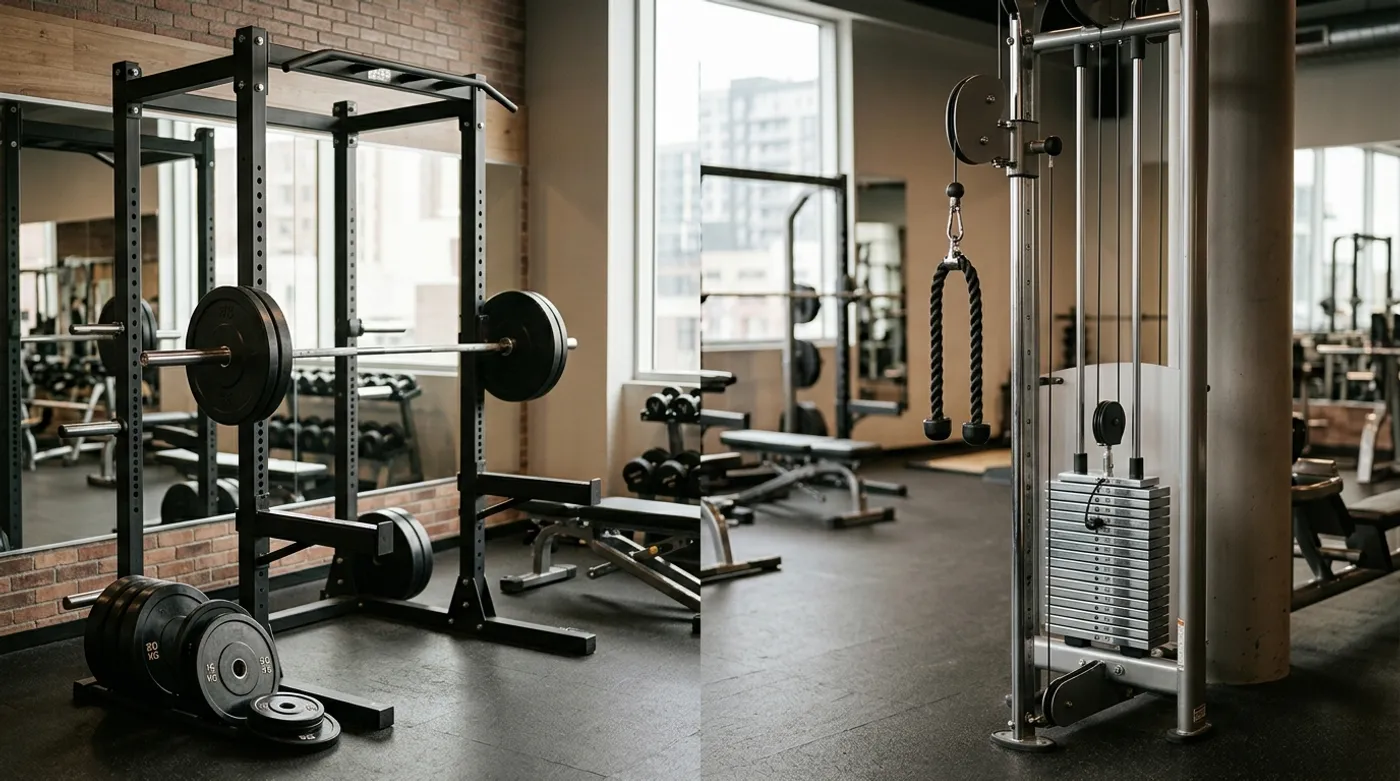
For a squat pattern, useful variations might include a front squat, goblet squat, hack squat, leg press, or split squat. For a horizontal press, you might use a dumbbell bench press, machine chest press, push-up, or Smith machine press. For a hinge, you might move between Romanian deadlifts, dumbbell RDLs, hip thrusts, cable pull-throughs, or back extensions.
That does not mean every variation is identical. A leg press is not the same as a squat. A machine press does not demand the same stabilization as a barbell bench press. But if the target muscles, range of motion, and loading pattern are close enough, the workout still makes sense.
Track variations separately when performance changes
Do not expect the same numbers across different variations. A lifter who benches 185 pounds for reps may not dumbbell press two 92.5-pound dumbbells for the same rep target. A front squat is usually lighter than a back squat. A machine row may allow more load than a free-weight row because the setup is more stable.
Treat each variation as its own trackable exercise. Your goal is not to force every version to match the original; it is to know whether each version is improving relative to itself.
This is especially important for progressive overload. If you swap barbell rows for chest-supported rows, record the new exercise clearly. Then compare chest-supported rows to your previous chest-supported rows, not to a completely different lift with different mechanics.
Keep your anchors stable
Most routines need anchor exercises: the lifts you repeat often enough to measure progress. These are usually your main compounds or your most important hypertrophy movements.
For those anchors, avoid changing variations too frequently. If your lower-body day is built around squats, keep a primary squat pattern long enough to learn it, load it, and see whether it is working. Variation can live around the anchor: accessory lifts, secondary movements, or planned blocks.
A simple rule:
- Keep your main lift stable for 4-8 weeks when it feels good and performance is moving.
- Rotate accessory variations more freely, especially if they train the same muscle well.
- Change the anchor early only when pain, equipment, technique, or recovery gives you a real reason.
That balance gives you both consistency and flexibility.
How to choose the right variation
Use this quick filter when deciding between options:
- Same target: Does it train the same main muscle or movement pattern?
- Similar difficulty: Can you load it hard enough for the goal?
- Clear setup: Can you perform it consistently from session to session?
- Recoverable: Does it fit the fatigue budget for the day?
- Trackable: Will the log make sense next time you review it?
If a variation passes those checks, it is probably a useful swap. If it fails several of them, it may still be a good exercise, but it is not a clean replacement for today’s plan.
How to use this in Steady
Steady is built around focused tracking, so exercise variation works best when you keep the log clean. Use the exact exercise you performed instead of writing a substitute in a note and pretending it was the original lift.
When you know your common swap-ins, save them as My Alternatives for the exercise. Steady also shows Suggested alternatives for supported exercises, and those suggestions respect your disabled equipment preferences, so the list can stay practical for your gym. During routine editing or an active workout, Replace Exercise lets you swap the movement while keeping the session organized.
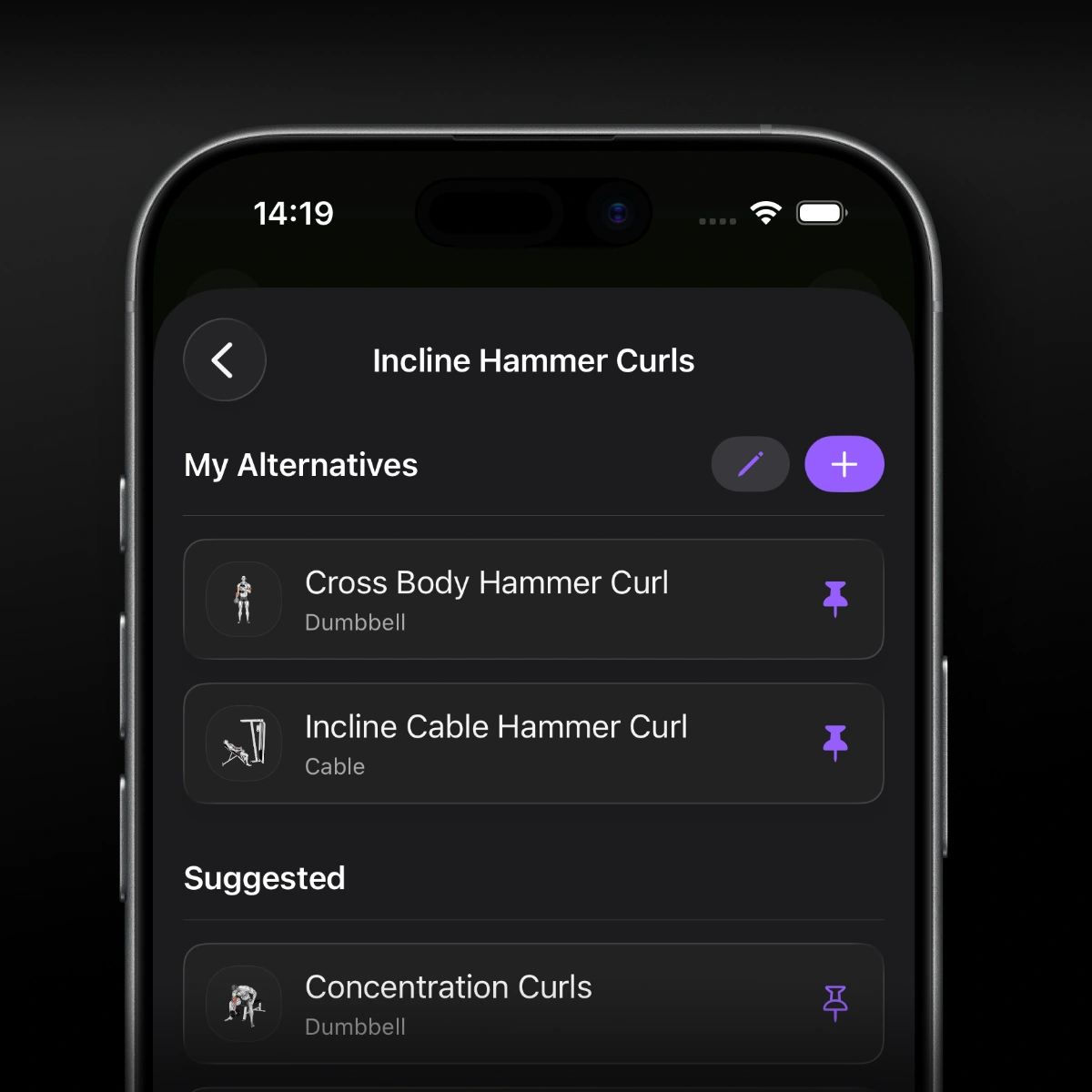 Saved and suggested alternatives make it easier to swap exercises without turning the workout into a guessing game.
The useful habit is simple: plan your likely variations before you need them. If the cable station is busy, your shoulder is cranky, or you want a different angle for the next block, you already have a controlled option ready.
Common mistakes
The biggest mistake is changing too much at once. If you change the exercise, rep range, tempo, rest time, and effort level, you no longer know which variable caused the result.
Another mistake is treating every variation as a downgrade. Sometimes a variation is the better choice for the day. A chest-supported row may be more productive than a barbell row when your low back is fatigued. A dumbbell press may be better than a barbell press if your shoulders feel better with a freer path.
The last mistake is refusing to update your routine when the evidence is clear. If a variation feels better, trains the target muscle well, and progresses consistently, it may deserve a permanent place in your program.
The bottom line
Exercise variations should make your program more resilient, not more random. Keep your main structure stable, swap exercises with a clear reason, and track each variation honestly.
Steady helps by keeping your routines, alternatives, and workout history in one focused place, so you can adapt the session without losing the thread of your progress.
Ready to start applying progressive overload?
Ditch the spreadsheets and complex notes. Join thousands of lifters who use Steady to focus on the workout, track their progress, and automatically know when to add weight.
Download Free for iPhone