How to Use RPE Without Overthinking It

The simplest way to use RPE is to rate only the sets where effort changes the decision you will make next time. You do not need to analyze every warm-up or turn your workout into a guessing game. Log the weight, reps, and set quality first. Then use RPE to answer one practical question: was that set easier, about right, or harder than the numbers suggest?
That is where RPE becomes useful.
Weight and reps tell you what happened. RPE tells you how costly it felt. If those two pieces of information point in the same direction, progression is usually simple. If they disagree, RPE gives you the context you need to avoid pushing too soon or holding back for no reason.
If you want the definition first, read What Is RPE in Strength Training?. This guide is about the day-to-day workflow.
Use RPE as context, not a second workout
RPE stands for Rating of Perceived Exertion. In lifting, it usually describes how close a set was to failure.
A practical scale looks like this:
- RPE 6: easy, roughly 4 or more reps in reserve
- RPE 7: moderate, roughly 3 reps in reserve
- RPE 8: hard but controlled, roughly 2 reps in reserve
- RPE 9: very hard, roughly 1 rep in reserve
- RPE 10: maximum effort, no reps in reserve
The mistake is treating those numbers like lab measurements. They are estimates. Useful estimates, but still estimates.
You are not trying to prove whether a set was exactly 8.0 or 8.5. You are trying to notice whether the set was easy enough to push, hard enough to respect, or too hard to repeat with confidence.
A simple RPE workflow for normal training
Use this approach when you want the benefit of RPE without adding friction to every set.
1. Log the objective numbers first
Start with the basics:
- exercise
- set number
- weight
- reps or duration
- whether it was a warm-up or working set
This keeps your log grounded. RPE should explain the set, not replace the set.
For example, “80 kg x 8 at RPE 8” is useful because the effort score sits next to a real performance. “Felt hard” by itself is too vague to guide progression.
2. Rate only meaningful working sets
You do not need to rate every warm-up.
For most lifters, RPE is most useful on:
- the last set of an exercise
- a heavy top set
- a set where reps dropped unexpectedly
- a set where the load felt unusually easy
- a set that affects whether you increase weight next time
That is enough to create useful context without slowing the session down.
 The moment after a hard set is usually when the RPE call is clearest: did you have another clean rep, or were you done?
3. Use broad zones instead of chasing precision
Think in zones:
- RPE 6-7: probably under-challenging for most working sets
- RPE 8: productive and repeatable
- RPE 9: hard, useful, but more costly
- RPE 10: failure or near-failure, use sparingly
Most strength and hypertrophy work lives well around RPE 7-9. That does not mean every set must land there, but it gives you a practical target. If all your working sets are RPE 6, you may be leaving too much on the table. If everything is RPE 10, recovery and consistency usually suffer.
4. Compare RPE to last time
RPE is most powerful when you compare it across similar sessions.
Imagine these two workouts:
- Week 1: 70 kg x 8 at RPE 9
- Week 2: 70 kg x 8 at RPE 7
The weight and reps did not change, but the set got easier. That can be progress.
Now flip it:
- Week 1: 70 kg x 8 at RPE 7
- Week 2: 70 kg x 8 at RPE 9
The numbers stayed the same, but the set became more expensive. Maybe sleep was poor. Maybe the exercise order changed. Maybe fatigue is building. The log gives you a reason to pause before adding load.
5. Let RPE influence the next decision
Here is a simple rule:
- Hit the target reps at a moderate RPE? Build reps or add a small amount of weight.
- Hit the target reps at a very high RPE? Repeat the target before pushing.
- Miss the reps at a high RPE? Reduce the target, reduce the load, or recover better.
- Beat the target reps at a low RPE? You may be ready for a bigger progression jump.
RPE should keep the next decision from becoming emotional. It should make it clearer.
Common ways lifters overcomplicate RPE
They rate every set before they understand the scale. Start with your hardest working sets. You can expand later.
They pretend RPE is perfectly objective. It is not. Your estimate will improve with practice, but it will always be a training judgment.
They use RPE to justify random changes. A high RPE does not always mean the program is wrong. A low RPE does not always mean you should make a huge jump. Look for patterns.
They ignore reps and weight. RPE is context. The actual work still matters.
They chase failure too often. RPE 10 can be useful, but if every set is a max-effort grind, your log may show effort more than progress.
Where this fits in Steady
Steady treats RPE and RIR as an optional layer inside the workout flow. You can keep tracking simple with sets, reps, weight, and history, or add effort ratings when they help you understand the session.
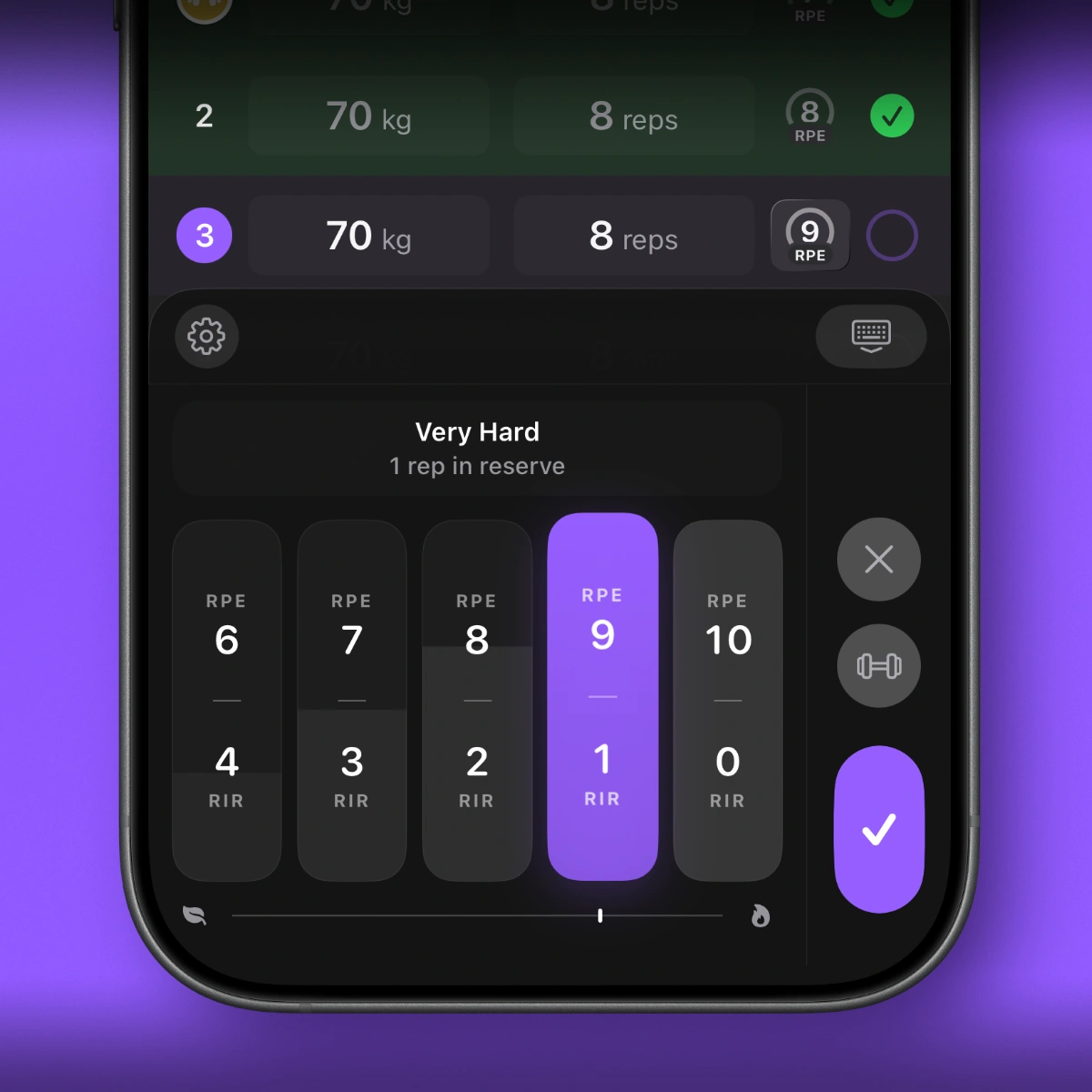 Steady can show RPE, RIR, or both, so the effort scale matches the way you think during training.
This is useful because different lifters think differently. Some people naturally say “that was RPE 8.” Others think “I had two reps left.” Those are two ways to describe the same effort.
Steady also supports settings around RPE tracking, including whether you want to be asked for RPE more consistently. That means you can make effort tracking lightweight or more deliberate depending on how much nuance you want in your log.
When RPE is logged, it can also give progression decisions more context. A set that hits the rep target at low effort is different from a set that barely survives the same target. Good progression should understand that difference.
A practical starting rule
If you are new to RPE, start with this:
Log RPE only on the final working set of each exercise for two weeks.
That gives you enough data to learn the scale without turning the whole workout into a rating exercise. After two weeks, review the patterns:
- Are most sets easier than expected?
- Are your main lifts always too close to failure?
- Do certain exercises spike in RPE faster than others?
- Does the same load feel easier across repeated sessions?
If the answers help you train better, keep using RPE. If it feels noisy, simplify.
Final thoughts
RPE works best when it stays practical. Use it to explain performance, guide progression, and notice fatigue before it becomes a bigger problem. Do not use it to second-guess every rep.
If you use Steady, start small: log your normal sets, add RPE where the effort actually matters, and let the pattern help you decide whether to push, repeat, or back off next time.
Ready to start applying progressive overload?
Ditch the spreadsheets and complex notes. Join thousands of lifters who use Steady to focus on the workout, track their progress, and automatically know when to add weight.
Download Free for iPhone