What Is Junk Volume?

Junk volume is training work that creates fatigue without adding enough useful stimulus to justify it. In plain terms: it is the extra set, exercise, or workout that makes you more tired but not meaningfully stronger, bigger, or better practiced.
That does not mean every hard set after the first few is junk. Productive training often feels demanding. But once your performance, form, focus, or recovery drops far enough, more work stops being a growth signal and starts becoming a tax you have to pay back.
The goal is not to do the least possible. The goal is to keep most of your hard work in the zone where it still moves you forward.
Junk Volume vs Productive Volume
Productive volume has three traits:
- It is hard enough to matter. The set is close enough to failure, or heavy enough, to create a training stimulus.
- It is controlled enough to repeat. Your form, range of motion, and intent are still reliable.
- You can recover from it. The work does not damage the next session more than it helps the current one.
Junk volume fails one or more of those tests. It might be a light set you added because the workout felt too short. It might be the fifth pressing variation after your shoulders are already done. It might be a final squat set where the reps are ugly, slow, and disconnected from the target you actually meant to train.
A useful rule: a set is probably junk if you would not want to repeat it next week under the same conditions.
Why Junk Volume Happens
Most junk volume comes from good intentions.
You want to make sure you did enough. You want to leave the gym feeling like the session counted. You see 10 to 20 hard sets per muscle per week as a target and assume the higher number is automatically better. Or you finish a good set and think, “one more can’t hurt.”
One more can be fine. Five more can quietly change the workout.
The problem is that fatigue accumulates faster than quality does. Early sets usually give you the clearest stimulus because you are fresh, focused, and moving well. Later sets can still be useful, especially for hypertrophy, but the return drops as fatigue climbs. At some point, you are no longer adding much signal. You are only extending the recovery bill.
Signs a Set Has Turned Into Junk
You do not need lab equipment to spot junk volume. Watch for patterns during the session and across the next few workouts.
During the workout
- Reps drop hard even though the weight and rest time stayed the same.
- Your form changes to survive the set instead of train the muscle.
- You are adding exercises because you feel guilty, not because the plan needs them.
- The target muscle is no longer doing most of the work.
- You are too distracted or drained to log accurately.
After the workout
- The next session for that muscle is worse for no clear reason.
- Soreness lingers longer than usual and does not improve over the cycle.
- Joints feel more beat up than muscles.
- Motivation drops because every workout feels like a grind.
- You keep adding work while the main lifts stop moving.
One rough workout does not prove you have a volume problem. But if the same pattern repeats for two or three weeks, the extra work is probably not earning its place.
 Fatigue is expected. The question is whether the next set still has enough quality to be worth the recovery cost.
Common Places Junk Volume Hides
1. Too many similar exercises
Three chest movements can make sense: a flat press, an incline press, and a fly. Six chest movements usually means the later work is overlapping what you already trained.
Before adding another exercise, ask what new stimulus it provides. If the answer is “more chest,” you may already have enough.
2. Extra sets after performance has crashed
If your first three working sets of rows are 10, 9, and 8 good reps, a fourth set might still be useful. If the fourth set is 5 sloppy reps with the same load, it may be time to stop or reduce the load intentionally.
The issue is not fatigue itself. The issue is fatigue without enough quality.
3. Accessories added because the workout feels incomplete
Small accessories are easy to add because they do not feel as costly in the moment. Lateral raises, curls, triceps extensions, calves, abs: all useful, all easy to over-stack.
If those sets start stealing recovery from the lifts you care about most, they are no longer harmless.
4. Chasing soreness
Soreness can happen after productive training, but it is not the goal. If you keep adding sets until a muscle feels wrecked, you are using soreness as a scoreboard. That often pushes you past the effective dose.
How to Reduce Junk Volume Without Undertraining
Cutting junk volume should make training sharper, not easier in a lazy way.
Start with these steps:
- Keep the best sets. Preserve your main lifts and the accessories that clearly support your goal.
- Remove the weakest overlap. Cut the exercise or set that adds the least distinct value.
- Track performance for two weeks. If reps, load, form, or recovery improve, the removed work was probably not needed.
- Add back slowly if needed. One or two sets per muscle per week is enough to test whether more volume helps.
- Use deloads intentionally. If everything feels heavy, a short reduction in volume may reveal that the problem was accumulated fatigue, not lack of effort.
This is why logging matters. Without a record, it is hard to know whether you are trimming junk or just reacting to one bad day.
Where This Fits in Steady
Junk volume is easiest to manage when you can see your weekly work by muscle instead of guessing from memory. Steady’s Muscle Activation view shows planned and past weekly set totals by muscle, with simple status labels such as whether a muscle is growing or in target.
That matters because junk volume is usually not obvious exercise by exercise. Four extra sets can look harmless in one workout. Across the week, they might push one muscle past the useful range while another muscle still needs attention.
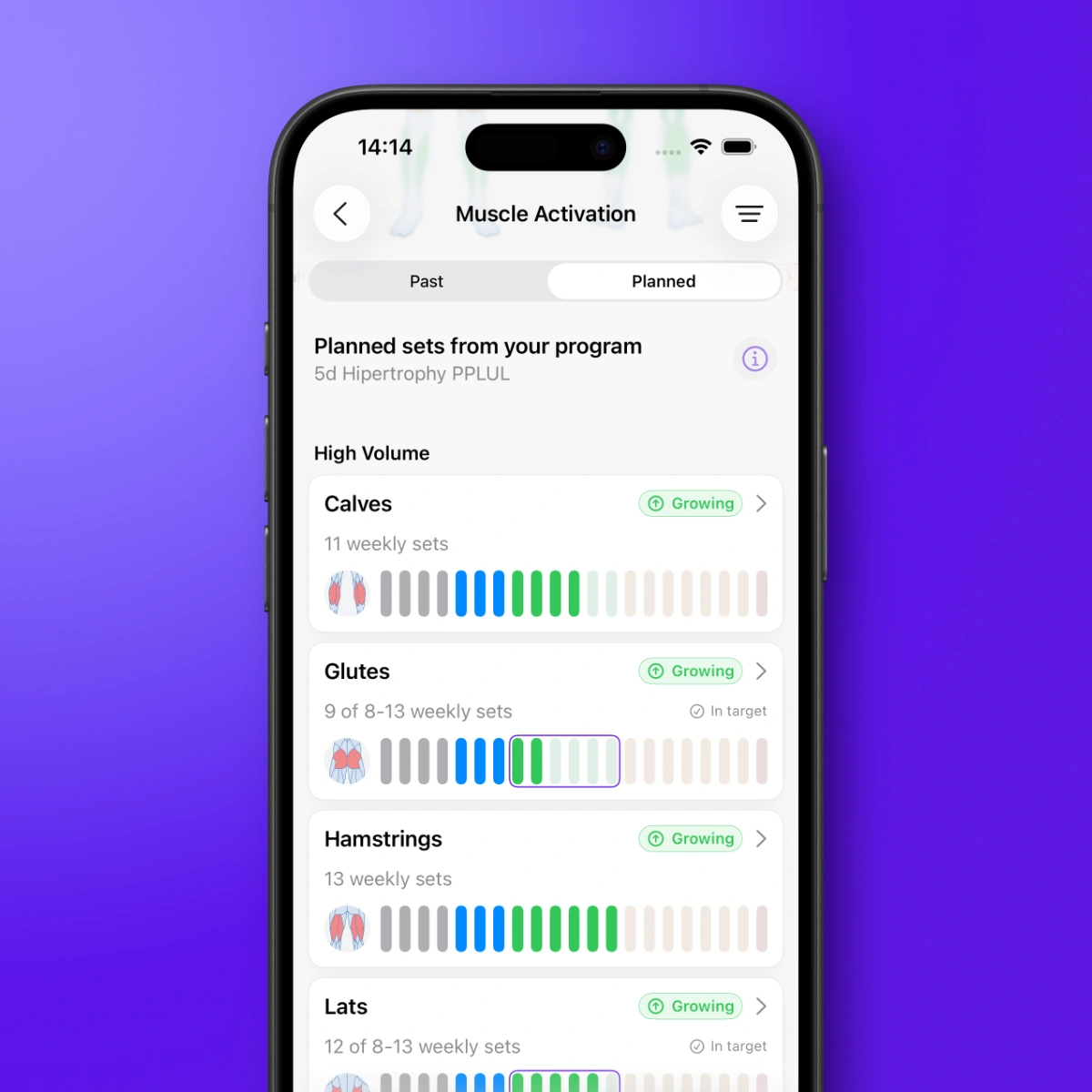 Steady helps you see whether your weekly volume is balanced before extra sets quietly become the default.
Use that view as a reality check: if a muscle is already getting plenty of quality work, the answer is rarely “add more because today’s session felt short.” It is more often “make the current sets better, recover, and come back ready to progress.”
The Bottom Line
Junk volume is not a specific number of sets. It is the point where extra work stops adding useful stimulus and starts mostly adding fatigue.
If your sets are hard, controlled, recoverable, and connected to a goal, they are probably productive. If they are sloppy, redundant, guilt-driven, or hurting the next session, they are probably junk.
Train hard, but make the work earn its place. Steady helps by keeping the numbers visible, so you can build a program around useful volume instead of just doing more.
Ready to start applying progressive overload?
Ditch the spreadsheets and complex notes. Join thousands of lifters who use Steady to focus on the workout, track their progress, and automatically know when to add weight.
Download Free for iPhone