What Is Progressive Overload? A Simple Guide for Strength and Muscle Growth

Progressive overload is the process of gradually making your training more challenging over time so your body keeps adapting. In practice, that can mean adding weight, doing more reps, improving form, increasing training volume, or performing the same work with more control. If your goal is to build muscle, get stronger, and avoid plateaus, progressive overload is one of the most important principles to understand.
The good news is that progressive overload does not mean forcing more weight onto the bar every workout. It means creating a clear, repeatable path for progress. And that path is much easier to follow when you actually track your workouts. That is exactly where Steady fits in: it is built to help you log sets, reps, weight, rest, and performance history in a distraction-free way, with optional auto-progression features for people who want more guidance.
What is progressive overload?
Your body adapts to the stress you place on it. When a workout becomes familiar, your body becomes more efficient at handling it. That is a good thing, but it also means that if training stays exactly the same forever, your results will eventually slow down.
Progressive overload is the answer to that problem. It is the practice of increasing the training demand gradually enough to stimulate adaptation, but not so aggressively that recovery and technique fall apart.
In simple terms:
If your body has fully adapted to what you are doing, it needs a slightly bigger challenge to keep improving.
That challenge can come from heavier loads, more reps, more sets, better range of motion, better control, shorter rest in some contexts, or a higher total amount of productive work over time.
Why progressive overload matters for strength and muscle growth
Strength and hypertrophy do not happen by accident. They are responses to training stress applied consistently over time.
Progressive overload matters because it helps you:
- give your body a reason to adapt
- measure whether your training is actually moving forward
- reduce randomness in the gym
- avoid repeating the same effort with the same outcome
- create a sustainable system instead of relying on motivation alone
A workout can feel hard and still not move you forward. Sweating more is not the same as progressing more. Progressive overload gives your training direction.
Steady supports that process by making it easier to see what you did last time, compare sessions, and spot real progress instead of guessing from memory. It also tracks personal records and exercise history, which helps turn vague effort into something measurable.
How progressive overload works in practice
A lot of people hear “progressive overload” and assume it only means adding weight. That is one valid method, but it is not the only one.
Here are some of the most common ways to apply it:
1. Increase the weight
This is the most obvious method. If you benched 60 kg for your target reps and later do 62.5 kg for the same target reps, that is progressive overload.
2. Increase the reps
You can keep the same weight and perform more reps with it over time. For example, moving from 8 reps to 10 reps at the same load is progress.
3. Increase the number of sets
If recovery is in a good place, adding an extra productive set can increase total training volume.
4. Improve execution
Better range of motion, better control, a cleaner pause, and more consistent technique all make the work more demanding and more valuable.
5. Increase total workload over time
Even if individual sets vary from session to session, your weekly or monthly training output can still trend upward.
6. Improve consistency
Showing up, repeating key lifts, and tracking your sessions consistently is often what makes progressive overload possible in the first place.
Steady helps here because each exercise in a routine can store its own targets, weight, rep range, rest settings, and performance history, making it easier to progress with intention rather than improvisation. It also lets you adjust rep range, weight, and rest directly in-session when needed.
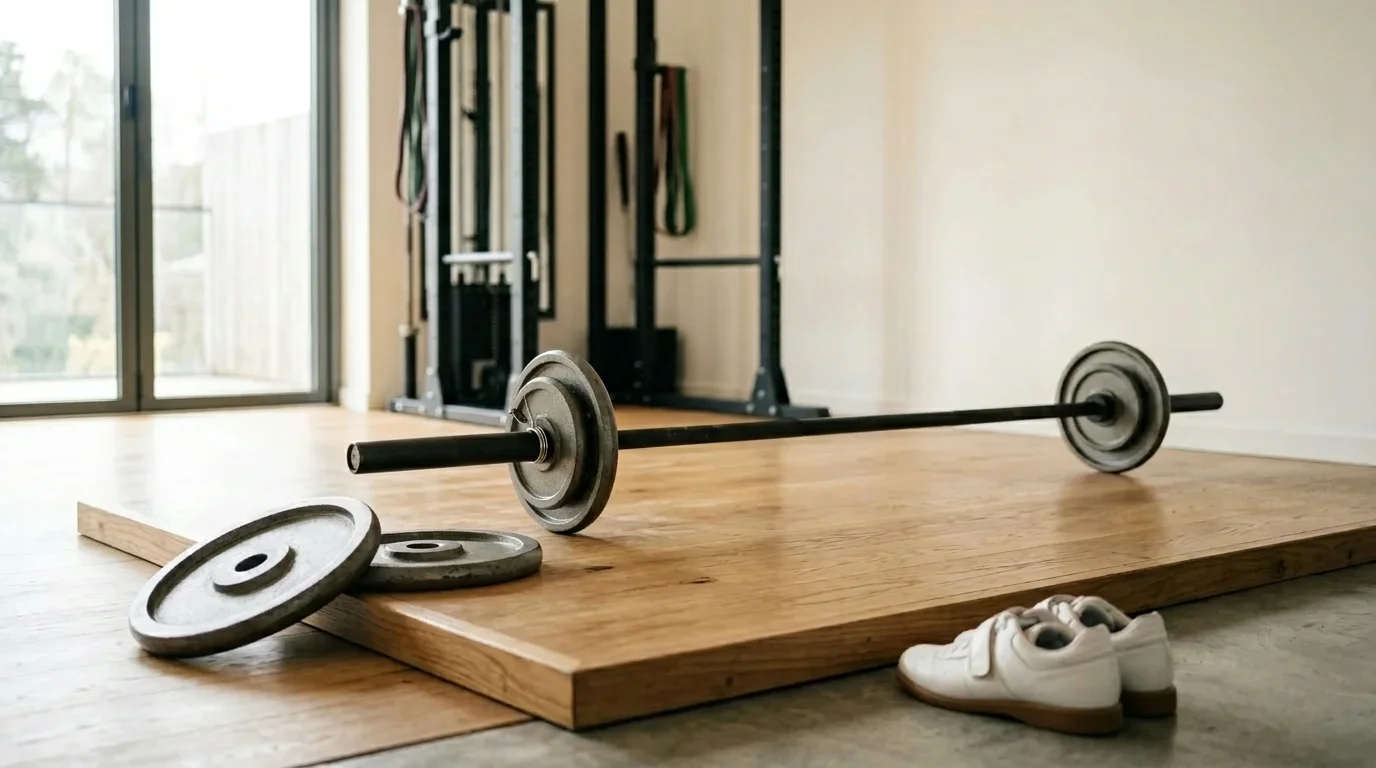 Progressive overload, made literal: today the bar takes one more plate than last week.
The easiest examples of progressive overload
There is no single “best” progression model for every exercise. Some movements work beautifully with a rep range. Others feel better with a fixed target. Two of the most practical models are dual progression and linear progression.
Steady supports both approaches, and one of the nice things about that is you can choose the method that fits each exercise in your routine best, instead of forcing one rigid system on everything. Its progression tools include automatic double progression, rep-range insights, and configurable exercise targets, so your setup can match the lift rather than the other way around.
Dual progression: build reps within a range, then increase weight
Dual progression is one of the simplest and most effective ways to train for muscle and strength at the same time.
Here is how it works:
- you define a rep range for an exercise, such as 8–10 reps
- you use a given weight and try to improve reps over time while staying inside that range
- once you reach the upper bound across all target sets with good form, you increase the weight
- after increasing the weight, your reps usually drop back toward the lower bound
- then you build them up again
That cycle repeats.
Example: dual progression on a dumbbell shoulder press
Target: 3 sets of 8–10 reps
- Week 1: 20 kg × 8, 8, 8
- Week 2: 20 kg × 9, 8, 8
- Week 3: 20 kg × 9, 9, 8
- Week 4: 20 kg × 10, 9, 9
- Week 5: 20 kg × 10, 10, 10
- Week 6: increase to 22 kg and start again near the bottom of the range:
- 22 kg × 8, 8, 8
This is a great model for hypertrophy-focused exercises because it is structured, realistic, and flexible. Progress does not depend on making a weight jump every session. You can still move forward by adding a rep here and there until the next load increase becomes appropriate.
Steady is especially useful for this model because it can track rep ranges, log each set, and help you see when you have earned the next jump instead of relying on memory. Its Pro progression tools are built specifically around this kind of alternating weight-and-rep progression.
Linear progression: hit the fixed target, then increase weight
Linear progression is simpler. Instead of aiming within a range, you set a specific rep target for all sets, and when you hit it, you increase the weight next time.
Example: linear progression on a barbell row
Target: 3 sets of 5 reps
- Session 1: 50 kg × 5, 5, 5
- Next session: increase to 52.5 kg
- Session 2: 52.5 kg × 5, 5, 5
- Next session: increase again
- If you miss the target, keep the same weight until you own it
This model is common in beginner strength training and on stable compound lifts where the goal is straightforward progression on a fixed rep prescription.
Linear progression works well when:
- the exercise is technically stable
- progress is still coming quickly
- the rep target is low and specific
- you want a very clear pass/fail rule for adding load
Steady also works well here because you can log specific set and rep targets, review your previous performance, and keep each exercise progressing according to its own logic. That matters because not every exercise should be pushed the same way. For example, a machine lateral raise might be better with a dual progression rep range, while a row or press might feel better with a fixed linear target.
Progressive overload is not just adding weight
This is one of the biggest misunderstandings in training.
Some sessions will feel great. Some will feel flat. Sleep, stress, food, fatigue, exercise order, technique, and recovery all affect performance. If you define progress too narrowly, you will either force bad jumps or feel like you are failing when you are not.
Here is what still counts as progress:
- using the same weight for more reps
- using the same weight and reps with better technique
- reaching the target with less grind
- matching performance with shorter rest in the right context
- doing more total quality work across time
- staying consistent long enough for trends to emerge
Steady’s exercise history, personal records, rep-range insights, and optional RPE tracking can help make those smaller forms of progress visible, which is important because real improvement is often more subtle than people expect.
How to apply progressive overload safely
The smartest progression is the one you can recover from and repeat.
A few practical rules help:
Prioritize form first
Do not add load just because you technically completed the reps if the movement quality collapsed. Clean reps matter.
Use a progression model that matches the exercise
Heavy compound lifts often respond well to fixed targets or slower progressions. Isolation lifts often work very well with rep ranges.
Increase gradually
Small jumps are usually better than big ones. The goal is sustainable progress, not proving a point.
Let the exercise earn the increase
Whether you use dual progression or linear progression, the increase should be a consequence of performance, not impatience.
Respect recovery
If sleep, soreness, stress, or overall fatigue is poor, your performance may temporarily stall. That does not mean the system is broken.
Think in weeks, not single workouts
One session does not define your progress. Trends do.
Steady reinforces this kind of measured approach with features like optional RPE input, effort-aware progression tools, and even deload/recovery support for times when pushing harder is not the right move. Its Progressive Overload 2.0 system is designed to balance reps, weight, and effort rather than just push numbers upward blindly.
Common mistakes with progressive overload
1. Increasing weight too fast
This is the classic ego mistake. A bigger jump is not always better. If the increase is too large, technique degrades and progress becomes less stable.
2. Ignoring rep quality
A sloppy set of 10 is not always better than a controlled set of 8.
3. Changing exercises too often
Progressive overload works best when you repeat key movements long enough to build skill and compare performance.
4. Not tracking anything
If you do not know what you lifted last time, it is much harder to apply progression deliberately.
5. Expecting improvement every single workout
Progress is rarely that linear, especially after the beginner stage.
6. Using the same progression model for every lift
Different exercises have different demands. What works for a squat or row may not be ideal for a lateral raise or cable curl.
7. Forgetting that recovery drives progress too
The training creates the signal. Recovery helps turn that signal into adaptation.
A good logging app reduces several of these mistakes at once by giving you a clear training history, visible targets, and more context for decisions. That is a big part of Steady’s appeal: it stays focused on workout execution and progress instead of distracting you with features that do not help you train better.
How to track progressive overload
You do not need a giant spreadsheet, but you do need a system.
At minimum, track:
- exercise name
- load used
- reps performed
- number of sets
- rest times when relevant
- notes on form or effort when useful
Once you do that consistently, progression becomes much easier to manage.
For dual progression, you want to see whether you are gradually filling out the top of the rep range before increasing weight.
For linear progression, you want to know whether you hit the exact target across all sets so you can decide whether to increase the load next time.
Steady is built around that workflow. It lets you log weights, reps, and rest for every exercise, view history, save personal records, and use a custom logging interface designed for fast in-gym input. On Apple devices, it also integrates with features like Apple Health, Live Activities, Dynamic Island, widgets, and iCloud backup, which makes the logging process feel more seamless over time.
How long does progressive overload take?
Longer than social media makes it look.
Beginners often progress quickly because almost everything is new. Intermediates usually progress more slowly and less predictably. Advanced lifters often need even more patience and precision.
A useful mindset is this:
The goal is not to improve dramatically every workout. The goal is to be measurably better over time.
That “better” might be:
- one more rep
- slightly better form
- a cleaner set at the same load
- a small load increase after several weeks
- more consistent training across a month
Tracking makes those wins visible. Without tracking, people often underestimate how much progress they are actually making.
Does progressive overload work for beginners?
Yes, and beginners are often the people who benefit from it most.
Early in training, you do not need complex programming. You need a small set of effective exercises, consistent effort, decent form, and a simple progression method you can actually follow.
A beginner might use:
- linear progression on a few key compound lifts
- dual progression on accessory work
- basic workout logging to remove guesswork
That combination is often more than enough to build strength, muscle, and confidence.
Steady fits well here because it can stay simple for free users while also offering more advanced progression guidance for people who want it later. The free version includes core workout logging, one full program, personal records, rest timer functionality, and Apple Health integration, while Pro adds more advanced progression features and flexibility.
Frequently asked questions
Is progressive overload necessary to build muscle?
You need some form of increasing training demand over time if you want continued muscle growth. That does not always mean heavier weight, but it does mean your training cannot stay static forever.
Do I need to increase weight every workout?
No. That is one possible outcome, not the definition of progress. Many people make excellent progress by adding reps first and increasing weight only when appropriate.
Is dual progression better than linear progression?
Neither is universally better. Dual progression is often excellent for hypertrophy and accessory work because it gives you more room to progress inside a rep range. Linear progression is often excellent for simple strength-focused setups with fixed rep targets. The best method depends on the exercise, the goal, and the lifter.
Can I use different progression models for different exercises?
Yes, and that is often the smartest approach. A routine does not need to use only one progression style. Steady supports that kind of flexibility by letting you choose the setup that makes the most sense exercise by exercise.
What if I stop progressing?
First, do not panic. Check the basics:
- are you sleeping enough?
- are you eating enough to support your goal?
- are you recovering between sessions?
- are your jumps too aggressive?
- are you actually tracking your performance accurately?
Sometimes the answer is better recovery. Sometimes it is a smaller load jump. Sometimes it is a deload. Sometimes it is simply patience.
Final thoughts
Progressive overload is one of the most important principles in strength training because it gives your workouts a direction: do a little more over time, recover, repeat.
That “little more” does not have to mean piling on weight every session. It can mean building reps within a range, hitting a fixed target more consistently, improving execution, or increasing workload gradually over time.
For many people, the most practical ways to apply it are:
- dual progression, where you build from the lower end of a rep range to the upper end, then increase the weight and repeat
- linear progression, where you hit a fixed rep target for all sets, then increase the weight once you own it
Both work. And in real training, different exercises often benefit from different approaches.
That is one of the reasons Steady is useful: it helps you track the details that make progressive overload work in the real world, while supporting both styles of progression so each exercise in your routine can follow the method that fits it best. With its distraction-free design, fast logging, exercise history, personal records, rep-range support, and advanced auto-progression tools, it turns a good training principle into a process you can actually follow.
If you are training seriously, that consistency matters more than hype. The best progression system is the one you can apply clearly, recover from, and repeat week after week.
Ready to start applying progressive overload?
Ditch the spreadsheets and complex notes. Join thousands of lifters who use Steady to focus on the workout, track their progress, and automatically know when to add weight.
Download Free for iPhone