Training Specificity: Why Strength Doesn't Always Transfer

Training specificity means that your improvements reflect the demands you repeatedly practice. Strength can carry over to related tasks, but the transfer is incomplete and varies with the task. Getting stronger on a machine does not guarantee an equally large improvement with a barbell, and an unfamiliar exercise feeling difficult does not erase the strength you have built.
This explains a familiar gym surprise: months of progress in one movement, followed by a humbling first session with another. The useful question is what the new task asks you to do differently.
Strength is expressed through a task
We often talk about strength as though it were one number stored in the body. In practice, every strength result comes from a particular action under particular conditions.
Muscle contributes to producing force. Expressing it in a lift also involves coordination, balance, familiarity with the movement, and the resistance you encounter along the way. A supported machine and a free-weight exercise can challenge the same muscles while asking for different combinations of those abilities.
Specificity can involve the movement, range of motion, contraction type, loading demands, or speed of the task. You do not need to memorize a checklist. Remember that “same muscle” does not automatically mean “same performance.”
That also separates strength from muscle size: a higher lift result alone cannot tell you how much of the improvement came from growth versus better performance of that task.
Practice matters, but transfer is real
In a 10-week trial involving 36 resistance-trained men, researchers compared chest-press training with different stability demands. Task-specific improvements appeared in the dumbbell and Swiss-ball groups, while the Smith-machine group improved similarly across the tested exercises. The findings show that the degree of specificity can depend on the task; they do not establish one tool as universally better.
The opposite extreme—assuming that only the exact exercise you train can improve—is too rigid. A trial in developmental rugby players found improvements in the trained lower-body exercise alongside some transfer between squats and step-ups. Results from these athletes cannot predict your carryover percentage, but they illustrate that specificity and transfer can coexist.
The practical interpretation is modest: related training can help, while practice of the outcome you care about still has value. There is no dependable universal conversion between two exercises.
Three gym situations that make more sense now
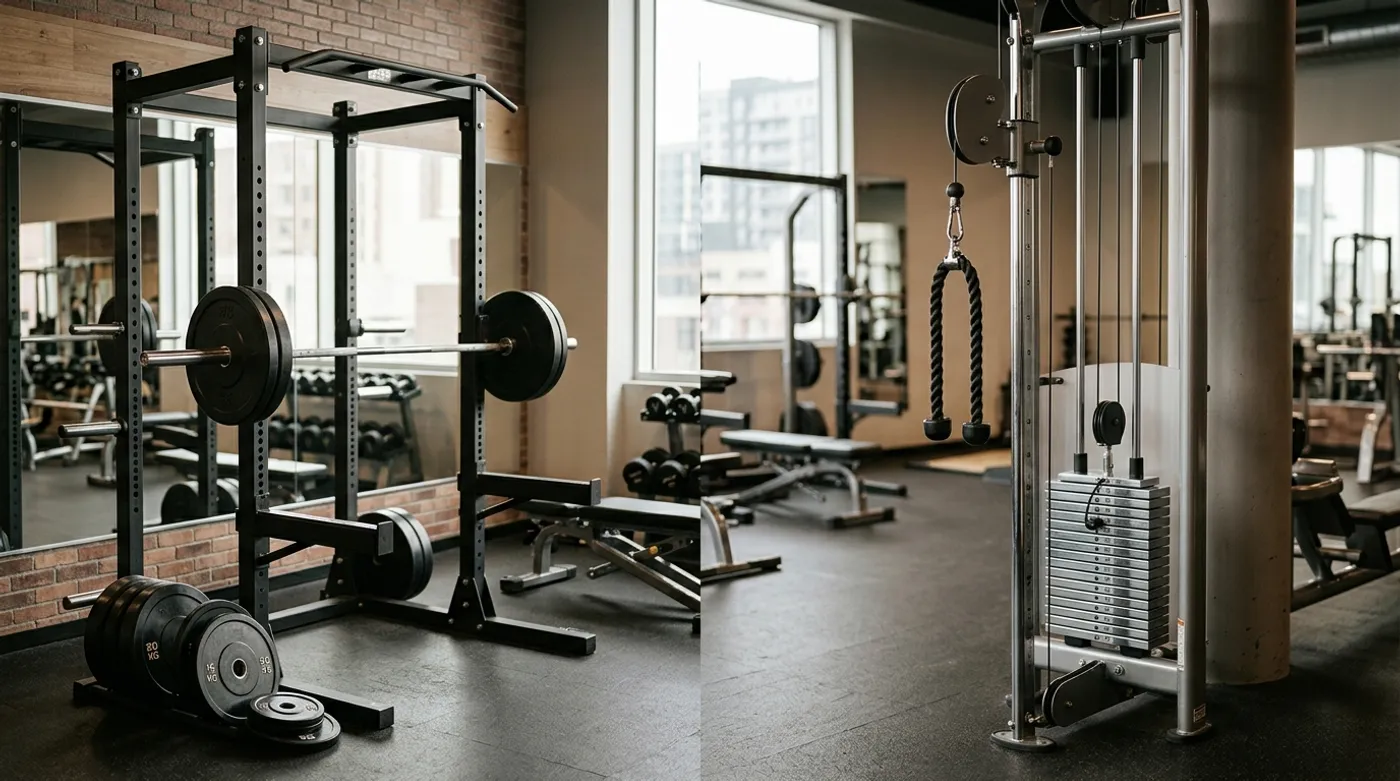 Sharing a training space—or a muscle group—does not make two exercises the same strength test.
Your machine press improves, but your barbell press barely changes. The machine result is still progress in that task. It does not prove that the barbell result should rise by the same amount. It also does not, by itself, prove that your chest grew or failed to grow.
You return to an exercise after months away. Your recent training may have preserved useful capacity, while the old movement feels unfamiliar. One return session cannot cleanly separate lost strength, reduced familiarity, and an ordinary poor day. Let the experience inform your next comparison rather than turning it into a verdict.
High-repetition performance improves without a matching jump in your maximum. Repeating a load more times and lifting the heaviest possible load are different performance outcomes. They can improve together, but one is not a guaranteed substitute for measuring the other. Our guide to strength versus power explores another example of related qualities that deserve distinct measures.
Match the conclusion to the goal
If your goal is a particular lift, regular appropriate exposure to that lift matters. Supporting exercises can contribute without replacing every demand of the main task. This principle does not specify how often to practice or how to arrange a weekly program; those decisions depend on the person and the goal.
If your goal is muscle growth, improving an unfamiliar competition lift is an optional outcome. A movement can serve your training well even when its numbers do not convert neatly to someone else’s preferred lift.
For a sport or everyday activity, gym progress is evidence of improved gym performance. To know whether it carries over, look at the activity itself too. A larger training number cannot establish a faster sprint or easier stair climbing on its own.
Before interpreting a result, finish the sentence: “I want to get better at ___.” Then ask whether the measurement actually tests that outcome.
Give each improvement its proper meaning
Specificity makes progress more precise. A stronger familiar lift is a worthwhile result. An awkward new movement is a different piece of information. Neither needs to cancel the other.
Keep recording the exercise, load, and repetitions you actually performed. Compare similar efforts, and leave room for a new task to become familiar before drawing a large conclusion. Steady gives those sessions a focused place to live, so the next decision can follow the work you have done.
Ready to start applying progressive overload?
Ditch the spreadsheets and complex notes. Join thousands of lifters who use Steady to focus on the workout, track their progress, and automatically know when to add weight.
Download Free for iPhone