How to Know When to Increase Weight, Reps, or Both

When it comes to progressive overload, weight and reps are the easiest variables you can control on purpose. Your body adapts to the resistance and effort it is repeatedly exposed to, and if you want to keep building muscle and strength, that demand needs to gradually increase over time.
In theory, there are several ways to make training harder. You could add more sets, reduce rest time, increase training frequency, or improve execution. But in real training, you often cannot increase sets forever, and in many cases you should not reduce rest time if your goal is to maintain performance and quality. That is why increasing weight, reps, or both over time is usually the most intentional and intelligent way to apply progressive overload.
The challenge is knowing when to do each one.
If you increase too early, your form may break down and progress becomes less repeatable. If you stay too conservative for too long, you may end up spinning your wheels. The sweet spot is knowing when you have truly earned the next step.
That is where tracking makes a big difference. Steady helps you log your workouts, review your history, see progression clearly, and decide for yourself when it is time to push forward. And if you want more guidance, it can also automatically suggest progression based on your performance, helping turn good training decisions into a repeatable system.
Why this decision matters
A lot of people know they should “progress,” but they are not sure how to do it in a practical way.
That uncertainty usually creates one of two problems:
- increasing the weight too soon because it feels like the only “real” form of progress
- staying at the same load for too long with no clear rule for when to move on
Neither is ideal.
The goal is not to make every workout harder at any cost. The goal is to make progress that is earned, repeatable, and aligned with the exercise.
That means the right progression choice depends on things like:
- the type of exercise
- your target rep scheme
- the quality of your execution
- how close you are to your target
- how manageable the next weight jump actually is
Steady helps with this because it keeps your previous performance visible. Instead of guessing what happened last session, you can see your actual reps, loads, and history, which makes progression decisions much more grounded.
First ask: did you really own the current weight?
Before deciding whether to increase reps, weight, or both, ask a more important question:
Did you truly own the current performance?
That does not just mean you survived the set. It means:
- you hit the intended reps
- your technique stayed consistent
- your range of motion was solid
- the set did not turn into chaos
- the load matched the purpose of the exercise
A weight is “owned” when you can perform it with control and repeatability, not just force it up once.
This matters because many people treat any completed set as a green light to progress. But if the reps were rushed, shortened, unstable, or heavily cheated, the answer might not be “increase the load.” The answer might be “repeat it and do it better.”
Steady makes this easier because your past workouts stay organized and visible. Over time, that helps you stop making decisions based on gym emotion and start making them based on actual performance.
When to increase reps
Increasing reps is often the smartest next step when the current weight is still challenging, but you clearly have room to do more within the plan.
This is especially true when:
- you are working within a rep range
- you have not yet reached the top of that range
- the weight feels appropriate for the exercise
- your form is good and repeatable
- the next load jump may be too aggressive right now
For example, if your target for an exercise is 3 sets of 8–10 reps, and you currently perform:
- 10 kg × 8, 8, 8
then the cleanest next step is usually not to jump to a heavier load immediately. It is to stay there and gradually build reps:
- 10 kg × 9, 8, 8
- then 10 kg × 9, 9, 8
- then 10 kg × 10, 9, 9
- then 10 kg × 10, 10, 10
Only then does it make sense to consider increasing the weight.
This is one of the most practical ways to progress on many hypertrophy-focused exercises because it keeps the challenge high without rushing the load upward.
Rep progression often works especially well for:
- dumbbell presses
- cable rows
- lateral raises
- machine presses
- curls
- triceps extensions
- leg extensions
- hamstring curls
These movements often respond well to more gradual rep accumulation before pushing heavier.
Steady is particularly useful here because it helps you see whether you are still building within the rep range or whether you have already topped it out. That clarity makes it much easier to know whether the next step should be another rep or a heavier load.
When to increase weight
Increasing the weight makes the most sense when you have clearly outgrown the current load for the intended target.
That usually means one of two things:
- you reached your fixed rep target across all sets with good form
- you reached the top of your rep range consistently with good form
For example, if your target is 3 sets of 10 reps, and you perform:
- 20 kg × 10, 10, 10
with solid execution and the reps match the intended standard, then it is usually time to increase the load.
Or if your target is 8–10 reps, and you finally hit:
- 20 kg × 10, 10, 10
then that is often the point where the exercise has earned the next jump.
The key is that the increase should be a consequence of performance, not impatience.
When you increase the weight, it is normal for reps to drop again. That is not failure. That is simply how progression works. You create a new challenge, then build your performance back up at that heavier load.
Weight progression often works especially well when:
- the exercise is stable
- the movement pattern is consistent
- the target is very clear
- the load jump is reasonable
- the current weight no longer provides the intended challenge
Steady helps users here by showing clear exercise history and progression trends, making it easier to recognize when the current load has stopped being the right level of challenge. And for users who want more support, Steady can also automatically suggest when to move the weight up based on performance.
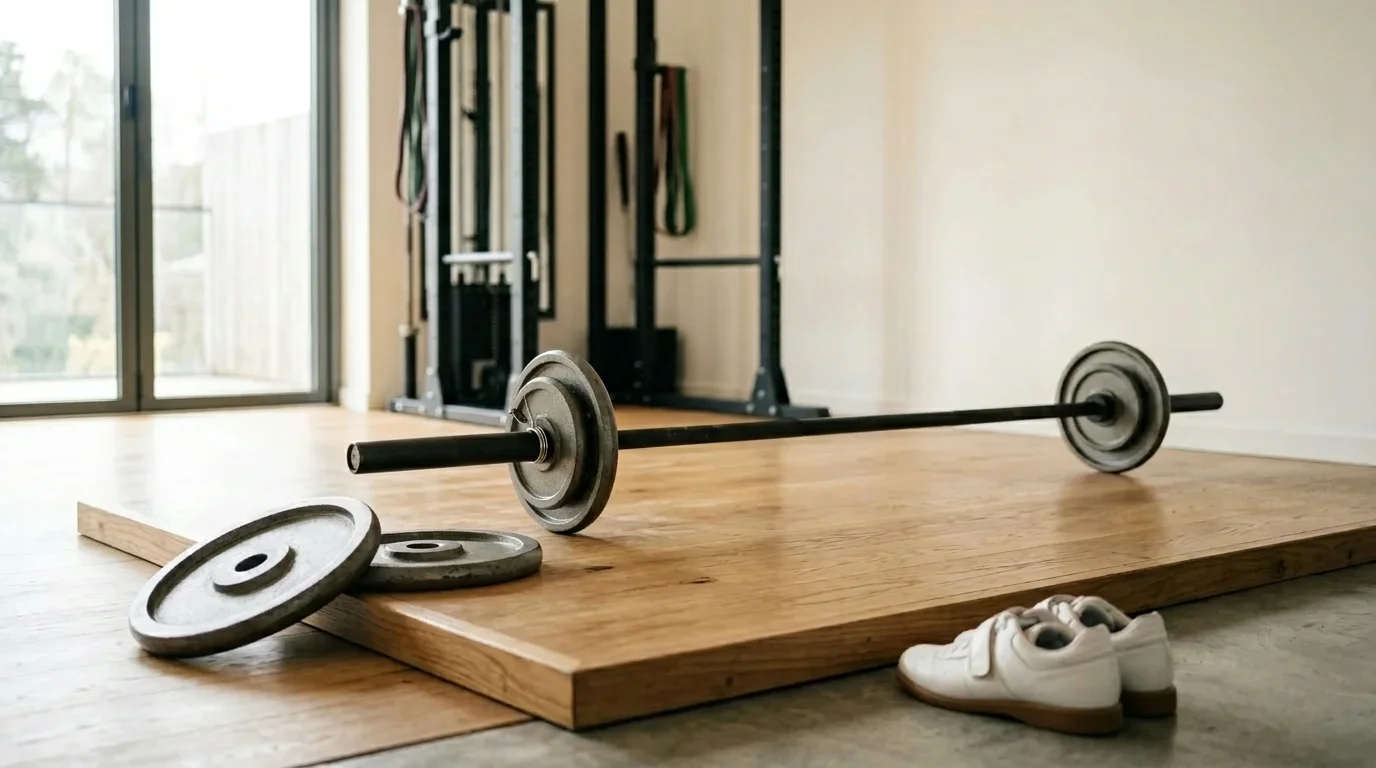 The signal to add a plate isn’t a feeling — it’s the rep count crossing the top of your target range across all working sets.
When both weight and reps increase over time
A lot of people ask whether they should increase weight, reps, or both.
The answer is that both usually increase across time, but not necessarily all at once.
In most cases, good progression is not:
- more reps and more weight in the same planned step, every time
Instead, it is more like this:
- first, you build reps at a given weight
- then you increase the weight
- then reps drop a little
- then you build reps again
- over the long term, both numbers trend upward
That is why progression is better understood as a pattern rather than a single workout event.
For example:
- Week 1: 20 kg × 8, 8, 8
- Week 4: 20 kg × 10, 10, 10
- Week 5: 22 kg × 8, 8, 8
- Week 8: 22 kg × 10, 10, 10
Across time, both the reps and the load improved. But the progression happened in an organized sequence rather than through random jumps.
Steady helps make this visible. Instead of only seeing today’s workout, users can see the pattern unfolding across sessions, which is often what makes progression finally “click.”
Dual progression: when reps come first and weight follows
One of the most effective progression models for many exercises is dual progression.
The idea is simple:
- choose a rep range, such as 8–10
- start with a weight that places you near the lower end
- build reps over time while staying inside the range
- once you reach the upper bound across all target sets, increase the weight
- after increasing the weight, return near the lower end and repeat
Example: incline dumbbell press
Target: 3 sets of 8–10 reps
- Session 1: 24 kg × 8, 8, 8
- Session 2: 24 kg × 9, 8, 8
- Session 3: 24 kg × 9, 9, 8
- Session 4: 24 kg × 10, 9, 9
- Session 5: 24 kg × 10, 10, 10
- Session 6: increase to 26 kg and restart near the lower bound:
- 26 kg × 8, 8, 8
This model is excellent because it gives you a clear decision rule:
- if there is room in the range, build reps
- if you have topped out the range, increase the weight
That makes it practical, sustainable, and easy to repeat.
It is also one of the best ways to handle hypertrophy-focused exercises because it avoids forcing weight increases before the current load is fully mastered.
Steady supports this particularly well. You can define rep targets per exercise, log set-by-set performance, see whether you are approaching the upper bound, and either decide for yourself when it is time to increase or let the app help suggest that next step automatically.
Linear progression: when hitting the target means it is time to load more
Another common model is linear progression.
Instead of working inside a range, you use a fixed rep target for all sets. Once you hit that target, you increase the weight next time.
Example: barbell row
Target: 3 sets of 5 reps
- Session 1: 50 kg × 5, 5, 5
- Session 2: increase to 52.5 kg
- Session 3: 52.5 kg × 5, 5, 5
- Session 4: increase again
If at some point you miss the target, you usually stay at the same load until you can hit it cleanly.
This model is common in beginner strength training because it is straightforward and easy to judge. It works well when:
- the exercise is stable
- the rep target is low and fixed
- you want a very clear pass/fail rule
- progress is still coming relatively quickly
Linear progression tends to work especially well on:
- rows
- presses
- squats
- smith machine compounds
- other stable multi-joint lifts
The decision rule is simple:
- hit the target cleanly → increase the weight
- miss the target → stay there and earn it
Steady works well with this model too because each exercise can follow its own logic. That matters, because not every exercise in a routine should progress the same way.
How exercise type changes the answer
One reason progression feels confusing is that different exercises often need different answers.
Stable compound lifts
Exercises like rows, presses, and squats are often easier to judge with fixed targets or slower, steady load progression. Performance is usually more consistent, and it is easier to tell whether you truly met the standard.
Machine and cable exercises
These often work beautifully with rep-range progression. They are stable enough to push hard, but they also respond very well to gradual rep building before the next load increase.
Isolation lifts
Movements like lateral raises, curls, and triceps extensions usually benefit from progressing reps first. These exercises can become sloppy quickly if you rush load increases.
Exercises with big weight jumps
Sometimes the problem is not effort. It is that the next jump is simply too large. In those cases, staying at the same load while increasing reps, improving control, or cleaning up execution may be the smartest move until the heavier weight becomes more realistic.
This is why rigid one-size-fits-all progression usually falls apart. Smart progression respects the exercise itself.
Steady supports that nuance by letting each exercise in a routine follow the method that suits it best, instead of forcing one blanket rule across everything.
Signs you are increasing too early
Sometimes the decision to progress is not wrong in principle, just wrong in timing.
Here are common signs that you may be increasing too early:
- your form breaks down badly after the jump
- your reps collapse much harder than expected
- range of motion gets shorter
- tempo becomes rushed or uncontrolled
- every workout starts feeling like a max-effort survival test
- recovery suffers more than it should
- you keep “progressing” on paper but the quality keeps getting worse
If every increase turns progress into chaos, the issue may not be effort. It may be timing.
A good rule is this: progression should make training more challenging, not completely change the nature of the set.
Steady helps here by showing whether the change actually led to useful progress or just to worse performance. That kind of feedback helps users make calmer, smarter decisions.
Signs you are staying too light for too long
Being patient is good. Staying comfortable forever is not.
You may be staying too light if:
- you repeatedly hit the top of the range with clean form
- the last reps are no longer challenging enough
- the sets feel clearly easier than intended
- progress has stalled because you never move the load up
- you are waiting for “perfect” confidence instead of objective readiness
In those cases, the answer may not be another rep. It may simply be time to load the movement more heavily and begin building again from there.
This is another place where logging matters. Many people do not realize they have outgrown a weight because they are not looking at the pattern. Steady makes that pattern much easier to see.
A simple decision framework
If you want a practical way to decide what to do after an exercise, use this framework:
1. Did I hit the target or move meaningfully toward it?
If yes, that is already a good sign.
2. Was the form good and repeatable?
If not, you may need to stay there and improve execution before progressing.
3. Am I working inside a rep range with room to grow?
If yes, increasing reps is often the smartest next step.
4. Have I already reached the top target consistently?
If yes, increasing the weight is usually the right move.
5. Would the next load jump still allow quality reps?
If not, stay where you are a bit longer and keep progressing reps, control, or execution.
That leads to a simple rule:
- room left in the range → add reps
- top of the range or fixed target already achieved cleanly → add weight
- poor execution → stay put and improve quality
- both trending upward across weeks → that is normal long-term progression
Steady helps users answer these questions because the app keeps the necessary context visible. And for users who prefer more automation, it can also make progression suggestions directly, reducing guesswork without taking control away.
How Steady helps you decide
The hardest part of progression is often not effort. It is decision-making.
That is where a good workout tracker becomes valuable.
Steady helps by making progression easier to manage in real life:
- you can log every set, rep, and weight
- you can review previous workouts quickly
- you can see patterns instead of isolated numbers
- you can use different progression logic for different exercises
- you can decide for yourself when it is time to progress
- or let the app suggest progression automatically based on your results
That combination matters. Some lifters want full control. Others want more support. Steady works well for both.
Instead of relying on memory, random instinct, or scattered notes, users get a clearer picture of whether they are still building reps, whether they have already earned a heavier load, or whether it is better to stay put for one more session.
Frequently asked questions
Should I increase reps or weight first?
Usually, increase reps first if you are working within a rep range and have not reached the upper bound yet. Increase weight when you have already hit the top of the range or your fixed target consistently with good form.
Can I increase both weight and reps at the same time?
It can happen naturally sometimes, but usually progression is cleaner when one variable is emphasized at a time. Over several weeks, both usually trend upward anyway.
What if the next weight jump is too large?
Stay at the same load a bit longer and progress reps, control, pauses, or execution quality until the jump becomes more realistic.
Does every exercise need the same progression method?
No. Different exercises often benefit from different approaches. That is why it helps when your tracking system supports exercise-by-exercise progression rather than one rigid rule for everything.
What if I hit the reps but my form was messy?
You probably have not fully earned the increase yet. Repeating the performance with better execution is often the smarter next step.
Final thoughts
Knowing when to increase weight, reps, or both is not about chasing numbers blindly. It is about recognizing when your current performance is truly under control and when the next step is justified.
In most real-world training, weight and reps are the most practical tools for progressive overload. They are the variables you can intentionally control, session after session, to keep giving your body a reason to adapt. Since adding endless sets is not realistic and reducing rest is often not the right choice, progressing load and reps intelligently becomes one of the clearest paths to more muscle and more strength.
A simple way to think about it is:
- if you still have room in the rep range, build reps
- if you have already reached the target cleanly, increase the weight
- if both rise over time, that is what good progression often looks like
The key is not progressing as fast as possible. The key is progressing in a way you can repeat.
That is exactly where Steady helps: it gives users a clear view of their performance, helps them log and review their progress, supports different progression styles per exercise, and can even automatically suggest when it is time to move forward. In other words, it helps turn progressive overload from a theory into a system you can actually follow.
Ready to start applying progressive overload?
Ditch the spreadsheets and complex notes. Join thousands of lifters who use Steady to focus on the workout, track their progress, and automatically know when to add weight.
Download Free for iPhone