When to Reduce Training Volume
Reducing training volume is the right move when your current number of hard sets is costing more recovery than it gives back in progress. If strength is sliding, soreness is lingering, joints feel irritated, motivation is dropping, and your log shows several flat sessions in a row, do not add more work. Cut a small amount of volume, keep the best exercises, and rebuild once performance stabilizes.
Volume is useful only when you can recover from it. More sets can help build muscle, but only up to the point where they still produce high-quality work. Past that point, extra sets become fatigue: they make the next session worse, blur your performance signals, and turn every workout into damage control.
What reducing volume actually means
Reducing volume does not mean giving up on progress. It usually means lowering the number of hard working sets for a short period while keeping the routine recognizable.
Practical examples:
- Take chest from 16 weekly hard sets to 12.
- Do 2 sets of lateral raises instead of 4.
- Remove one accessory exercise from leg day.
- Keep the main lift, but skip the final back-off set.
- Run a lighter deload week before returning to normal training.
The goal is not to make training easy forever. The goal is to bring fatigue back under control so your productive sets become productive again.
Signs your volume is too high
One bad workout is not enough evidence. Look for patterns across multiple sessions.
Your performance is trending down
If the same exercises are dropping despite normal effort, that matters. A single bad bench day could be sleep, stress, or timing. But if your bench, incline press, and dips all slide for two weeks while you are still pushing hard, the issue may be accumulated fatigue.
Watch for repeated misses at weights and reps you normally own, especially if rest times, exercise order, and technique have not changed.
Soreness is outlasting the training effect
Some soreness is normal. Soreness that constantly interferes with your next session is a signal. If your legs are still wrecked every time leg day returns, adding more sets is unlikely to solve the problem.
Joint irritation is becoming part of the routine
Muscle fatigue is one thing. Elbow, shoulder, knee, or hip irritation that gets worse as the week goes on is different. In that case, reduce the repeated stress first. You can often keep training by cutting redundant work, changing exercise selection, and keeping effort a little farther from failure.
 Recovery decisions are training decisions. The work only counts if you can come back and repeat it.
How much volume should you cut?
Start smaller than your frustration wants.
For most lifters, a good first cut is 10-25% of weekly hard sets for the muscle or routine that is underperforming. If you are doing 18 hard sets for chest, move to 14 or 15 before dropping to 8. If you are doing 5 hard sets of curls twice per week, try 3 or 4 per session.
Cut from the lowest-value work first:
- Extra isolation sets added at the end of a session.
- Exercises that duplicate the same movement pattern.
- Sets that are consistently low quality.
- Sets taken to failure mostly out of habit.
- Additional work for muscles that are already getting plenty from compound lifts.
Keep the lifts that are easiest to track, easiest to progress, and most important to your goal.
Reduce volume before changing everything
When a program starts feeling bad, lifters often want a full reset: new split, new exercises, new rep ranges, new app, new plan. Sometimes that is needed. Often, it is too much.
Try the smaller fix first. If your routine is mostly sound, reduce the volume for the problem area and keep the structure stable for two to four weeks. That lets you see whether recovery improves without introducing ten new variables at once.
This is especially useful if you recently increased sets, added advanced techniques, trained closer to failure, shortened rest periods, or moved to a higher-frequency split. The problem may not be the whole program. It may simply be more total work than you can currently absorb.
When to use a deload instead
A deload is better than a normal volume cut when fatigue feels system-wide.
Use a deload when:
- Several muscle groups are underperforming at once.
- Warm-up weights feel unusually heavy.
- Sleep, stress, or life demands have been poor.
- You feel mentally flat before most sessions.
- Small aches are spreading instead of calming down.
A useful deload usually lasts about one week. Keep the movement pattern, lower load or sets, avoid failure, and leave the gym feeling better than when you walked in. After that, return to normal training with slightly more caution.
How to rebuild volume after cutting it
Do not immediately jump back to the old number just because one workout felt better. Use performance as the signal.
Add volume back when:
- Reps are stable or improving.
- Soreness no longer disrupts the next session.
- Joints feel normal during and after training.
- Motivation is returning.
- You can finish the current workload without needing heroic effort every week.
Then add one small piece at a time: one set to one exercise, one extra accessory, or one harder final set. Give it at least two weeks before adding more.
How to use this in Steady
Steady gives you a few ways to make this less emotional and more concrete. Weekly Set Targets show how many working sets you are doing for each muscle, and custom ranges let you decide what “enough” means for your current block. The app can show whether a muscle is under, in, or over your selected range, which is useful when you are trying to pull volume down without losing the whole plan.
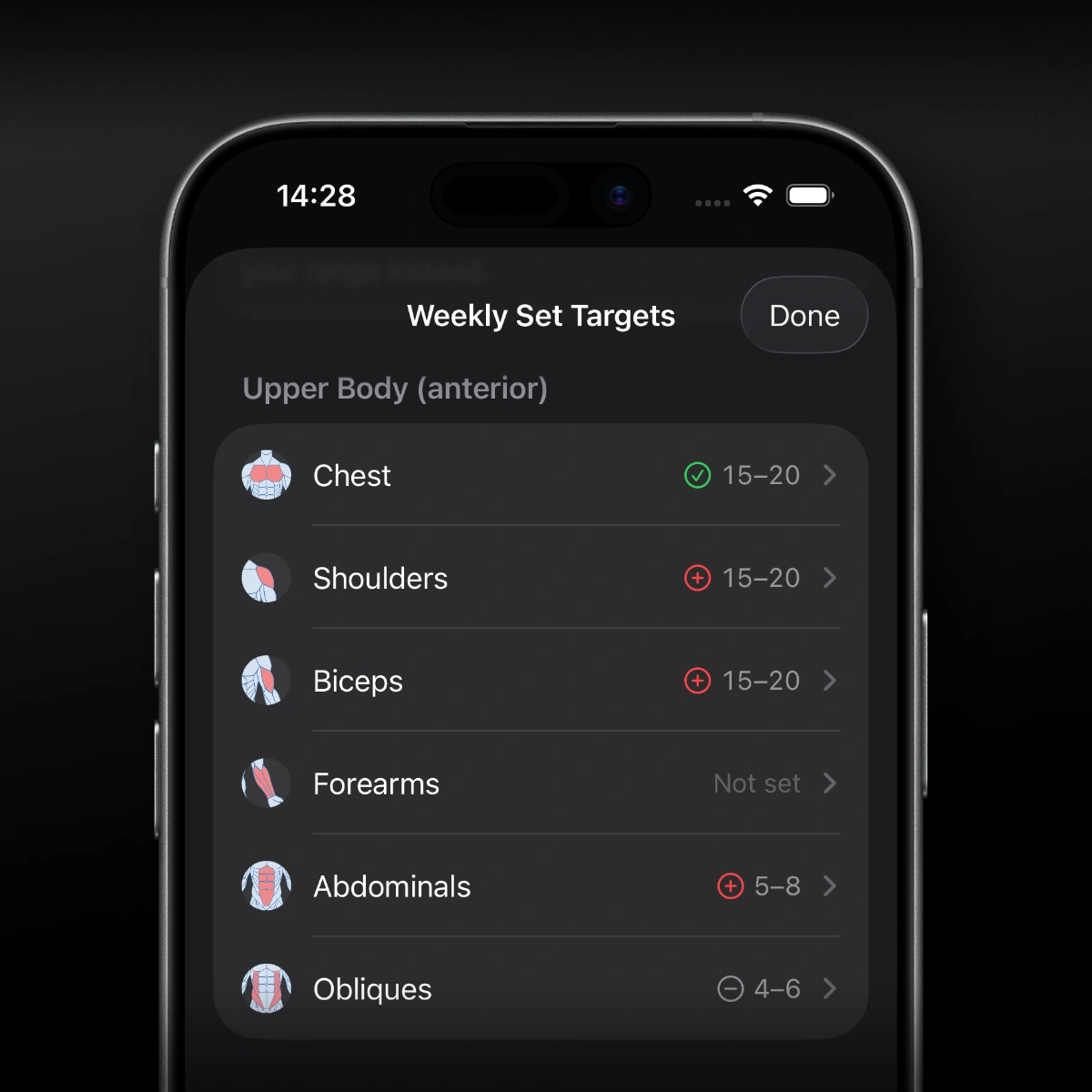 Custom Weekly Set Targets help separate deliberate lower-volume training from accidentally doing too little or too much.
This works well with a simple rule: when performance is falling and a muscle is already above your target range, reduce sets before adding more intensity. When performance is good and the muscle is below range, volume may still be available. The target is not a law, but it gives your training log a useful reference point.
The bottom line
Reduce training volume when your log shows that extra work is no longer producing better workouts. Cut the lowest-value sets first, keep the important lifts, and give recovery time to catch up. Once performance is stable again, rebuild volume slowly.
Steady is built for that kind of adjustment: clear set-by-set logging, visible weekly volume, and enough context to make a small change instead of rebuilding your whole routine every time training gets heavy.
Ready to start applying progressive overload?
Ditch the spreadsheets and complex notes. Join thousands of lifters who use Steady to focus on the workout, track their progress, and automatically know when to add weight.
Download Free for iPhone