Why a Distraction-Free Workout App Can Improve Consistency

A lot of fitness apps try to do more than help you train.
They add social feeds, engagement features, public profiles, likes, reactions, and endless content designed to keep you inside the app longer. On paper, that can sound motivating. In practice, it often creates a very different experience from the one many people actually want in the gym.
When you are training, your attention matters.
A good workout is not just a list of exercises. It also depends on focus, pacing, effort, technique, and your ability to stay mentally connected to what you are doing. The more your attention is split between the workout itself and a stream of posts, comparisons, and notifications, the harder it becomes to stay present.
That is one reason a distraction-free workout app can be so valuable.
Instead of competing for your attention, it protects it. Instead of turning your session into another place to scroll, compare, and consume, it helps you train, log your work, and move on. That difference may sound subtle, but over time it can have a real effect on consistency.
This matters even more for people who care about training quality. In many kinds of strength training, especially hypertrophy-focused work, people often talk about the mind-muscle connection: paying attention to the muscle you are trying to train, controlling the movement, and avoiding sloppy, distracted reps. Whether or not someone uses that exact term, the broader point is simple: training usually goes better when you are mentally engaged with the exercise in front of you.
A social feed can work against that.
Instead of staying focused on your set, your rest period, or your next target, your mind gets pulled toward what other people are doing, how they look, what they are lifting, what they are posting, and how your own progress compares. Even brief interruptions can make a workout feel more fragmented and less intentional.
There is also a deeper problem with social-style fitness features: they make comparison feel normal, even when comparison is often misleading.
What you see from another person rarely includes the full context. Genetics, age, sleep quality, stress, injury history, work schedule, available time, money, coaching, access to equipment, food quality, recovery capacity, training experience, health conditions, enhancement protocols, cosmetic procedures, and countless other variables all influence how someone looks or performs. Two people may appear similar on the surface while operating under completely different circumstances.
That is why comparison is often a poor guide for training.
In some cases, it can even become counterproductive. Instead of helping you stay motivated, it can make your own progress feel smaller than it really is. It can shift your attention from “Am I improving?” to “Why don’t I look or perform like that?” And over time, that mindset can create unnecessary pressure around body image, confidence, and motivation.
A workout app without social media features takes a different approach.
It does not assume you need more stimulation. It assumes you need a clearer path to show up, do the work, track your progress, and stay consistent.
That is not a missing feature. For many people, it is the point.
What does “distraction-free” actually mean in a workout app?
A distraction-free workout app is not just an app with a cleaner design.
It is an app built around a different philosophy.
Instead of trying to maximize time spent inside the product, it tries to make training easier to execute. That usually means:
- no social feed
- no public performance layer
- no pressure to post workouts
- no follower or comparison mechanics
- no extra noise between you and your routine
The goal is not to create more engagement for its own sake. The goal is to help you train with more clarity and less friction.
That is one reason Steady was designed the way it was. Its core idea is simple: focus on your training, your progress, and your consistency — without the noise.
Why social features can hurt consistency
A lot of people assume social features automatically improve motivation.
Sometimes they do. But they can also create forms of friction that quietly make consistency harder.
More distraction during the workout
Training already asks a lot from your attention.
You need to manage exercise order, rest periods, effort, technique, and sometimes progression decisions. Adding a social feed on top of that creates another attention layer that has nothing to do with the quality of the workout itself.
You may open the app to log a set and end up checking what other people posted.
You may finish a set and use the rest period to scroll instead of reset mentally for the next one.
You may start thinking about content rather than execution.
That does not just waste time. It can change the texture of the workout. A session feels less focused, less intentional, and more fragmented.
Less mental presence while lifting
Even if someone does not care about the phrase mind-muscle connection, most lifters understand the underlying idea: better attention usually leads to better reps.
When you are paying attention to how an exercise feels, how the target muscle is working, whether your tempo is controlled, and whether your range of motion is consistent, the set becomes more productive.
When your mind is elsewhere, the quality often drops.
That does not mean every distracted rep is useless. But it does mean a gym environment built around comparison and scrolling can push people away from the kind of mental presence that often helps training feel better and more deliberate.
More comparison, less useful motivation
Comparison is one of the most common side effects of social fitness environments.
At first, it can feel harmless or even motivating. But over time it often becomes noisy and misleading.
You are not comparing your full reality to someone else’s full reality. You are comparing your day-to-day experience to a filtered surface-level snapshot, often with very little context.
That can distort expectations.
Maybe someone else has trained for ten years longer than you. Maybe they have a completely different recovery profile. Maybe their workday, sleep, stress, finances, equipment access, or health is completely different. Maybe they use methods or protocols you do not see. Maybe they simply have different genetics.
Once you remember how many variables are involved, comparison starts to lose some of its power.
The better question is usually not:
“How do I compare to them?”
It is:
“Am I doing a little better than I was before?”
That is a much more stable foundation for consistency.
More pressure to perform your training instead of doing it
When an app includes social mechanics, it can subtly shift the role of training itself.
Your workout stops being only something you do.
It starts becoming something you might present.
That can add pressure. Some people begin thinking about how a workout looks instead of how well it is serving their goals. Others feel discouraged when their training does not look exciting, lean, advanced, or impressive enough compared with what they see online.
That is not a great basis for sustainable progress.
Consistency usually works better when your workout remains personal, practical, and focused on the next repeatable step.
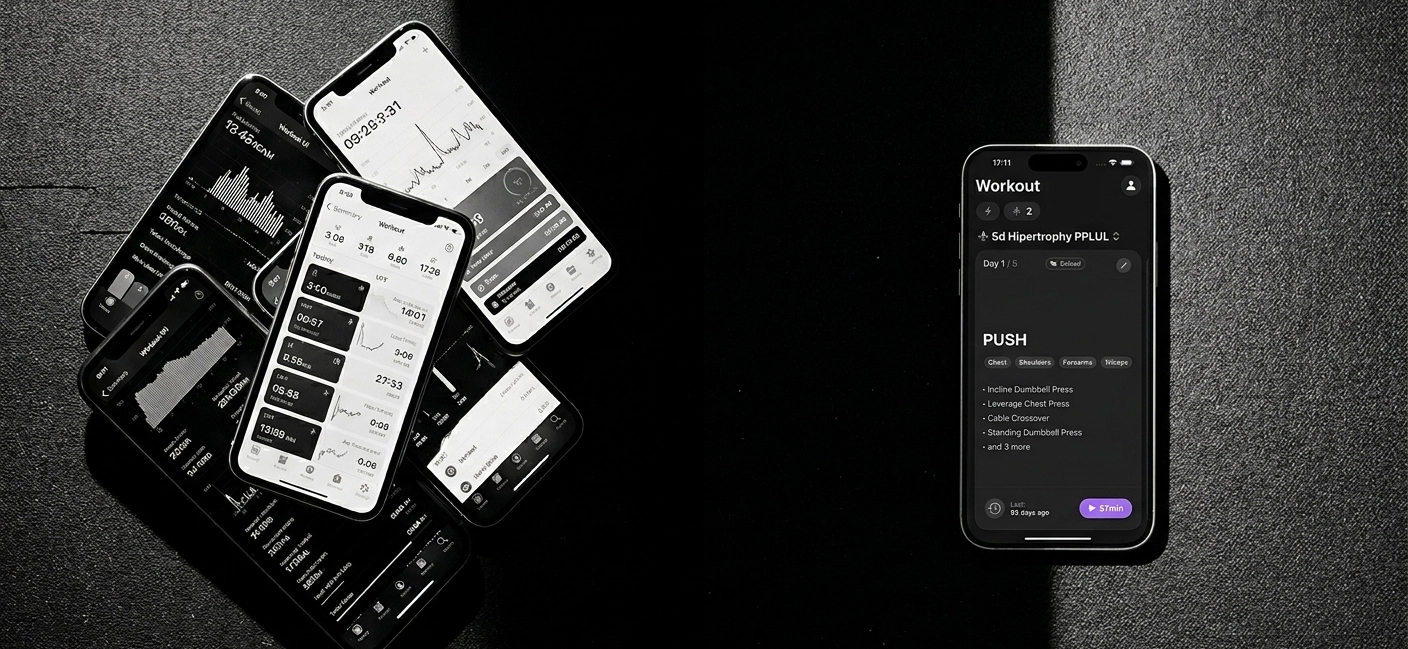 Most workout apps fight for engagement the way social media does — and lose lifters in the process.
Why consistency depends on reducing friction
A lot of people talk about consistency as if it is mainly a matter of willpower.
In reality, it is often a matter of friction.
The easier it is to open your plan, know what to do, log your sets, manage your rest, and see your progress, the easier it becomes to keep showing up.
The more extra noise gets added to that process, the harder it becomes to repeat.
That is why a good minimalist workout tracker is often more effective than a feature-heavy one.
It removes unnecessary steps.
It helps you:
- see what you did last time
- know what you are aiming for today
- log your work quickly
- stay focused during the session
- review progress without guesswork
That kind of simplicity does not make training less serious. In many cases, it makes serious training easier to sustain.
Why “no social features” can be a strength
It is easy to look at a product with no social layer and assume it is offering less.
But in a workout app, removing something can be exactly what improves the experience.
A workout app without social features can be stronger because it stays focused on the actual job:
- helping you follow your routine
- helping you log your sets and reps
- helping you manage rest and pacing
- helping you see your own progress clearly
- helping you return tomorrow with less friction
That is a very different design philosophy from an app that is trying to keep you engaged with content.
For many people, this is what makes a gym app without social media feel more calming, more private, and more sustainable.
It is not trying to become another platform.
It is trying to be a tool.
What a distraction-free workout app should do instead
If a workout app is not going to rely on social features, it still needs to be genuinely useful.
The best ones usually do a few practical things very well.
1. Make logging fast
If entering sets feels slow or clunky, people stop doing it consistently.
A good app should make it easy to log reps, weight, and basic performance without breaking the flow of the workout.
2. Keep your training history clear
Consistency improves when you can quickly see what happened last time.
That is one reason workout tracking matters so much. The clearer your history is, the easier it becomes to make good decisions.
3. Support progression without guesswork
A strong workout tracker should help you understand whether you are improving.
That might mean seeing rep increases, personal records, performance history, effort trends, or progression suggestions.
4. Help manage rest and workout flow
Rest periods are part of training quality.
A good app should help you follow your planned rest without forcing you to juggle separate tools or mentally track time yourself.
5. Stay focused on your training, not your image
This is one of the most underrated qualities of a fitness product.
A useful workout app should reinforce behavior that helps you train better, not behavior that makes you think more about being seen.
That difference matters.
Who benefits most from a workout app without social media?
Not everyone dislikes social features.
But a lot of people benefit from removing them.
A workout app without social media is often especially useful for:
- people who want more focus during workouts
- lifters who dislike comparisons and public performance culture
- users who prefer a more private training experience
- people who want a simple system they can actually stick with
- Apple users looking for a clean, native workout tracker
- anyone who feels mentally drained by feed-based apps in general
In other words, this kind of app is often best for people who want their workout tool to stay in its lane.
A different kind of motivation
There is a difference between motivation that gets attention and motivation that lasts.
External motivation can be loud. It often depends on comparison, stimulation, novelty, or validation.
Internal motivation is quieter. It grows from routine, visible progress, competence, and the feeling that your effort is adding up.
That quieter form of motivation is often better for consistency.
You show up because the system makes sense.
You keep training because you can see your history.
You stay engaged because progress feels measurable.
That is a more stable foundation than constantly being pulled into what other people are doing.
A distraction-free workout tracker supports that kind of motivation by making your own progress the center of the experience.
Why this philosophy fits real training better
Most people are not looking for another social platform when they go to the gym.
They are looking for a way to:
- follow a plan
- stay on task
- log what they do
- recover between sets
- improve over time
That is a much narrower job than most modern apps try to do.
But it is also a more useful one.
Steady is built around that narrower job on purpose. It focuses on workout execution, progress, privacy, and a calmer training experience instead of trying to turn training into a feed. Its design is built around the idea that a workout app should help you lift, not distract you from lifting.
For people who are tired of noisy fitness apps, that is often exactly what makes consistency easier.
Frequently asked questions
Can a workout app without social features still be motivating?
Yes. In many cases, it can be more motivating over time because it keeps your attention on your own routine, your own progress, and what you need to do next instead of constantly redirecting you toward other people.
Why do social feeds feel distracting in the gym?
Because they compete with the attention that would otherwise go toward your workout. Logging a set can turn into scrolling, comparing, reacting, or consuming content, which makes the session feel less focused.
Is comparing yourself to other people useful for fitness progress?
Usually not in a very reliable way. Too many variables affect how someone looks or performs, including genetics, health, sleep, money, recovery, schedule, training age, access to equipment, and many other factors. Comparing your current reality to someone else’s filtered result often creates more confusion than clarity.
What is a distraction-free workout app?
It is a workout app designed to help you train without adding social feeds, comparison mechanics, or unnecessary noise. The focus stays on routine, logging, progression, and workout flow.
Is a minimalist workout app better for consistency?
For many people, yes. Fewer distractions and less friction make it easier to show up, stay focused, and repeat the process consistently.
What should a good workout tracker actually do?
At minimum, it should help you log sets quickly, review previous workouts, support progression, manage rest smoothly, and keep the interface focused on training rather than engagement features.
Final thoughts
A distraction-free workout app is not about offering less for the sake of simplicity.
It is about protecting the part that matters.
When a workout app removes feeds, comparisons, and social noise, it becomes easier to stay focused on the actual purpose of the session: training, logging, recovering, and progressing. For many people, that makes consistency easier because the app supports the workout instead of competing with it.
That is especially true in a gym environment, where attention is already valuable. The more mentally present you are, the easier it is to stay connected to your technique, your pacing, your rest, and the quality of the work itself.
And when it comes to comparison, it is worth remembering that fitness progress is shaped by countless variables you cannot see from the outside. Genetics, health, time, money, recovery, schedule, background, and many other factors all affect results. That is why comparing yourself too closely with other people is often misleading and sometimes actively discouraging.
A better standard is simpler:
Train with intention. Track your own progress. Compare yourself with your past performance. Repeat.
That is the kind of consistency a focused workout app can support.
And that is exactly why Steady is intentionally built without social feeds, ads, or comparison-driven features. It is designed to help users train in a calmer, more private, and more deliberate way — so the app stays centered on the work, not the noise.
Ready to start applying progressive overload?
Ditch the spreadsheets and complex notes. Join thousands of lifters who use Steady to focus on the workout, track their progress, and automatically know when to add weight.
Download Free for iPhone