Why Most Workout Apps Are Built for Engagement, Not Training
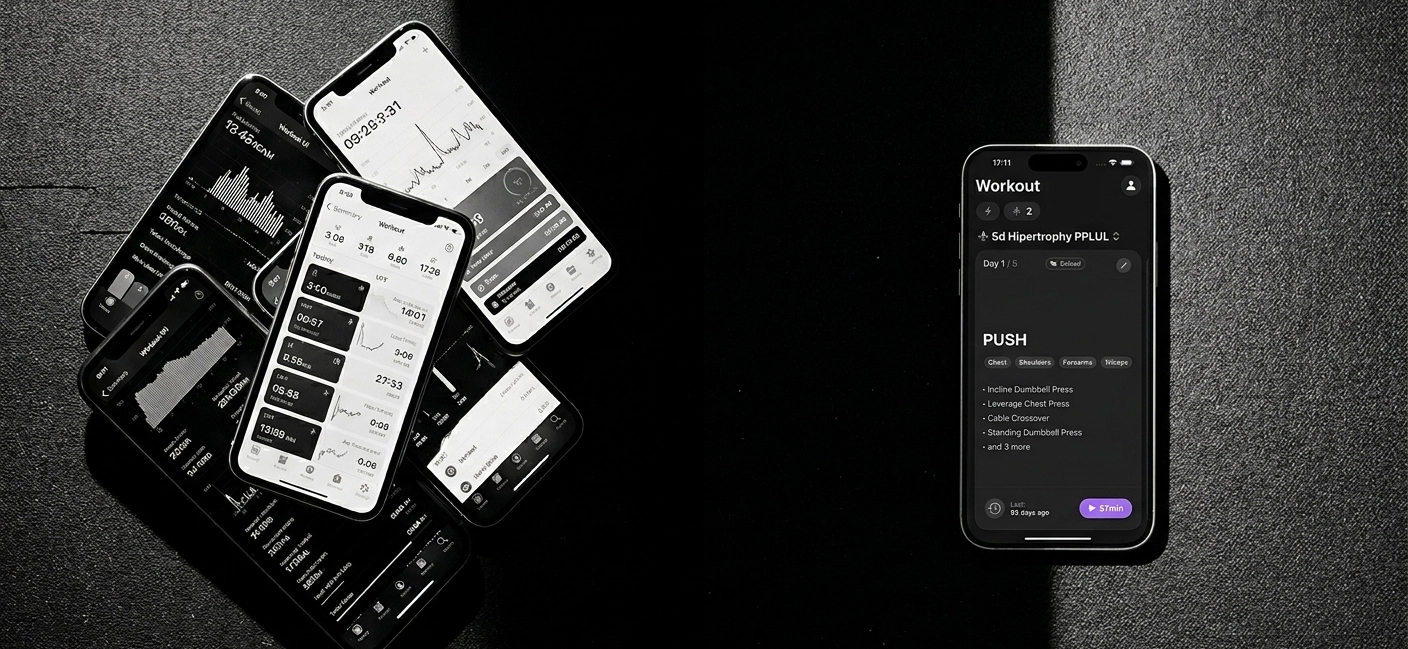
You downloaded a workout app to log your sets. Somewhere along the way, you ended up with a social platform and a catalog of 300 programs to scroll through before you can even start training.
This is not an accident. Most fitness apps are not built around training — they are built around engagement. And those two goals are often in direct conflict.
The social feed problem
A lot of popular workout apps come with a built-in social feed. Followers, likes, shared workouts, leaderboards, comment sections. On paper, it sounds motivating. In practice, it is one of the worst things you can add to a training tool.
Feeds are engineered to keep you inside the app. More time in the app means better retention metrics, which means a better story for investors. The feed is not there to make your training better. It is there to make you scroll longer.
That cost is real and it shows up mid-workout. You finish a set, pick up your phone to log it, and suddenly you are three posts deep watching someone else’s deadlift PR. Your rest period is gone. Your focus is gone. You have been routed away from your own training and into someone else’s highlight reel.
Comparison culture is actively bad for training. Strength is deeply individual. Your progression depends on your baseline, your recovery, your schedule, your history — none of which look like the person whose videos are surfacing on your feed. When you start measuring your squat against someone else’s, you are measuring the wrong thing. Progress in the gym is always relative to where you were last session, not relative to a stranger’s best lift.
Feeds create a performance incentive that distorts the choices people make. You train for the content, not for the adaptation. You choose exercises that look impressive, skip the boring accessory work, and stop treating your own log as the only benchmark that matters.
A workout app should make it easier to focus on your own training. A feed does the opposite.
The program-store problem
The other common trap is the app built around a massive library of pre-built programs. Hundreds of them, sometimes thousands. Six-week cuts, twelve-week strength blocks, beginner hypertrophy plans, elite powerlifting cycles — all available in a marketplace, often behind a subscription.
The pitch is that there is something for everyone. The reality is that there is nothing for anyone in particular.
A program designed for everyone is designed for no one. Your training history, weak points, available equipment, schedule, injury history, and goals make you specific. A template built for a generic intermediate lifter, written without knowing any of that, is going to misfit you in ways that matter: wrong volume, wrong frequency, wrong exercise selection. You will either grind through a program that does not suit you or abandon it and buy another one.
The program-store model also creates a browsing problem. When there are 300 options, choosing one becomes a project. You spend time that should go into training on reading program descriptions, watching preview videos, and reading reviews from people whose goals and experience levels have nothing to do with yours. More choice does not produce better outcomes — it produces more decision-making overhead.
The dirty secret of most program stores is that the programs are remarkably similar. They cluster around a handful of well-known templates with different branding. The variety is mostly aesthetic. Buying the “premium 12-week system” is usually just buying a spreadsheet someone else already posted for free.
The constant-variety problem
A newer variation of this pattern is apps that skip the catalog entirely and just serve you a different workout each time you train, adjusted to your mood, your reported recovery, or whatever signals the app collects. Every session is fresh and dynamic.
It sounds like an upgrade. It is actually worse than a generic program.
Consistency is how strength training works. Your muscles adapt to specific movements over repeated exposures. The first time you squat at a given load, a lot of what you are doing is just learning the movement pattern. The second session, you recover and consolidate. By the third, fourth, and fifth session, you are producing real force adaptations. That is where progress actually comes from — not from performing a movement once and moving on.
When your workout changes every session, you never accumulate enough stimulus on any one movement to adapt to it. You are perpetually in the first-session learning phase on everything. The result is that you stay mediocre at a rotating cast of exercises instead of getting strong at a fixed set of them.
This is why experienced lifters rarely change their programs. Not because they lack imagination — but because they understand that the value is in the repetition. You run the same squat, bench, and deadlift pattern for months, and you make small tweaks: add a kilo here, adjust your grip there, swap an accessory when something stops working. The program is stable; the adjustments are incremental. That is what produces a log you can actually read, a trend you can actually follow, and progress that compounds over time.
Constant variety makes that impossible. If you cannot compare today’s session to last week’s equivalent session, you cannot make informed decisions about load, volume, or intensity. You are flying blind — and the app is using that fog to make itself feel indispensable.
What all of these have in common
Social feeds, program stores, and AI-generated daily workouts are different features, but they come from the same design philosophy: build something that maximizes engagement, monetizable surface area, and perceived novelty rather than something that makes training more effective.
An app with a social feed can sell advertising and premium profile features. An app with a program store can sell individual programs and subscription access. An app that constantly varies your workouts makes itself impossible to leave — because without it, you have nothing to follow and no history to compare against. These are real revenue levers, and they shape the product around what makes money, not what improves your deadlift.
When you understand that, the feature set stops looking like a generous offering and starts looking like what it is: a business model wrapped in fitness branding.
What you actually need
Strip away the noise and the job a workout app needs to do is narrow:
- Know what you are doing today
- Log sets, reps, and load quickly
- See what you did last session
- Time your rest without switching apps
- Build a history you can actually use to make decisions
That is the whole job. Your history — your own numbers, your own progressions, your own records — is the only benchmark that matters. An app should make that history easy to build and easy to read.
If you want to dig into what a good tracking habit actually looks like, How to Start Tracking Your Workouts covers the fundamentals.
 What a workout app should actually look like: the next set’s numbers, a rest timer, and the exit.
Why Steady is built differently
Steady has no social feed. There is no way to follow other users, see their workouts, or compare your numbers to theirs. That is not a missing feature — it is a deliberate decision. Your training is yours.
Steady also has no program store. There is no catalog to browse, no templates to purchase. You build your own routines and repeat them — session after session, with full history — so you can make progress decisions based on your actual data. That puts the logic of your training back where it belongs: in your hands.
What Steady does have is everything you need to train well: fast set logging, built-in rest timers, per-exercise history, progressive overload tracking, personal records, rep ranges, and sync across iPhone and Apple Watch. All of it focused on making your sessions easier to run and your progress easier to see.
The goal is simple: show up, log your work, see your progress. No feed, no catalog, no distraction.
Ready to start applying progressive overload?
Ditch the spreadsheets and complex notes. Join thousands of lifters who use Steady to focus on the workout, track their progress, and automatically know when to add weight.
Download Free for iPhone