Consistency Wins Every Time in Weight Training

The clearest message from the 2026 ACSM guidelines for weight training is that a simple program you repeat is more useful than a sophisticated program you abandon. After synthesizing 137 systematic reviews representing more than 30,000 participants, the American College of Sports Medicine concluded that many forms of resistance training improve strength, muscle size, power, and physical function. The practical baseline is straightforward: train all major muscle groups with high effort at least twice per week, then adjust the details to match your goal.
That does not mean programming details never matter. It means the first priority is building a plan that survives real life.
What the new ACSM paper actually reviewed
The new ACSM position stand on resistance training is an overview of reviews, not one new training experiment. The authors examined systematic reviews of randomized trials in healthy adults. Eligible programs lasted at least six weeks and included at least 12 training sessions; most of the underlying research involved people with little or no resistance-training experience.
That scope matters. The recommendations are strong general guidance for healthy adults, but they are not a rehabilitation protocol or a sport-specific plan for advanced athletes.
There is another important distinction: the paper did not directly test which habit strategy produces the best adherence. It identifies adherence as a core programming principle and shows that many training approaches work. ACSM’s own summary of the updated guidelines turns those findings into the practical message that consistency matters more than unnecessary complexity.
The key findings you can use
1. Start with the minimum effective structure
ACSM’s primary recommendation is high-effort resistance training for all major muscle groups at least twice per week. This is a baseline for regular exposure, not a demand for a complicated split or a seven-day schedule.
High effort does not require taking every set to absolute failure. The authors propose that finishing challenging sets near failure—often around two to three repetitions in reserve—can provide enough stimulus, while also noting that the evidence cannot define one exact RIR target for everyone.
2. Match the dose to the goal
The review found that different goals benefit from different adjustments:
- Strength: heavier loads, around 80% of one-repetition maximum or more, with roughly two to three sets per exercise.
- Muscle growth: higher weekly volume, with approximately 10 sets per muscle group as a useful target.
- Power: moderate loads, around 30–70% of 1RM, moved as quickly as possible during the lifting phase.
These are ways to optimize a plan that is already happening consistently. They are not prerequisites for receiving any benefit from resistance training.
3. Many training formats work
The evidence supports traditional weights, machines, elastic bands, bodyweight exercises, circuits, and home-based training. That flexibility is valuable because access, enjoyment, confidence, and schedule all affect whether a program gets repeated.
A basic home session you complete every Tuesday and Friday can be more productive than a theoretically superior gym plan that regularly loses to commuting, work, or family obligations.
4. Most advanced methods are optional
Training to momentary muscular failure did not improve strength, hypertrophy, or power compared with stopping earlier. Machine versus free-weight training and complex periodization also did not consistently change outcomes for the average healthy adult.
Those choices can still matter for preference, specificity, variety, or athletic preparation. The point is narrower: they should not become barriers to starting or reasons to rebuild your routine every few weeks.
Why consistency is a programming variable
 A repeatable plan becomes easier to improve when the previous session is available as a reference.
Consistency is not just motivation. It is partly the result of program design.
A consistent plan has a realistic number of training days, exercises you can access, enough challenge to produce adaptation, and a simple way to resume after an interrupted week. It removes decisions that do not need to be made again every session.
This is where “optimal” plans often fail. Adding another day, another technique, or more exercise rotation may improve a spreadsheet while making the plan harder to execute. The paper separates getting meaningful results from optimizing a specific result. Most people should secure the first before chasing the second.
Consistency also does not mean never missing a session. It means your routine has a clear return path. One disrupted week should not force a full restart.
A consistency-first weight training plan
Use the ACSM findings as a simple decision order:
- Choose at least two realistic training days. Build around your normal week, not your best possible week. If you need help choosing a schedule, see how many days per week you should lift.
- Cover all major muscle groups across the week. A full-body routine twice weekly is a valid starting point. More days are optional ways to distribute additional work.
- Make the working sets challenging. Near-failure effort is sufficient; failure on every set is unnecessary.
- Keep the main exercises stable long enough to compare sessions. Constant novelty makes progress harder to measure.
- Record sets, reps, and load. Your log should answer what you did last time and what a sensible next step looks like.
- Optimize only for a clear reason. Add heavier work for strength, more weekly sets for hypertrophy, or faster concentric intent for power.
This order protects the behavior that makes every later adjustment useful: returning for the next session.
How Steady helps make consistency visible
Steady turns a repeatable plan into a low-friction system. Saved routines tell you what comes next. Workout history shows what you performed last time. You can repeat a past workout, schedule recurring workout reminders, and set a weekly training goal rather than rebuilding the plan from memory.
Its Trends view makes weekly consistency, streaks, and training months visible. That shifts the question from “Was today perfect?” to “Am I repeatedly doing the work?”
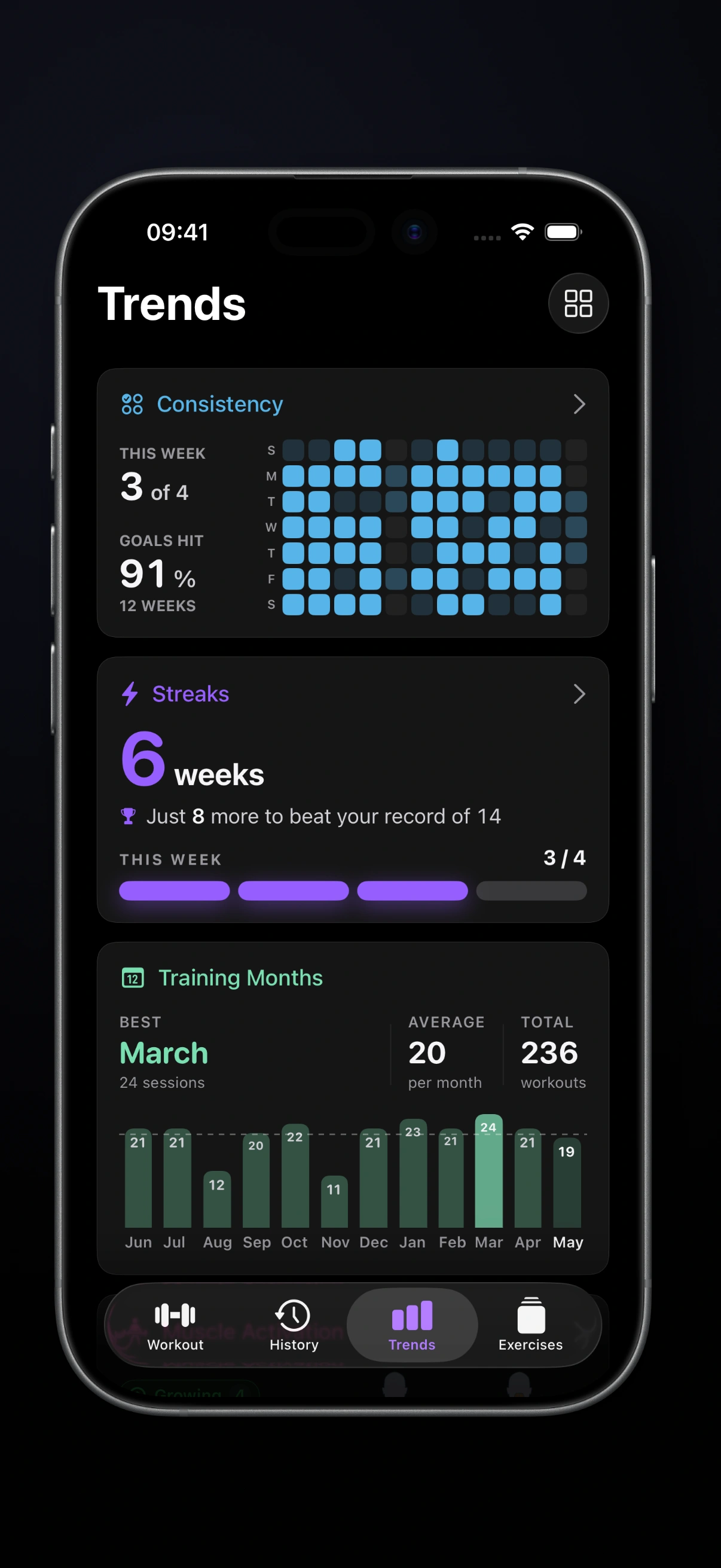 Steady tracks the repeatable behavior behind progress, not only the best performance from one day.
The goal is not to make training simplistic. It is to keep useful depth—targets, progression, history, and trends—without putting a social feed or unnecessary noise between you and the next set. When the evidence says many approaches can work, the best tracker is the one that helps you keep doing yours.
The takeaway
The ACSM update does not say every program is equally good for every goal. It says the largest practical win is moving from no weight training to regular weight training, and that many accessible methods can deliver meaningful results.
Build the repeatable version first. Train the major muscle groups at least twice weekly, work with real effort, track what you did, and let your goal determine the next adjustment. Steady helps keep that process clear enough to repeat—and consistency is what gives the details time to work.
Sources
Ready to start applying progressive overload?
Ditch the spreadsheets and complex notes. Join thousands of lifters who use Steady to focus on the workout, track their progress, and automatically know when to add weight.
Download Free for iPhone