How many days per week should you lift weights?

For most lifters, three to five days per week is the sweet spot. Three is enough to build real strength and muscle if every session is well-programmed. Four to five gives you more room to spread volume across muscle groups without burning out. More than five rarely produces better results unless you’re an advanced lifter with very specific goals.
The right number isn’t about doing the most — it’s about finding a rhythm you can repeat for months without dropping sessions.
The short answer by experience level
Beginners (0–6 months of training): 3 days per week. A simple full-body routine three times a week trains every major muscle with enough frequency to drive progress, and leaves recovery days that prevent overuse before your tendons and joints catch up to your enthusiasm.
Intermediate (6 months – 2 years): 3–4 days per week. This is where most people land long-term. Three full-body sessions still works, but a four-day upper/lower split gives you more total sets per muscle group without excessively long workouts.
Advanced (2+ years): 4–5 days per week. At this stage your work capacity supports more volume, and split routines (upper/lower or push/pull/legs) start to outperform full-body for hypertrophy.
What three days a week actually buys you
Three sessions can deliver almost everything most lifters want — strength, muscle, and the habit of training. If each session covers all major movement patterns (squat, hinge, push, pull) and you progressively add weight or reps, you’ll keep improving for a long time.
Where three days falls short is specialization. If you want bigger arms specifically or a stronger bench specifically, three full-body sessions don’t leave much room for direct accessory work without dragging each session past 75 minutes.
If you’re starting from scratch, a 3-day gym routine is almost certainly the right move.
When four days makes more sense
A four-day week opens up two structural advantages:
- More volume per muscle group, spread across shorter sessions. Two upper days and two lower days means each major group gets 8–12 working sets per week without any single workout running 90 minutes.
- Targeted weak-point work. You have time for a few extra sets of arms, calves, rear delts, or whatever you’re trying to bring up.
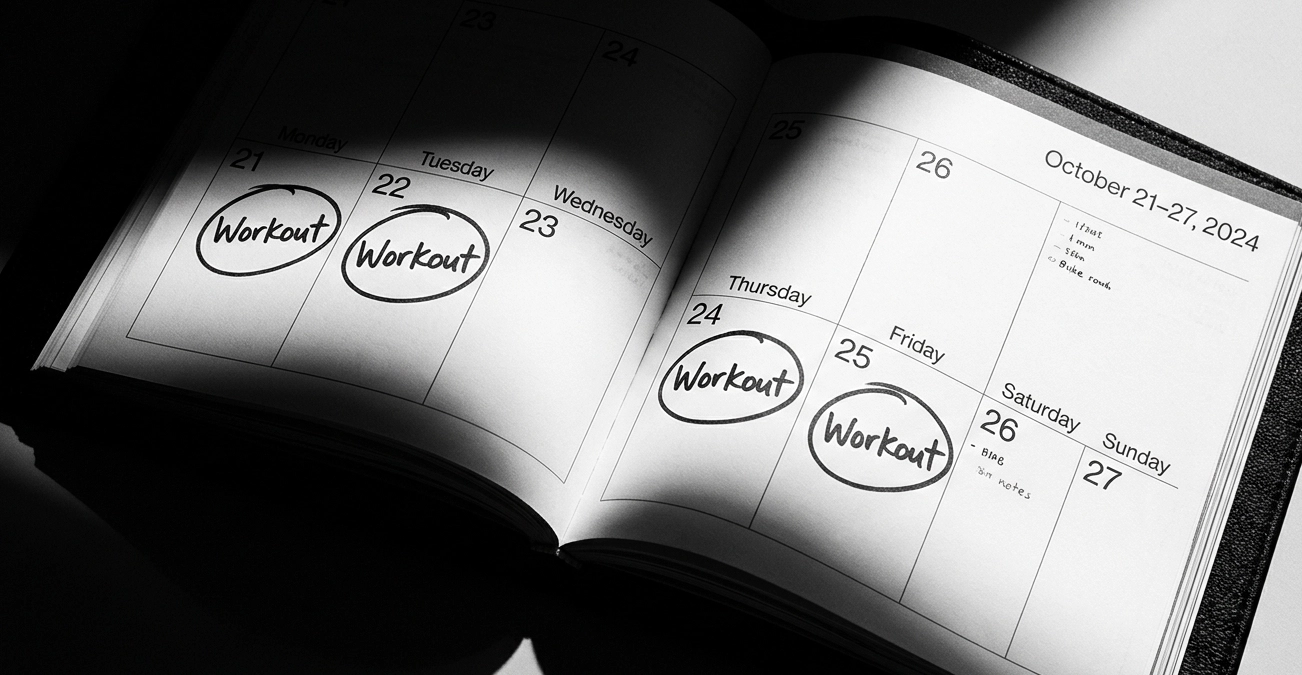
The classic format is an upper/lower split — Monday upper, Tuesday lower, Thursday upper, Friday lower. If hypertrophy is the goal, a 4-day upper/lower program consistently outperforms three full-body days for most intermediate lifters.
When five days is worth it (and when it isn’t)
Five days a week is great if:
- You have stable schedule access to a gym, ideally close to home or work
- Your sleep, food, and recovery are dialed in
- You have a specific reason for the volume — competing in a sport, peaking for an event, prioritizing a lagging muscle group
Five days is not worth it if you’re regularly missing sessions, sleeping poorly, or already feeling beaten up after four. Four well-executed sessions outperform five sessions you’re dragging through.
Push/pull/legs is the most common five- or six-day split — each muscle group gets hit twice a week with high session-by-session focus.
Why “more days = more gains” is mostly wrong
A common mistake is assuming that doubling your sessions doubles your progress. It doesn’t. Muscle growth is driven by weekly volume (total challenging sets) plus adequate recovery — not by how many times you walk into the gym.
Two examples:
- A lifter doing 3 full-body sessions of 18 sets each = 54 weekly sets, fully recovered.
- A lifter doing 6 sessions of 9 sets each = 54 weekly sets, partially recovered, more cumulative fatigue.
Same volume, different fatigue cost. The 3-day version is often more productive simply because the recovery is cleaner.
How to actually decide
Pick the schedule you can hit consistently for the next three months, not the one that looks best on paper. Ask:
- How many days can I realistically train without conflicts? Not your ideal week — your real week, factoring travel, kids, work crunches.
- Can I recover from this load? If you’re sore four days deep into a 5-day week and dreading the gym, the schedule isn’t working.
- Is my volume hitting each muscle group at least twice a week? Frequency of 2x per muscle group is the sweet spot for hypertrophy regardless of total session count.
Three days you do every week beats five days you do for a month and abandon. Consistency compounds; ambition without consistency doesn’t.
A simple rule of thumb
Start with three days. Move to four when three feels too easy and you have time. Move to five only when you have a specific reason and bulletproof recovery.
When you’re ready to track sessions and watch each lift progress over weeks instead of guessing, that’s where Steady helps — log every set on your iPhone or Apple Watch, see the numbers move, and stop second-guessing whether the schedule is working.
Ready to start applying progressive overload?
Ditch the spreadsheets and complex notes. Join thousands of lifters who use Steady to focus on the workout, track their progress, and automatically know when to add weight.
Download Free for iPhone