How to Build a 3-Day Gym Routine That You Can Actually Stick To
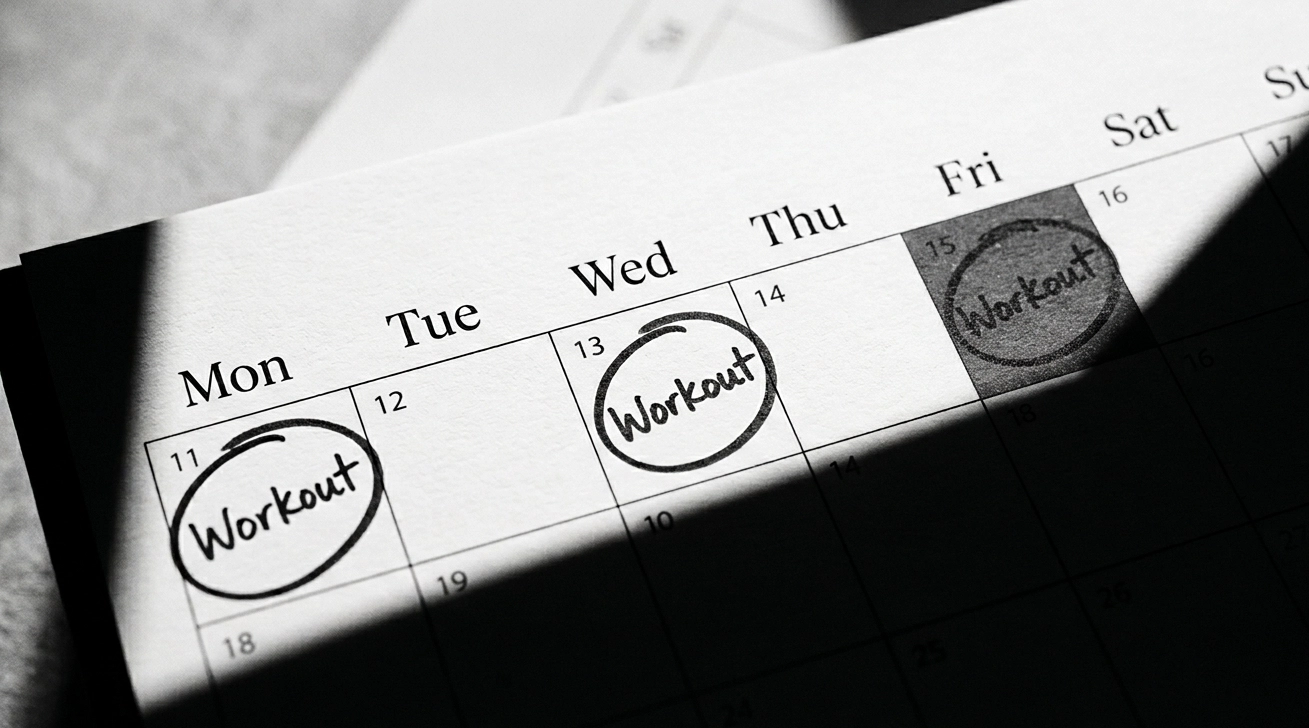
The best 3-day gym routine is usually the one that gives you enough training to progress, enough recovery to come back fresh, and a structure simple enough that you can repeat it for months instead of abandoning it after two weeks. For most people, that means training three consistent days per week, centering each session around a few big movement patterns, keeping the exercise list short, and using a progression rule that is easy to follow.
A lot of people want a better routine, but quietly make the plan too ambitious to live with.
They choose too many exercises, too much volume, too many training days, or a split that looks impressive on paper but does not fit their real week. The result is not always a bad routine. It is often a routine that asks for more consistency than real life is likely to give.
That is why a 3-day structure works so well.
It gives you enough frequency to improve, enough flexibility to recover, and enough simplicity to stay organized. For beginners, it is often one of the best ways to build momentum. For intermediate lifters, it can be a very effective way to keep progressing without turning training into a scheduling problem.
If you also want that routine to be measurable over time, this is where a good gym log app or strength training app becomes useful. A strong routine works even better when you can repeat it, log it, and compare it clearly from week to week.
Short definitions
Before building the routine, a few terms help.
- 3-day gym routine: a training plan built around three lifting sessions per week.
- Training split: the way exercises are organized across the week, such as full body or upper/lower plus one extra day.
- Compound lift: an exercise that trains multiple joints and a lot of muscle mass at once, such as a squat, press, row, or deadlift variation.
- Accessory lift: a smaller exercise used to add volume, train specific muscles, or support bigger lifts.
- Progression rule: the rule you use to decide when to add weight, add reps, or keep the same load.
Why a 3-day gym routine works so well
A 3-day routine works because it solves a practical problem:
it is hard to make progress on a routine you cannot recover from or consistently show up for.
Three lifting days per week is often the middle ground that works for real life.
It is enough for:
- repeated exposure to the main lifts
- steady strength and muscle progress
- useful weekly volume
- building a real training habit
It is also low enough that many people can recover well from it while managing work, school, family, poor sleep, or the normal unpredictability of life.
That balance matters.
A four-, five-, or six-day split can work very well, but only if you can actually sustain it. A good 3-day plan often beats a perfect-looking 5-day plan that gets skipped constantly.
This is also why 3-day routines fit so naturally with How to Repeat a Past Workout and Progress More Consistently. The more repeatable the training week is, the easier progress becomes to measure.
The simplest way to build a 3-day gym routine
For most people, the simplest good system looks like this:
- pick three realistic training days
- use a full-body structure unless you have a clear reason not to
- build each day around a few key movement patterns
- keep the exercise count low enough to recover from
- use a progression rule you can actually follow
- repeat the plan long enough to judge it properly
Here is what each step means in practice.
1. Pick training days you can really protect
This sounds obvious, but it is one of the biggest reasons routines fail.
Do not start with the “ideal” schedule if you know it collides with your real week.
A better question is:
Which three days can I most consistently train for the next two to three months?
For many people, that might be:
- Monday, Wednesday, Friday
- Tuesday, Thursday, Saturday
- Monday, Thursday, Saturday
There is nothing magical about a specific set of weekdays. What matters is consistency and enough recovery between sessions.
If you cannot reliably protect three days, the first fix is not usually a smarter split. It is a more realistic schedule.
2. Use full body as the default starting point
When people search for a 3-day gym routine, many assume they need a complex split.
Usually, they do not.
For most beginners and many intermediates, full-body training three times per week is the best default. It keeps the main movement patterns frequent, makes missed sessions less damaging, and spreads the weekly workload more evenly.
A practical full-body week usually includes:
- one knee-dominant lower-body movement
- one hip hinge or posterior-chain movement
- one horizontal or vertical press
- one horizontal or vertical pull
- one or two smaller accessories
That structure is hard to beat for simplicity.
You can absolutely use other 3-day setups, but full body is usually the cleanest place to start because it makes each session valuable on its own.
3. Organize the week around movement patterns, not random exercises
A lot of routines become messy because they are built around exercise lists instead of movement coverage.
The cleaner approach is to make sure the week covers the basics:
- squat or leg press pattern
- hinge pattern
- horizontal press
- vertical press
- horizontal pull
- vertical pull
- optional arms, calves, abs, or lateral raises
That does not mean every session needs every pattern.
It means the week as a whole should cover the important bases without becoming bloated. If you organize the routine that way, exercise selection becomes much easier.
For example:
- Day 1 can emphasize squat, bench, row
- Day 2 can emphasize hinge, overhead press, pulldown
- Day 3 can emphasize leg press or split squat, incline press, cable row
This kind of structure is usually more sustainable than trying to cram every favorite exercise into one plan.
4. Keep each session short enough that you will still finish it on a tired day
This is where many routines quietly become unrealistic.
People build a 90-minute plan when their real life only supports 50 to 65 minutes consistently.
A better rule for most 3-day routines is:
- 4 to 6 exercises per session
- 2 to 4 hard work sets per exercise
- enough rest to perform the lifts properly
That is usually enough to make progress without turning each workout into an event.
If your routine looks exciting when you are motivated but impossible when you are busy, it is too big.
5. Use a simple progression rule
A good routine is not just a list of exercises. It is a repeatable system for moving forward.
For most lifts, the easiest progression rule is one of these:
- use a rep range, such as 3 sets of 6 to 8 or 3 sets of 8 to 10, and increase the weight after you reach the top of the range across the target sets
- use a fixed target, such as 3 sets of 5, and increase the load once you hit the goal with solid form
If you want the full explanation of that choice, read What Is Progressive Overload? and How to Know When to Increase Weight, Reps, or Both.
The important part is not which model sounds smartest. The important part is that the next step is obvious when you repeat the workout.
6. Keep the plan stable long enough to evaluate it
Many people change routines too early.
They run a plan for ten days, get bored, and assume the routine is the problem. Usually, the bigger problem is that the plan never stayed stable long enough to create useful comparisons.
A better rule is to keep the core structure in place for at least several weeks unless there is a clear issue with:
- pain
- equipment availability
- recovery
- exercise fit
- schedule
This works best when the routine is logged clearly. How to Start Tracking Your Workouts for the First Time is the best companion if you are building both habits at once.
A practical 3-day full-body template
Here is a simple example of what a 3-day routine can look like.
Day 1
- Squat or leg press: 3 sets of 5 to 8
- Bench press or dumbbell bench press: 3 sets of 6 to 8
- Chest-supported row or seated row: 3 sets of 8 to 10
- Romanian deadlift: 2 to 3 sets of 6 to 8
- Lateral raise or triceps pressdown: 2 to 3 sets of 10 to 15
Day 2
- Romanian deadlift or deadlift variation: 3 sets of 5 to 8
- Overhead press: 3 sets of 6 to 8
- Lat pulldown or pull-up: 3 sets of 8 to 10
- Split squat or leg curl: 2 to 3 sets of 8 to 12
- Curl or calf raise: 2 to 3 sets of 10 to 15
Day 3
- Leg press, hack squat, or front squat: 3 sets of 8 to 10
- Incline dumbbell press: 3 sets of 8 to 10
- Cable row or machine row: 3 sets of 8 to 12
- Hip thrust or hamstring curl: 2 to 3 sets of 8 to 12
- Abs, lateral raises, or arms: 2 to 3 sets of 10 to 15
This is not the only good template.
It is simply an example of a routine that:
- covers the main movement patterns
- keeps frequency high enough to improve
- leaves enough room for recovery
- is simple enough to repeat for a long time
 Each full-body day is anchored by a heavy compound — squat, bench, or deadlift — followed by a few well-chosen accessories.
Examples
Example 1: beginner who wants the simplest good option
This person has never followed a structured lifting plan before.
The smartest move is usually a full-body routine three times per week with:
- a squat or leg press variation
- a press
- a row or pulldown
- a hinge or hamstring movement
- one small accessory
That is enough to learn the lifts, build consistency, and create a training history that actually means something.
Example 2: busy intermediate lifter
This person already knows how to train, but life no longer supports four or five consistent gym days.
A 3-day routine works well because it lets them keep the most valuable lifts, maintain progression, and stop spreading recovery too thin. In a case like this, a simple full-body plan is often better than forcing an upper/lower split into a week that never quite fits.
Example 3: someone returning after a long break
This person often makes the mistake of training like their old self too early.
A better 3-day routine keeps the structure simple, limits total volume, and focuses on repeating basic lifts well enough that the next session is still productive. Consistency matters more than trying to prove that you can still handle your old workload.
Common mistakes when building a 3-day gym routine
1. Choosing a split that looks advanced instead of one that fits your week
A routine is only as good as your ability to repeat it.
2. Using too many exercises per workout
If every session includes eight or nine lifts, the routine often becomes harder to recover from and harder to finish.
3. Ignoring progression
Without a clear progression rule, the routine becomes a list of tasks instead of a system for improvement.
4. Changing the plan too often
If the exercises, order, or rep targets keep drifting, progress becomes much harder to interpret.
5. Copying advanced volume too early
Many people do better with slightly less work performed consistently than with a high-volume plan they only survive for two weeks.
6. Treating missed workouts like proof the routine failed
Real life happens. A good 3-day plan should be resilient enough that one imperfect week does not destroy it.
Who this is for
This kind of routine is especially useful for:
- beginners who want a clear starting point
- people returning to the gym after time away
- busy lifters who cannot reliably train four or more days per week
- intermediate trainees who want a simpler structure with enough frequency to progress
- anyone who needs a routine that is easier to recover from and easier to repeat
Conclusion
If you want the shortest version, build your week around three realistic training days, use a simple full-body structure, keep the exercise list tight, and follow a progression rule you can actually repeat. That is usually what makes a 3-day gym routine effective in the real world.
If you want to make that routine easier to track and improve, the most useful next reads are How to Start Tracking Your Workouts for the First Time, How to Repeat a Past Workout and Progress More Consistently, and What Is Progressive Overload?. And if you want a tool that fits that workflow, Steady’s pages for Gym Log App and Strength Training App are the most relevant next steps.
Ready to start applying progressive overload?
Ditch the spreadsheets and complex notes. Join thousands of lifters who use Steady to focus on the workout, track their progress, and automatically know when to add weight.
Download Free for iPhone