How to Repeat a Past Workout and Progress More Consistently
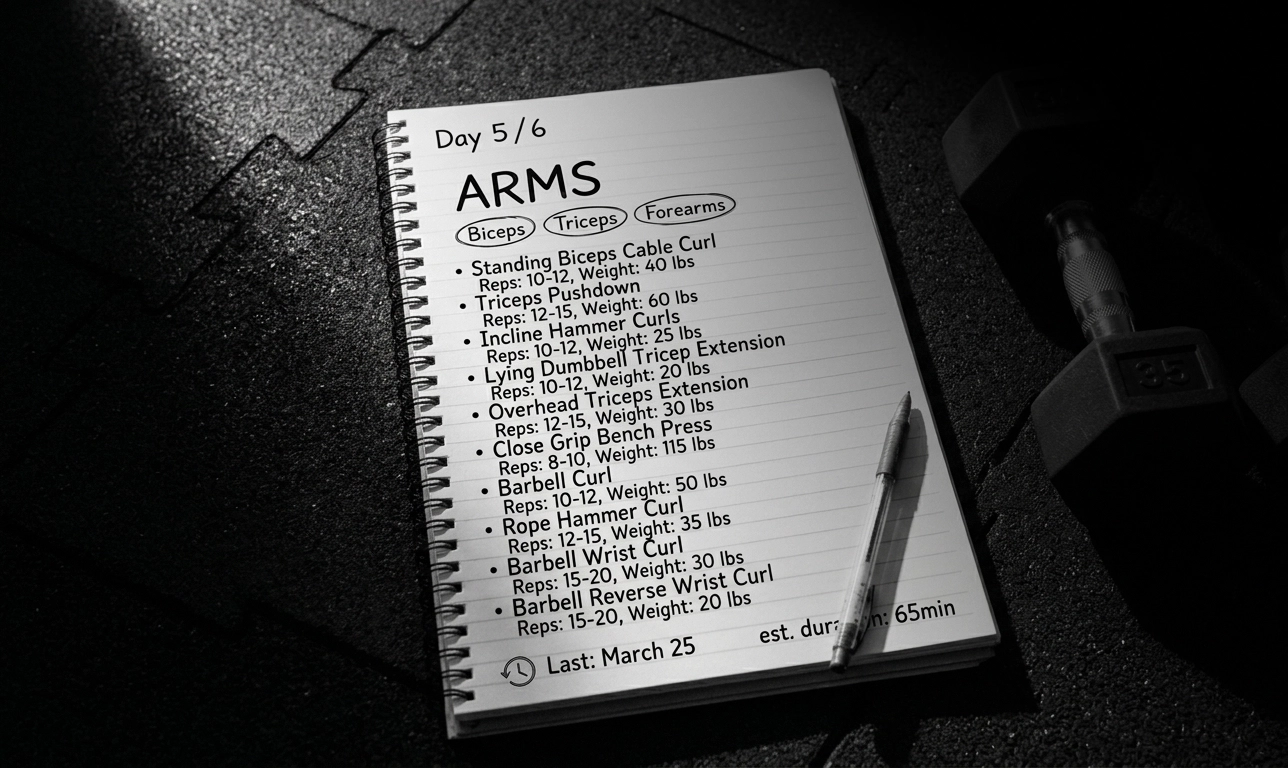
The best way to repeat a past workout is to use the previous session as a reference point, keep the important variables reasonably stable, and aim for a clear improvement instead of random variety. In practice, that usually means repeating the same main exercises, checking your last sets before you start, keeping exercise order and rest times similar enough to compare, and then progressing by adding a rep, improving execution, or increasing weight when it is earned. That approach makes training easier to measure and much easier to improve consistently over time.
A lot of people understand that progressive overload matters, but they still make one mistake that quietly slows everything down: they change too much from one session to the next.
Maybe the exercise order changes every workout. Maybe the rep targets drift around. Maybe one week you remember the last session clearly and the next week you are guessing. The result is not always bad training, but it is harder-to-interpret training.
That is why repeating a past workout well matters so much. It gives your next session context. Instead of walking into the gym thinking “what should I do today?”, you walk in asking a much better question:
What can I improve from last time?
That question is where a good gym log app, a cleaner progressive overload app, or even a simple workout history can become much more useful than memory alone.
Short definitions
Before getting practical, it helps to define a few terms clearly.
- Repeat a workout: perform the same or very similar session again so you can compare performance against the last time you did it.
- Workout history: the record of your past sessions, including exercises, sets, reps, weight, and sometimes rest times or notes.
- Reference point: the last performance you are trying to match, beat, or interpret today.
- Progressive overload: gradually making training more challenging so your body keeps adapting over time.
- Training consistency: keeping enough of the workout stable that progress is easier to measure from one session to the next.
Why repeating a past workout works so well
Most strength and hypertrophy progress comes from doing useful work repeatedly, not from constantly creating novelty.
That does not mean every workout should feel identical forever. It means your training needs enough repetition that performance changes actually mean something. If you do a lift once, then replace it, reorder everything, or change the rep target completely, the next comparison becomes much weaker.
Repeating a past workout solves that problem because it gives you a cleaner baseline.
When the session is similar enough to the previous one, you can answer practical questions like:
- did I add a rep?
- did the same load feel easier?
- should I increase weight next time?
- was performance down because I was tired, or because the setup changed?
This is also why repeating workouts fits so naturally with What Is Progressive Overload?. Overload is not just about trying harder. It is about making comparisons you can trust.
 A glance at last session’s numbers tells you the only thing you need to know — was it a clean win, a stall, or a miss?
Practical steps for repeating a past workout and progressing more consistently
Here is the simplest system that works well for most people.
Step 1: Keep the main exercises stable long enough to measure them
You do not need to keep every exercise forever.
But if your goal is to get stronger, build muscle, or simply understand whether your plan is working, your key exercises should stay in place long enough to produce useful comparisons.
That usually means repeating the same main movements for multiple weeks, such as:
- squat pattern
- horizontal press
- row or pulldown
- hip hinge
- shoulder press
- a few consistent accessory lifts
If those movements keep changing too often, your workout history becomes less useful. You are no longer comparing training. You are comparing different workouts.
Step 2: Open the last session before you start the current one
This is one of the highest-value habits in all of workout tracking.
Before the first working set, check what happened last time:
- what weight did you use?
- how many reps did you get?
- where did performance drop off?
- did you leave a setup note or rest target?
That becomes your reference point for today.
If you are still building the logging habit itself, How to Start Tracking Your Workouts for the First Time is the best companion to this article. Repeating workouts works best when the previous workout is easy to find and easy to read.
Step 3: Decide what counts as progress before the workout becomes chaotic
Progress does not always mean adding weight immediately.
For many exercises, a smarter rule is:
- match the previous session
- beat it slightly if possible
- increase load only after the target has clearly been earned
That improvement might look like:
- one more rep on one or more sets
- cleaner technique at the same weight
- the same performance with better control
- the same reps with less perceived effort
- a load increase after consistently hitting the top of the rep range
If you want a deeper guide for that decision, How to Know When to Increase Weight, Reps, or Both covers the progression logic in more detail.
Step 4: Repeat the workout structure, not every tiny detail
A lot of people hear “repeat a workout” and assume that means every session must be mechanically identical.
That is not necessary.
The real goal is to keep the variables that matter most reasonably consistent:
- exercise selection
- exercise order
- rep targets
- rest times
- machine setup or execution notes when relevant
Real training still has variation. Some days you feel better. Some days the gym is crowded. Some days you use a different bench or cable station. That is fine. You do not need laboratory conditions. You only need enough consistency that the comparison still means something.
Step 5: Keep rest times and exercise order reasonably stable
If you repeat the same exercises but change the workout flow completely, the data becomes harder to read.
For example, a leg press set after a hard squat session is not the same as a leg press set done fresh at the start of the workout. The same goes for rest: if one week you rest 75 seconds and the next week you rest 3 minutes, the result is less comparable.
That is why The Best Way to Track Rest Times Between Sets matters so much here. The more stable your rest and order are, the easier it becomes to trust what changed.
Step 6: Use bad days as information, not as a reason to abandon the system
One weaker session does not mean the workout stopped working.
Performance changes day to day. Sleep, fatigue, stress, food, and exercise order can all affect what happens. A single off day should usually be treated as data, not as proof that the plan is broken.
A better question is:
Is the trend moving forward across repeated sessions?
That is another reason a dedicated distraction-free workout tracker can help. Clear workout history makes it easier to judge the trend instead of overreacting to one day.
Examples
Here are a few practical examples of how repeating a workout can work well.
Example 1: beginner full-body routine
You are doing a simple full-body workout three times per week.
On Monday, your dumbbell bench press looks like this:
- 20 kg x 8
- 20 kg x 8
- 20 kg x 7
When the workout comes around again, your first job is not to invent something new. It is to use that session as the target. If Friday becomes:
- 20 kg x 8
- 20 kg x 8
- 20 kg x 8
that is already useful progress.
Example 2: upper/lower hypertrophy training
You are running an upper/lower split with rep ranges.
Last upper day, your chest-supported row was:
- 55 kg x 12
- 55 kg x 11
- 55 kg x 10
Your target rule is to increase load only after you can stay near the top of the range across all sets. So on the next upper day, you repeat the same exercise, same slot in the workout, and similar rest time.
If the next session becomes:
- 55 kg x 12
- 55 kg x 12
- 55 kg x 11
you probably keep the same load for now and try to beat it again next time. That is a much cleaner system than jumping to a new row variation every week.
Example 3: performance is down on a rough day
Last week on incline dumbbell press, you did:
- 24 kg x 9
- 24 kg x 8
- 24 kg x 8
This week you slept badly and only get:
- 24 kg x 8
- 24 kg x 8
- 24 kg x 7
That is not automatically failure. It may simply be a low-readiness day. If the next repeated session returns to or exceeds your prior numbers, the broader trend is still intact.
This is one reason some people eventually add effort notes like RPE. It can help explain whether a repeated workout felt unusually hard even when the structure stayed the same.
Common mistakes when repeating a past workout
1. Changing exercises too often
Variation can be useful, but too much variation makes progression harder to measure.
2. Repeating the workout without checking the last performance
If you do not look at the previous session, you lose the main benefit of repeating it.
3. Increasing weight too early
Sometimes the next step is one more rep, not more load. Rushing load increases often makes performance noisier, not better.
4. Ignoring exercise order and rest times
If those change wildly, the comparison gets weaker even when the exercise itself stays the same.
5. Treating one bad session like proof the plan failed
Training progress is noisy. A trend matters more than a single workout.
6. Confusing repetition with boredom
Repeating a useful workout is not “doing the same thing for no reason.” It is how you create measurable progress.
Who this is for
This is especially useful for:
- beginners who want a simple way to stop guessing in the gym
- intermediate lifters trying to make progressive overload more consistent
- people moving from notes or memory to a real workout history
- anyone whose routine changes so often that progress is hard to judge
- lifters who want a simpler and more repeatable system than constant variety
Conclusion
If you want the shortest version, repeat the important parts of the workout, check the last session before you start, and look for a small improvement you can actually measure. That is usually the fastest way to make training more consistent and progression easier to trust.
If you want to build the full system around that idea, read How to Start Tracking Your Workouts for the First Time, How to Know When to Increase Weight, Reps, or Both, and The Best Way to Track Rest Times Between Sets. And if you want a tool built for that workflow, Steady’s pages for Gym Log App, Progressive Overload App, and Distraction-Free Workout Tracker are the most relevant next steps.
Ready to start applying progressive overload?
Ditch the spreadsheets and complex notes. Join thousands of lifters who use Steady to focus on the workout, track their progress, and automatically know when to add weight.
Download Free for iPhone