Free Weights vs Machines: Which Builds More Muscle?
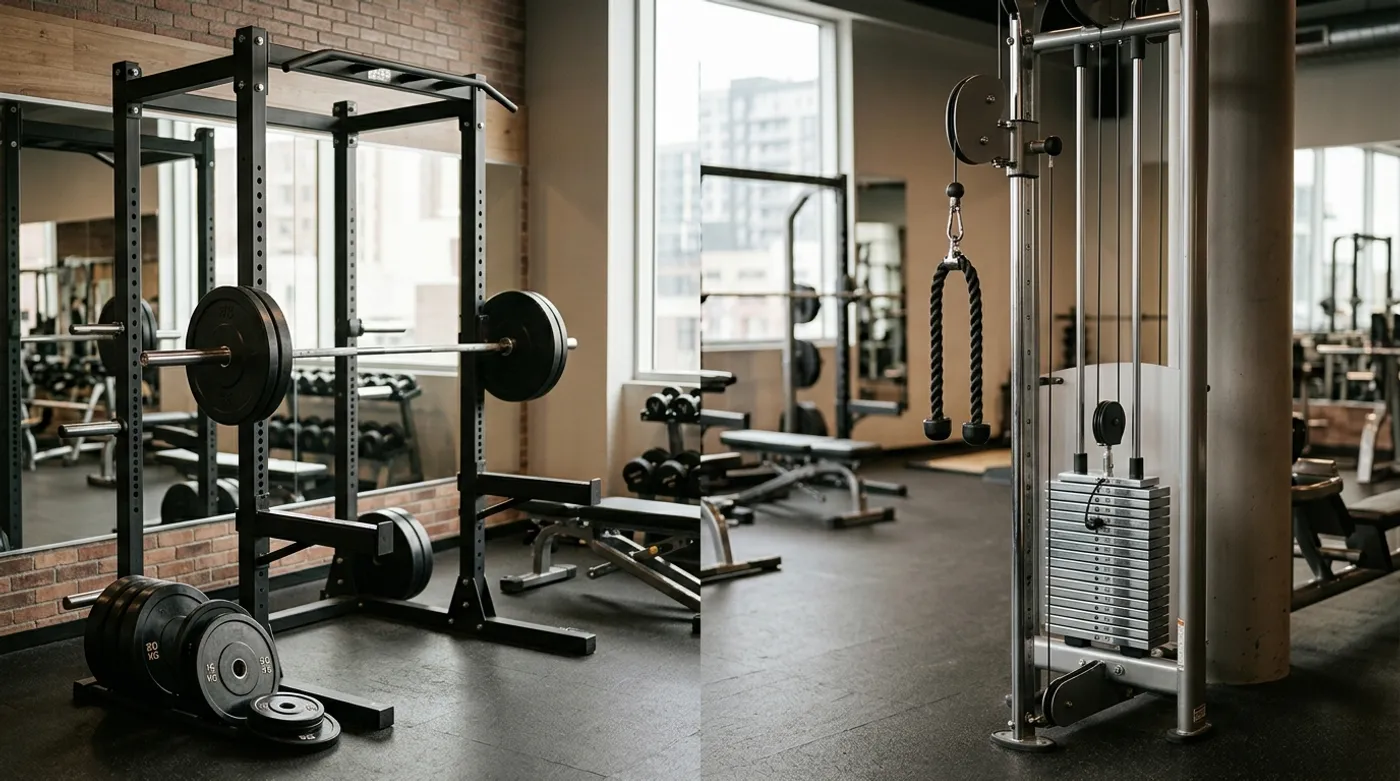
Free weights and machines both build muscle effectively — when total volume and effort are matched, hypertrophy outcomes are comparable. The real difference is what each does best: free weights train stabilizers and transfer to real-world strength, while machines isolate target muscles, simplify form, and let you safely train closer to failure. A smart routine uses both, and the right mix depends on your goals and experience.
There’s no shortage of strong opinions on this. “Real lifters use barbells.” “Machines are for newbies.” Or the inverse — “Machines are safer and more effective.” The truth is less dramatic and more useful: each category has clear strengths, and ignoring either one leaves results on the table.
The Core Difference
A free weight is a load you have to balance and stabilize yourself — barbells, dumbbells, kettlebells. The path of the bar isn’t fixed. You decide where it goes, and dozens of small stabilizer muscles work to keep it there.
A machine moves the load along a guided path — leg press, chest press, lat pulldown, hack squat, cable rows. The machine handles the balance. You just push or pull along the track it gives you.
That single structural difference — fixed path vs. free path — drives almost every other practical difference between the two.
Why Free Weights Are Often the Default
For most lifters, free weights make up the backbone of training, and there are real reasons for that:
- More muscle per rep. A barbell squat trains stabilizers, core, and lower body together. A leg press trains the prime movers and very little else. For total muscle stimulus per minute, the squat wins.
- Better strength transfer. Real-world strength — picking things up, pushing through resistance, holding a position under load — looks more like a free-weight lift than a machine lift.
- Skill carryover. A heavy deadlift teaches you how to brace, breathe, and produce force in a way that nothing else does. That skill compounds over years of training.
- Equipment availability. A rack, a barbell, and some plates cover most of what a serious lifter needs. You don’t need a gym full of specialized machines.
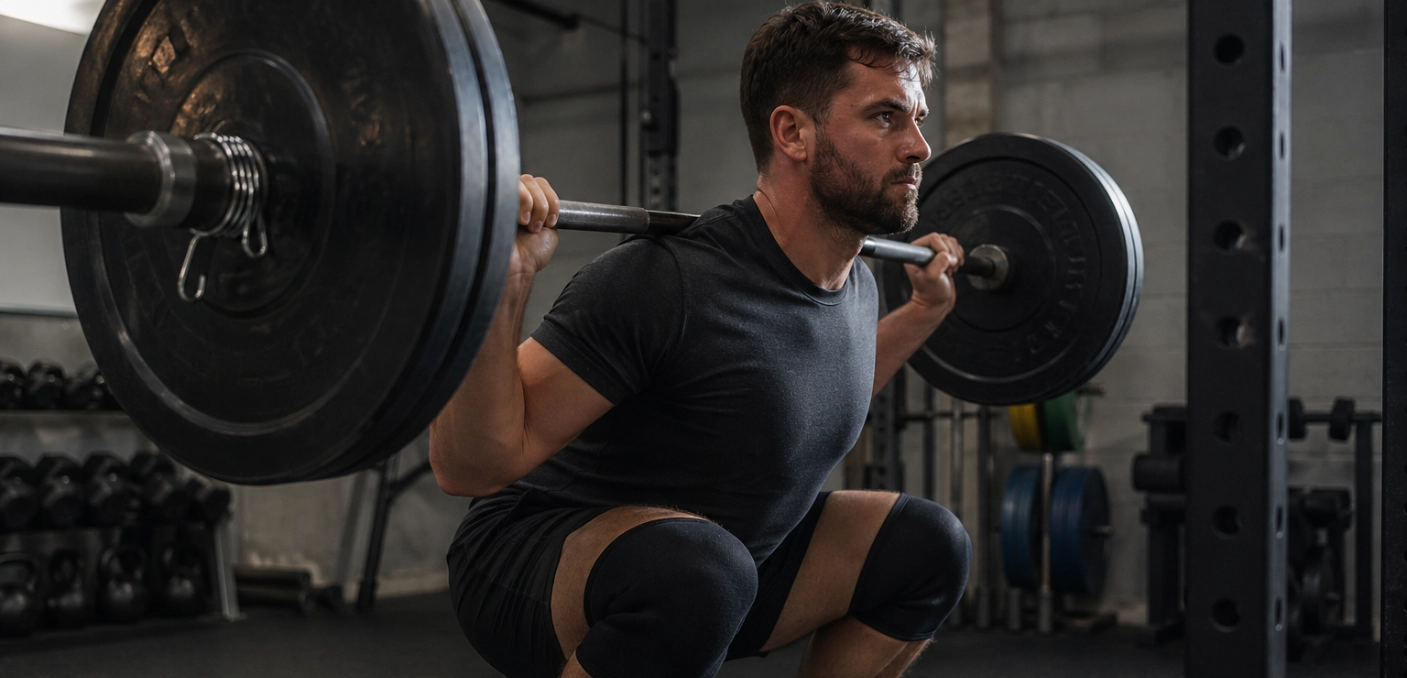 Free weights like the barbell back squat are the most efficient way to load multiple muscle groups in a single rep.
If you only had access to a barbell, a bench, and dumbbells, you could build a great physique. The free-weight side of the room is rarely the wrong place to start.
Where Machines Are Actually Better
Machines aren’t a backup plan — they do specific jobs better than free weights.
1. True isolation. It’s hard to isolate the rear delts with a dumbbell — you end up cheating with momentum or recruiting the lats. A reverse pec-deck removes those options. The target muscle does the work because the machine won’t let it not.
2. Training closer to failure, safely. Pushing a heavy free-weight squat or bench to true failure requires a spotter or safety bars, and even then it’s risky. On a leg press or hack squat, you can grind out the last rep and just rack it. That makes it much easier to use intensity techniques like drop sets or rest-pause without worrying about getting pinned.
3. Targeting weak points. When a specific muscle lags behind, machines are often the cleanest tool for the job. Cable lateral raises stay tense at the top of the rep where dumbbells go slack. A glute kickback machine loads the glutes through a longer effective range than most free-weight options.
4. Lower technical barrier. A new lifter can learn to use a leg press in five minutes. The squat takes months to do well. That’s not a reason to skip the squat — it’s a reason machines are useful while you’re learning the harder lifts.
5. Joint-friendly options. When something hurts — a tweaked shoulder, a cranky hip, a bad knee day — a machine often offers a way to keep training without aggravating it. The fixed path can be exactly what an irritated joint needs.
A Simple Framework: Free Weights First, Machines Second
For most sessions, this structure works:
- Start with your heaviest free-weight compound while you’re freshest. Squat, bench, deadlift, overhead press, row.
- Add a secondary free-weight movement if it fits. Front squat, incline press, RDL.
- Use machines for accessory and isolation work — leg press, chest fly, lat pulldown, lateral raise, leg curl.
- Use machines first if a free-weight version is high-injury-risk for you that day, or if a specific muscle needs targeted work that a free weight can’t provide.
A push session might run: bench press → incline dumbbell press → machine chest fly → cable lateral raise → tricep pushdown. Two free-weight compounds, three machines. That’s a normal, productive session — not a sign you’ve gone soft.
Common Mistakes
Treating it as a moral choice. “I only use free weights” is a constraint, not a virtue. The strongest physiques in any gym were built with both.
Using machines as a way to avoid hard work. Machines make form easier; they don’t make the set easier. If you finish a leg press with three reps in the tank because the seat got uncomfortable, that’s not the machine’s fault.
Free-weighting an isolation movement that wants to be isolated. Cheat-curling a heavy dumbbell to feel hardcore loads everything except the biceps. Use the machine, use a cable, or use stricter form.
Machine-only training for years and never learning the basic lifts. It works at first, but the lack of stabilizer development and skill carryover catches up with most people who stick with it long enough.
Tracking Progress Across Both
One practical issue: progress on free weights and machines doesn’t always look the same.
Free-weight lifts tend to move in clean increments — 2.5 kg jumps on a barbell, weeks of stalling, then a clear new PR. Machine lifts often progress on a different scale — sometimes the next step on the stack is 5 or 7 kg, sometimes the difficulty between two pin positions is huge. Reps and form quality matter as much as load.
The cleanest way to handle this: track every working set the same way — weight, reps, and effort — and judge each exercise against its own past, not against other exercises.
In Steady, free-weight lifts and machine lifts are logged with the same simple flow, and history per exercise stays separate. You can see steady progress on a hack squat without your barbell numbers crowding it out.
The Bottom Line
Free weights and machines aren’t rivals — they’re tools that do different jobs. Free weights build the most stimulus per minute, transfer best to real-world strength, and develop the stabilizers and skills that make you a better lifter. Machines isolate cleanly, let you push closer to failure safely, target weak points, and offer a way to keep training when something hurts.
A routine that uses both honestly will outperform one that picks a side. Lead with free weights for the heavy work, fill in with machines for the focused work, and judge each lift against its own history.
Ready to start applying progressive overload?
Ditch the spreadsheets and complex notes. Join thousands of lifters who use Steady to focus on the workout, track their progress, and automatically know when to add weight.
Download Free for iPhone