How to Build a Leg Day Workout

A good leg day workout should include one main squat or leg-press pattern, one hip-hinge pattern, one single-leg or secondary compound, and one to three isolation exercises for hamstrings, calves, glutes, or weak points. Most lifters do best with 4 to 6 exercises and 12 to 20 hard working sets.
The goal is not to destroy your legs with every machine in the gym. The goal is to train quads, hamstrings, glutes, and calves hard enough to grow while keeping the session repeatable next week.
The Basic Leg Day Formula
Use this structure as your default:
- Main lower-body lift - squat, front squat, hack squat, or leg press
- Hip hinge - Romanian deadlift, stiff-leg deadlift, hip thrust, or good morning
- Secondary compound - lunge, split squat, step-up, extra leg press, or machine squat
- Hamstring isolation - seated or lying leg curl
- Calf work - standing or seated calf raise
- Optional weak-point work - glute medius, adductors, extra quads, or extra hamstrings
That template covers the lower body without turning the workout into a random tour of equipment. You get a knee-dominant movement, a hip-dominant movement, unilateral or secondary volume, and direct work for muscles that compounds often underload.
Start With the Main Lift
Your first exercise should usually be the movement that matters most for the day. For most lifters, that means a squat variation or a heavy leg press.
Choose based on your goal:
- Back squat if you want a big strength-focused compound and tolerate spinal loading well
- Front squat if you want more quad emphasis and a more upright torso
- Hack squat if you want hard quad work with less balance demand
- Leg press if you want heavy lower-body volume without making the session as technically demanding
Do this movement first because it needs the most focus, coordination, and bracing. A hard squat after five accessory exercises is usually just a worse squat.
Add a Hip Hinge
Leg day is not just quad day. If your lower-body training has no hinge pattern, your hamstrings and glutes are probably not getting the work they need.
The most practical hinge for hypertrophy is usually the Romanian deadlift. It trains the hamstrings in a stretched position, loads the glutes, and pairs well with squats or leg press. Hip thrusts are another strong option if you want more direct glute work with less hamstring emphasis.
Keep the hinge honest. If every rep turns into a lower-back extension, reduce the load and control the range of motion.
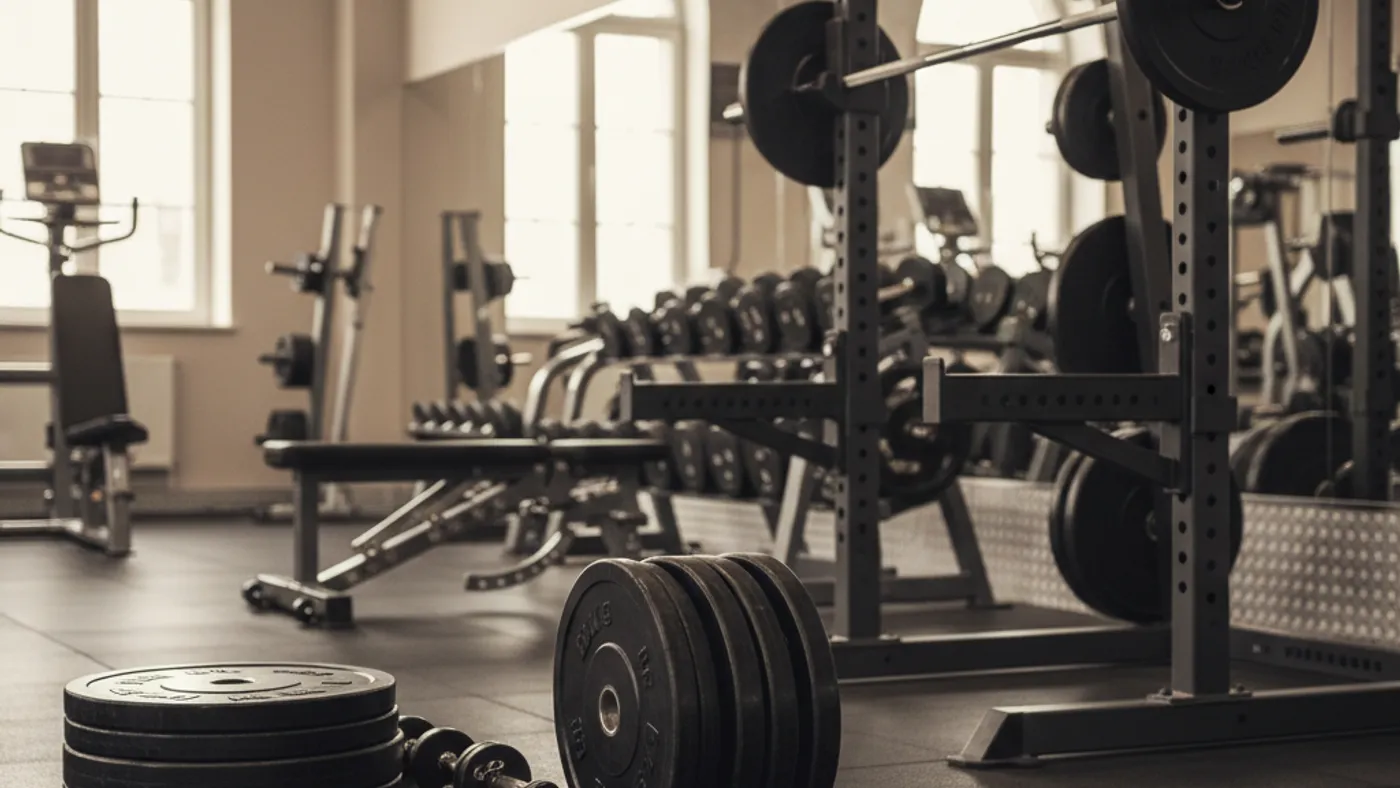 Good leg days are built around a few repeatable lifts, not a new lineup every week.
Use One Secondary Compound
After the main lift and hinge, add one movement that gives you more productive volume without needing the same level of setup.
Good choices:
- Bulgarian split squat
- Walking lunge
- Step-up
- Second leg press angle
- Smith machine squat
- Machine squat
This is where many leg days go too far. You probably do not need squats, leg press, hack squats, lunges, split squats, and extensions all in the same session. Pick the movement that fills the gap.
If your main lift was a squat, a single-leg movement often makes sense. If your main lift was a leg press, a squat pattern or lunge can give you more stability and range. If you are training legs twice per week, rotate the secondary compound between sessions instead of forcing everything into one day.
Finish With Isolation Work
Isolation exercises are not filler. They let you train muscles that big compounds may not hit evenly.
For most lifters, the best finishing work is:
- Leg curls for direct hamstring work
- Calf raises for calves, which rarely get enough stimulus from squats alone
- Leg extensions when quads need extra volume without more systemic fatigue
- Hip abduction or adduction when those muscles are a real weak point or part of your sport demands
Do these with controlled reps and honest range of motion. The point is not to swing a stack for 8 messy reps. The point is to put tension exactly where the compound lifts did not.
How Many Sets Should Leg Day Have?
A solid leg day usually lands between 12 and 20 working sets, depending on your training frequency and recovery.
If you train legs once per week, you may need the higher end:
| Exercise | Sets |
|---|---|
| Back squat | 4 |
| Romanian deadlift | 3 |
| Bulgarian split squat | 3 |
| Leg curl | 3 |
| Calf raise | 4 |
| Leg extension | 2 |
| Total | 19 |
If you train legs twice per week, each session can be tighter:
| Exercise | Sets |
|---|---|
| Leg press | 4 |
| Romanian deadlift | 3 |
| Walking lunge | 2 |
| Leg curl | 3 |
| Calf raise | 3 |
| Total | 15 |
That second version is not easier because it is lazy. It is smarter if you are repeating lower-body work later in the week.
Example Leg Day Workouts
Balanced Leg Day
Use this when you want one lower-body session that covers everything:
- Back squat - 4 sets of 5 to 8
- Romanian deadlift - 3 sets of 6 to 10
- Bulgarian split squat - 3 sets of 8 to 12 per leg
- Seated leg curl - 3 sets of 10 to 15
- Standing calf raise - 4 sets of 8 to 15
Quad-Focused Leg Day
Use this when quads are the priority:
- Front squat or hack squat - 4 sets of 6 to 10
- Leg press - 3 sets of 10 to 15
- Romanian deadlift - 3 sets of 8 to 10
- Leg extension - 3 sets of 12 to 20
- Seated calf raise - 3 sets of 10 to 20
Hamstring and Glute-Focused Leg Day
Use this when posterior-chain work needs more attention:
- Romanian deadlift - 4 sets of 6 to 10
- Hip thrust - 3 sets of 8 to 12
- Reverse lunge - 3 sets of 8 to 12 per leg
- Lying leg curl - 3 sets of 10 to 15
- Calf raise - 3 sets of 10 to 20
Common Leg Day Mistakes
The biggest mistake is doing too much of the same pattern. Three quad-dominant machines in a row may feel productive, but fatigue climbs faster than stimulus. If the third movement is just a worse version of the first two, drop it.
Another mistake is skipping hamstrings because squats “hit everything.” Squats train the lower body hard, but they do not replace direct knee-flexion work like leg curls or hip-hinge work like Romanian deadlifts.
The third mistake is changing exercises every week. Leg training rewards repetition. Keep your main lifts stable long enough to see whether load, reps, control, or range of motion are improving.
How to Track Leg Day in Steady
Leg day is where workout tracking earns its place. The movements are fatiguing, the numbers matter, and small changes in reps or load can disappear from memory by the time next week arrives.
In Steady, build the leg session as a repeatable routine: main lift first, hinge second, secondary compound third, then isolation work. Log sets, reps, weight, and rest so you can see whether your squat, RDL, leg curl, and calf raise are actually moving over time. If a movement needs a technical cue, use notes instead of trying to remember it mid-set.
That keeps the session simple: open the routine, train the plan, adjust based on real performance.
The Bottom Line
A strong leg day does not need twelve exercises. Start with one main lower-body lift, add a hinge, choose one secondary compound, and finish with targeted isolation work. Train hard, repeat the structure, and progress the lifts over time.
That is how leg day becomes a program instead of a punishment.
Ready to start applying progressive overload?
Ditch the spreadsheets and complex notes. Join thousands of lifters who use Steady to focus on the workout, track their progress, and automatically know when to add weight.
Download Free for iPhone