How to Build an Arm Workout
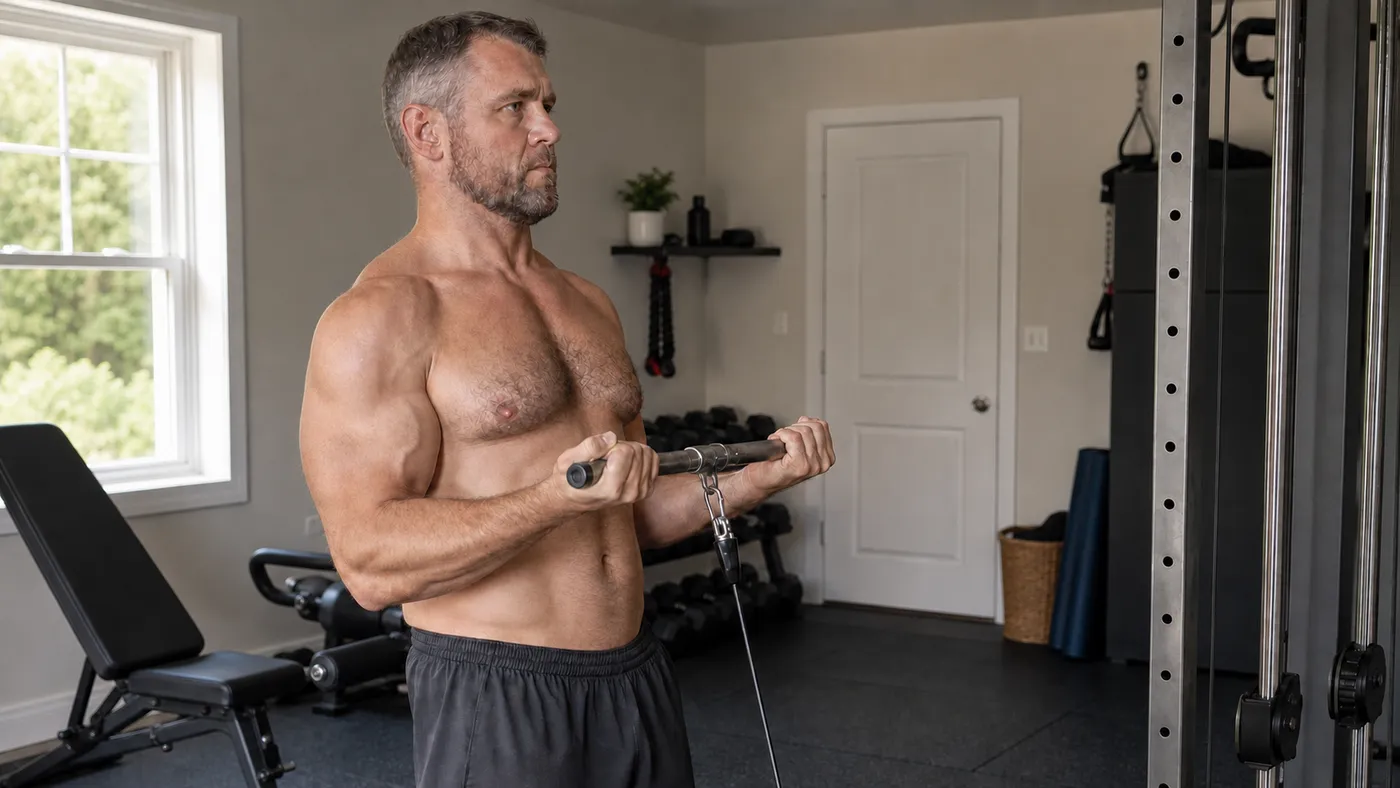
An effective arm workout needs at least one curl with your arms beside your torso, one curl with a different shoulder position, one triceps pressdown, and one overhead triceps extension. For most lifters, 4 to 6 exercises and 10 to 16 total working sets are enough for a focused session.
The goal is not to collect every curl variation in the gym. It is to train the biceps and triceps through complementary positions, use stable exercises you can progress, and stop before elbow discomfort or low-quality reps take over.
Start With a Balanced Arm Workout Structure
Use this simple order as your default:
- Heavier biceps movement — standing cable curl, EZ-bar curl, or dumbbell curl
- Heavier triceps movement — cable pressdown, close-grip bench press, or assisted dip
- Lengthened-position biceps movement — incline dumbbell curl or behind-the-body cable curl
- Overhead triceps movement — cable or dumbbell overhead extension
- Optional biceps finisher — preacher curl, hammer curl, or machine curl
- Optional triceps finisher — single-arm pressdown or machine extension
This structure gives both muscle groups an early exercise while you are fresh, then changes the joint position to cover what the first movements miss. You do not need six exercises every time. Four well-executed movements can be a complete arm workout.
Train Biceps in More Than One Position
The biceps flex the elbow, but curl variations do not all load the arm in the same way. Your shoulder position changes where the exercise feels hardest and how the biceps are challenged.
A practical pairing is:
- Standing cable or EZ-bar curl with the upper arm close to your side
- Incline dumbbell curl with the upper arm slightly behind your torso
The first movement is stable and easy to progress. The second puts the biceps under tension in a more lengthened position. If incline curls bother your shoulders, use a behind-the-body cable curl and control the stretch rather than forcing more range.
Add hammer curls when you want more work for the brachialis and forearms. They are useful, but they should complement regular curls rather than replace every supinated, palms-up curl in the workout.
Give Triceps Both Pressdown and Overhead Work
The triceps make up most of the upper arm, so an arm day built around five curls and one pressdown is not balanced. Include one exercise with your elbows near your sides and one with your arms overhead.
Cable pressdowns are a strong first choice because they are stable, easy to adjust, and usually friendly to the elbows. Use a straight bar, angled bar, or rope based on comfort; the attachment matters less than keeping your upper arms controlled and finishing each rep without turning it into a full-body movement.
Follow with an overhead cable extension or dumbbell extension. The overhead position places the long head of the triceps in a more lengthened position, giving the exercise a different role from pressdowns. Start lighter than you think, keep the motion smooth, and avoid chasing depth that makes the elbow or shoulder feel pinched.
Alternate Biceps and Triceps to Save Time
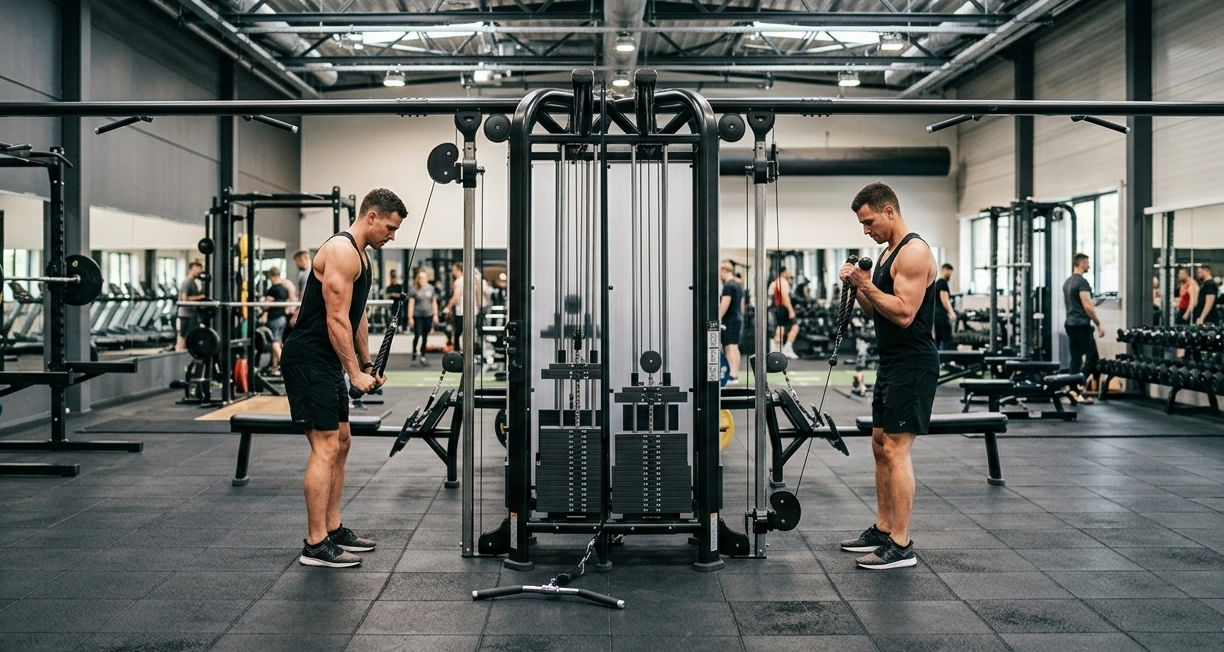 Pairing opposing arm exercises keeps the session moving without asking the same muscle to work again immediately.
Arm workouts are well suited to alternating sets. Perform one biceps exercise, rest briefly, perform one triceps exercise, then rest before returning to the curl. Because the two movements train opposing muscle groups, this setup usually preserves performance better than pairing two curls together.
For example:
- Cable curl — 3 sets of 8–12 reps
- Rope pressdown — 3 sets of 8–12 reps
- Incline dumbbell curl — 3 sets of 10–15 reps
- Overhead cable extension — 3 sets of 10–15 reps
Alternate exercises 1 and 2, then exercises 3 and 4. Keep enough rest that the second half of each pair does not become rushed. A superset is a scheduling tool, not a reason to turn strength training into cardio. For more detail, see what a superset is and how to use one.
How Many Sets Should You Do for Arms?
Start with 6 to 10 direct weekly sets for biceps and 6 to 10 for triceps, then count the indirect work they receive from the rest of your program. Rows and pulldowns train the elbow flexors; presses and dips train the triceps.
If you already run a demanding push/pull/legs or upper/lower program, one short arm session may only need 6 direct sets per muscle. If your main workouts contain little direct arm work, the focused session can provide more. Add volume only when your elbows feel good, your reps remain controlled, and performance is stable or improving.
More soreness is not proof that you found the perfect dose. The useful dose is the amount you can recover from and progress.
Two Arm Workout Examples
Efficient 30-Minute Arm Workout
- Cable curl — 3 sets of 8–12 reps
- Rope pressdown — 3 sets of 8–12 reps
- Incline dumbbell curl — 2 sets of 10–15 reps
- Overhead cable extension — 2 sets of 10–15 reps
Alternate each biceps exercise with the triceps exercise below it. This gives you 5 direct sets per muscle without unnecessary setup changes.
Higher-Volume Arm Workout
- EZ-bar curl — 3 sets of 6–10 reps
- Cable pressdown — 3 sets of 8–12 reps
- Incline dumbbell curl — 3 sets of 10–15 reps
- Overhead cable extension — 3 sets of 10–15 reps
- Hammer curl — 2 sets of 10–15 reps
- Single-arm pressdown — 2 sets of 12–20 reps
Use the higher-volume version only when it fits your weekly program. Sixteen direct arm sets on top of heavy pulling and pressing can be excessive for someone whose arms already receive plenty of work.
Common Arm Workout Mistakes
The first mistake is using momentum to move a load your elbows cannot control. Some body movement on a final hard rep is not a disaster, but every rep should not begin with a hip swing.
The second is changing exercises constantly. Keep a few main curls and extensions stable long enough to improve reps, load, or control. Variation is useful when it changes the training position or solves discomfort—not when it prevents comparison.
The third is ignoring joint feedback. Arm isolation work creates a lot of repeated elbow movement. If discomfort builds, reduce volume, review technique, and choose a cable or handle that lets your wrists and elbows move comfortably.
Track the Small Progressions
Arm exercises often progress in small steps: one extra rep, a cleaner set, or the next cable-stack increment. Those changes are easy to forget when the workout contains several similar movements.
Build the session as a repeatable routine in Steady, log the actual reps and loads, and compare each exercise with the previous workout. Keep the plan focused, make one progression at a time, and let several weeks of performance—not one dramatic pump—tell you whether the arm workout is working.
Ready to start applying progressive overload?
Ditch the spreadsheets and complex notes. Join thousands of lifters who use Steady to focus on the workout, track their progress, and automatically know when to add weight.
Download Free for iPhone