How to Choose Your Next Workout Targets
Your next workout targets should be based on what you actually performed, how repeatable that performance was, and whether you want the routine to change automatically or stay under manual control. In Steady, that choice lives in Default Next Target: Smart Progression, Repeat last performance, or Keep routine unchanged.
That sounds small, but it changes how consistent your training feels.
A lot of lifters finish a session, close the app, and assume the next workout will somehow make sense. Then next week arrives and the question comes back: should this exercise go up, repeat what you just did, or stay exactly as written? Steady 2.9 makes that an explicit default instead of a decision you have to remake after every session.
The best answer depends on the exercise, the quality of the session, and the kind of progression system you are trying to run.
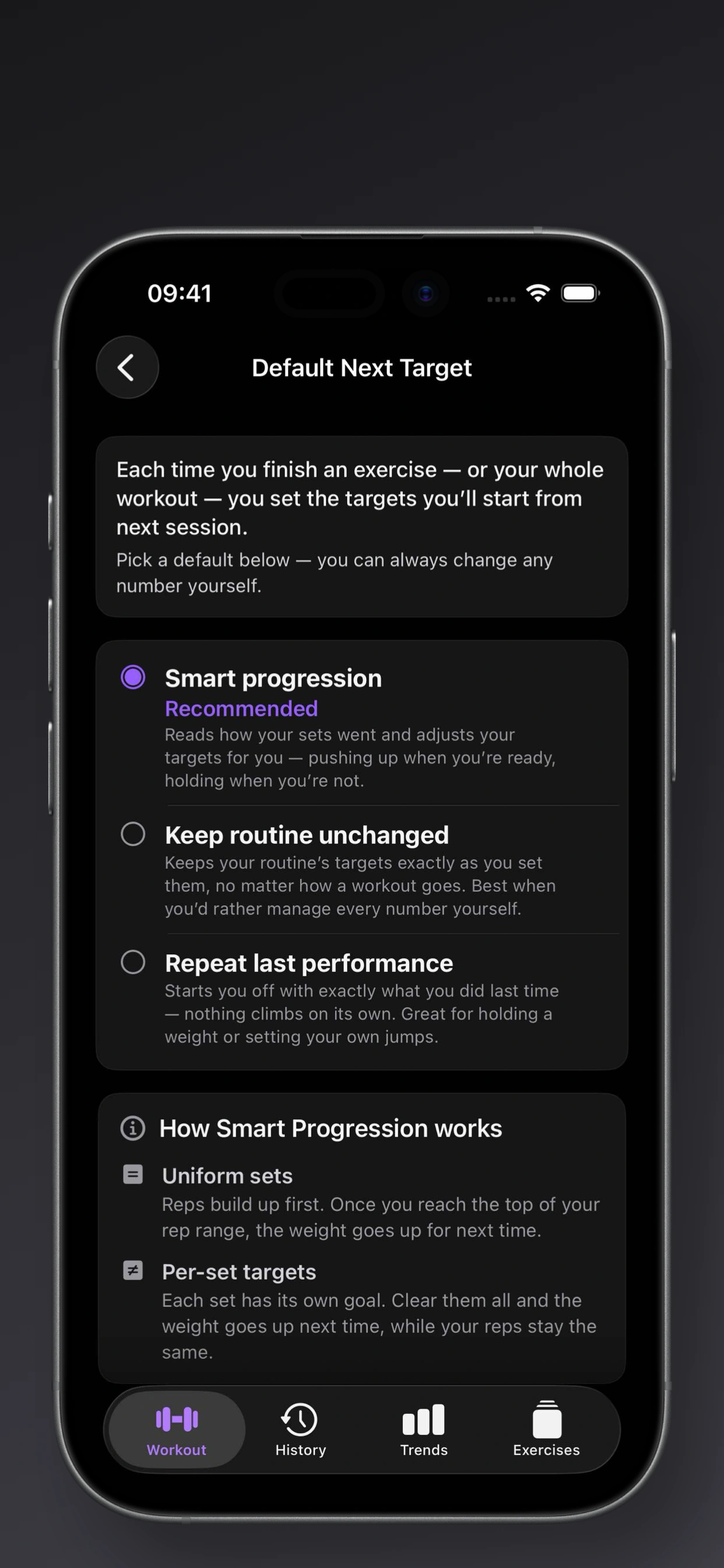 Default Next Target lets you choose the normal behavior, while still leaving room to change individual targets yourself.
The important part is that this is a default, not a trap. Steady frames next targets as the numbers you will start from next session, and you can still change any number yourself when the situation calls for it. For Pro users, Smart Progression is the recommended automatic option. Repeat last performance starts next time from what you logged. Keep routine unchanged leaves the routine’s targets exactly as you set them.
What a next workout target actually is
A next workout target is the planned weight, reps, duration, or set structure you want to start from the next time you perform the exercise.
It is not the same thing as your all-time best. It is not always the heaviest thing you touched today. It is the next practical starting point.
For example, if your dumbbell bench press target was 3 sets of 8 to 10 and you logged:
- 30 kg x 10
- 30 kg x 10
- 30 kg x 9
your next target might be to repeat 30 kg and finish the last set at 10. If you logged 10, 10, 10 with solid form, your next target might be a small weight increase. If you logged 8, 7, 6 on a bad sleep day, the right target might be to repeat rather than punish the routine.
The goal is not to make every workout look more aggressive. The goal is to make the next workout clear enough that you can train instead of negotiating with yourself between sets.
The three useful ways to handle next targets
Most lifters need one of three workflows.
1. Smart progression
Smart progression is best when you want the routine to update from your performance data. If you hit the target with room to move forward, the next target can climb. If you miss the target or the session does not justify a jump, it can hold steady.
This works especially well for repeatable exercises with clear rep ranges, such as presses, rows, pulldowns, leg presses, curls, and lateral raises.
Use it when:
- the exercise has a stable progression rule
- you log sets accurately
- you want less manual decision-making after every workout
- you still want to review the recommendation before accepting it
Smart progression is not a replacement for judgment. A messy session, a rushed warm-up, a painful rep, or a one-off equipment change can still make you override the suggestion.
2. Repeat last performance
Repeat last performance is best when today’s workout should become the next plan.
This is useful when you are holding a weight, rebuilding after a break, learning a new exercise, or intentionally making small manual jumps. Instead of asking the routine to climb automatically, you start next time from what you actually proved today.
Use it when:
- you want a conservative next session
- you are stabilizing technique
- you are returning after time off
- today’s performance is a better reference than the old written target
This option can feel boring in the best way. You do the work, carry it forward, and only push when you choose to.
3. Keep routine unchanged
Keep routine unchanged is best when the routine is the plan and the workout log is just the record.
This fits lifters who want to manage every number manually, follow a coach-written program, or run a block where the targets are already planned in advance. A single session should not rewrite the routine if the program has its own logic.
Use it when:
- your program already dictates the next step
- you want the log to preserve performance without editing the routine
- you are testing a workout rather than evolving it
- you prefer manual control over automatic updates
Keeping the routine unchanged is not less serious. It is just a more deliberate workflow.
Match the method to the set structure
The next-target decision also depends on whether the exercise uses uniform targets or per-set targets.
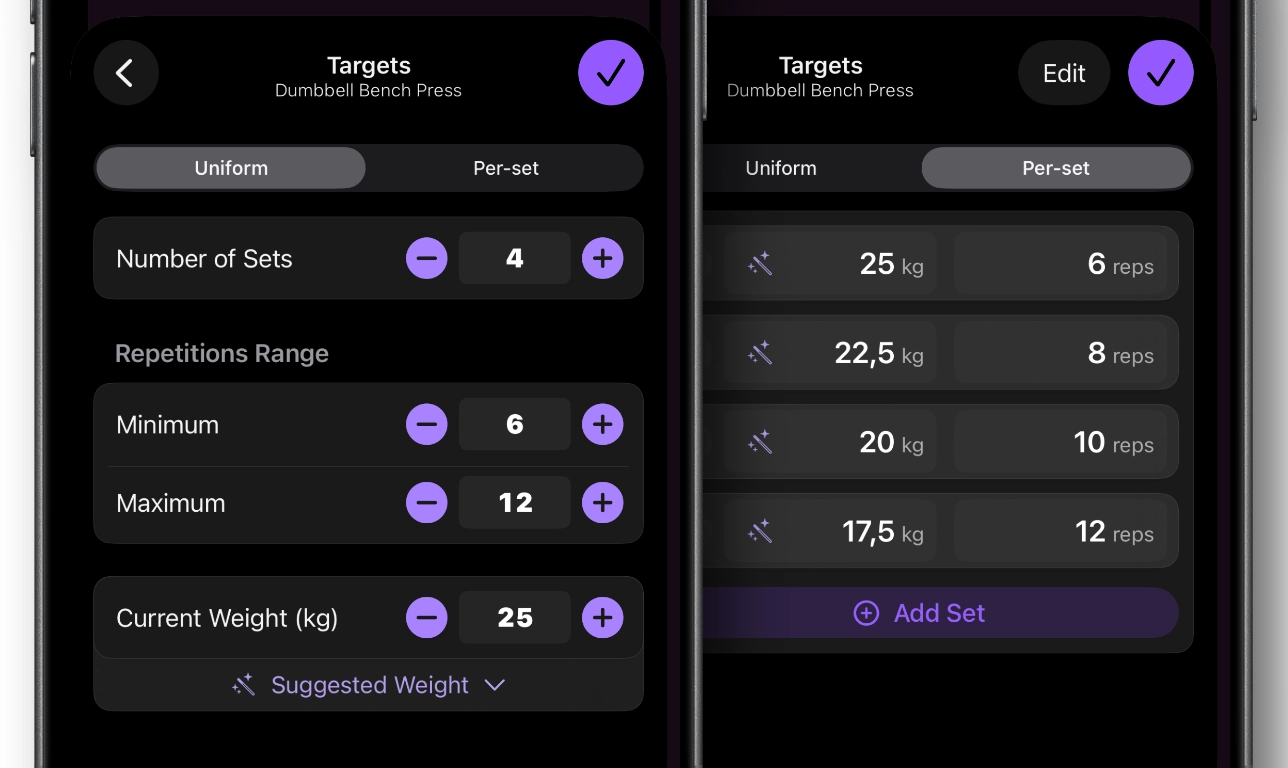 The more specific the set structure is, the more important it becomes to preserve what each set was meant to do.
Uniform targets are simple. If every working set has the same weight and rep range, progression is usually easier to read as one shared pattern: build reps, then add weight when the top of the range is earned.
Per-set targets are more specific. A top set, back-off sets, a ramping pattern, or different set goals should not always be averaged into one generic target. In those cases, the next target may need to preserve the role of each set.
That is why a good target workflow should understand both structures:
- with uniform sets, repeating the average or applying one progression rule can make sense
- with per-set targets, carrying forward exact set-by-set performance may be more useful
- with a coach-written plan, keeping the routine unchanged may be the cleanest choice
If you want the deeper comparison, read Per-Set Targets vs Uniform Targets.
How to choose the right default
Start with the method that matches how you actually train.
This is useful because not every exercise deserves the same behavior. A stable machine row might work well with Smart Progression. A new Bulgarian split squat might be better with Repeat last performance while you dial in balance and range of motion. A coached squat block might belong on Keep routine unchanged because the plan already decides next week.
Choose Smart Progression if your main goal is progressive overload with less manual math. It works best when you repeat exercises, log complete sets, and want the next target to respond to performance.
Choose Repeat last performance if you want your routine to stay close to reality without automatically pushing harder. This is a strong default for lifters who prefer to make their own jumps but still want the next session to reflect what happened last time.
Choose Keep routine unchanged if your written program matters more than the last session. This is the right choice when you are following outside programming, testing a routine, or intentionally separating the plan from the log.
If you are unsure, ask one question:
Should today’s performance rewrite the next workout?
If yes, use Smart Progression or Repeat last performance. If no, keep the routine unchanged.
Common mistakes
Treating every good day as a reason to increase weight. One strong workout is useful data, but it is not always a new baseline. If everything lined up perfectly today, repeating once can be smarter than jumping.
Ignoring bad-session context. A poor workout after bad sleep, travel, illness, or a skipped meal may not mean the target is wrong. It may mean the day was wrong.
Using manual control but never reviewing history. If you keep the routine unchanged, you still need to look at the log. Manual progression works only when you actually make manual decisions.
Letting the app decide when the inputs are messy. Smart tools depend on clean data. If you logged partial reps as full reps, skipped RPE, changed the exercise setup, or used a different machine, review the recommendation before accepting it.
Make the next workout obvious
Good training does not require you to make dramatic changes every session. It requires the next step to be clear.
Sometimes that means increasing the target. Sometimes it means repeating what you just proved. Sometimes it means leaving the routine alone because the plan already has structure.
Steady’s Default Next Target setting exists for that exact decision. Pick the default that matches your training style, log the session honestly, then let the next workout start from a number you can trust.
Ready to start applying progressive overload?
Ditch the spreadsheets and complex notes. Join thousands of lifters who use Steady to focus on the workout, track their progress, and automatically know when to add weight.
Download Free for iPhone