Per-Set Targets vs Uniform Targets: Which Method Is Better for Gym Progress?
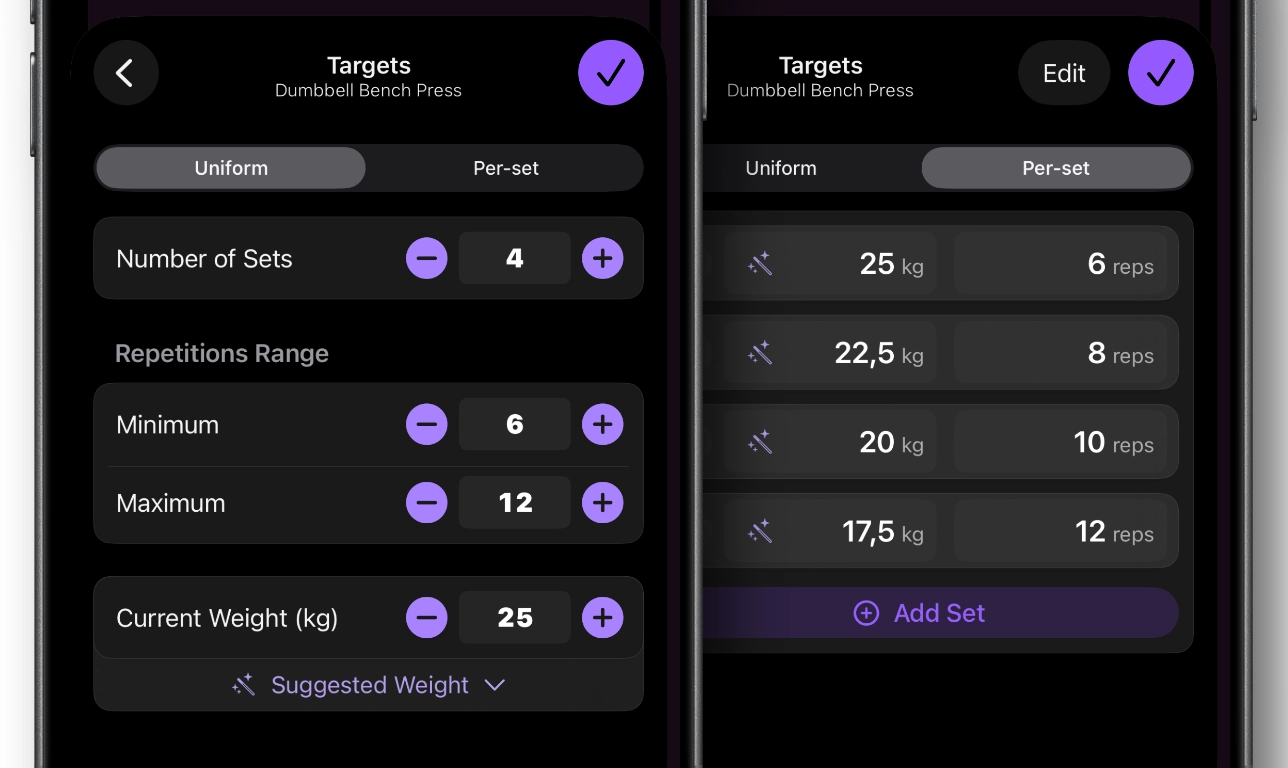
Uniform targets and per-set targets can both work well for gym progress, but they create slightly different progression patterns. Uniform targets usually create one shared target across the exercise, while per-set targets let each set keep its own role. Neither method is automatically superior. The more useful choice is the one that matches the exercise, keeps your logging clear, and makes the next workout easier to understand.
That distinction matters more than many people realize.
A lot of lifters know they should track exercises, sets, reps, and weight. But once they start organizing a routine, a more specific question shows up:
Should every work set have the same target, or should each set have its own target?
This is where many programs start to feel confusing.
Some workouts are written as 3 sets of 8. Others are written more like 10, 8, 8 or 6, 8, 10. Some apps make you use the same target on every set. Others let you define per-set targets and rep ranges separately.
If you are trying to improve strength or build muscle, the important part is not choosing the method that looks more advanced. It is choosing the one that helps you progress more clearly in real training.
Short definitions
Before comparing them, a few terms help.
- Uniform targets: the same target values across all work sets, such as 3 sets of 8 or 3 sets of 5 with the same planned weight and reps for every set.
- Per-set targets: different rep targets or ranges assigned to specific sets, such as 10, 8, 8 or one heavy top set followed by lighter back-off sets.
- Progression rule: the rule you use to decide whether to add reps, add weight, or repeat the same load next time.
- Fatigue management: organizing training so later sets still make sense as performance drops during the workout.
- Workout history: the record of what you actually did in past sessions.
If you want the larger progression context first, read What Is Progressive Overload? and How to Track Progressive Overload Properly Without Using Spreadsheets.
What uniform targets do well
Uniform targets are popular for a reason.
They are easy to understand, easy to repeat, and easy to compare across sessions. If you write 3 sets of 8 for an exercise, the goal is immediately obvious. You know what you are trying to do, and next time you can quickly compare whether you matched or beat the last session.
That simplicity creates a few real advantages:
- progression decisions are easier to make
- workout logging stays cleaner
- performance comparisons are more straightforward
- beginners usually learn the system faster
- routines are easier to reuse week after week
This is why uniform targets work especially well for people who are still building consistency. If your main struggle is remembering what to do, a simple target structure usually helps more than a highly customized one.
They also fit well with a clean gym log app, because repeating a past workout becomes much more obvious when the target pattern stays stable.
What per-set targets do well
Per-set targets are useful when one repeated target does not reflect how the exercise is actually supposed to feel.
For example, some movements are programmed with:
- a harder first set and slightly lower later targets
- a top set followed by back-off sets
- different rep goals based on fatigue
- slightly different goals for technique or control
In those cases, forcing the same target onto every set can make the workout less realistic. The first set may be too easy, or the last set may look like a failure even when the workout went exactly as intended.
Per-set targets can help because they:
- make expected fatigue more explicit
- fit top-set and back-off structures better
- allow more exercise-specific programming
- create clearer intent for each set
- reduce the feeling that every rep drop is a mistake
This can be especially helpful for intermediate lifters who already understand basic progression and want a little more nuance without turning the workout into math homework.
How progressive overload interacts with each method
Progressive overload does not disappear when you switch from one method to the other. What changes is how progress tends to show up and how easy it is to interpret.
With uniform targets, overload is usually easier to read as one shared progression path for the whole exercise.
That often looks like:
- keeping the same load while building reps inside a target range
- reaching the top of the range across the work sets
- increasing weight
- building reps again from the lower end of the range
If you use an app like Steady, this structure works especially cleanly with rep ranges such as 8 to 12, because the app can keep the target values uniform across the sets and make the next step easier to review. In practice, this creates a progression rhythm where some sessions are more rep-focused and others become relatively more load-focused as the weight climbs again. On a chart, that often looks less like a straight line and more like an upward-trending wave.
With per-set targets, overload is usually more set-specific.
That means progress may show up like this:
- the first set moves up before later sets do
- a top set changes while back-off sets stay stable
- different sets get adjusted because they have different jobs
- the whole exercise becomes more aligned with what you actually performed
This matters because per-set targets are often not trying to force identical progression across every set. They are trying to preserve the role of each set while still moving the exercise forward over time.
In Steady, that can make per-set targets useful when you want progression to reflect the real structure of the workout instead of flattening everything into one repeated target. The result may look less like a single wave and more like a set-by-set progression pattern, where different parts of the exercise move at slightly different times.
The important point is not that one method progresses “better.” It is that they express progressive overload differently:
- uniform targets tend to make overload easier to read as one shared progression loop
- per-set targets tend to make overload more specific to the role of each set
 Per-set targets let you ramp the load across the working sets — same exercise, three different prescriptions.
Which method is better for gym progress?
Neither method is better in every case.
And clarity matters a lot.
A progression method is only useful if it helps you answer practical questions like:
- what am I trying to beat today?
- what counts as a successful session?
- when should I increase weight?
- what should the next workout look like?
Uniform targets often answer those questions through one shared rule across the exercise. Per-set targets often answer them by making the role of each set more explicit.
If you want the shortest possible version:
- use uniform targets when you want the same target values repeated across the exercise
- use per-set targets when the structure of the lift genuinely changes from set to set
That is the practical answer.
When uniform targets tend to fit well
Uniform targets tend to fit well when:
- you are a beginner
- you want fast workout logging
- the exercise is stable and repeatable
- you want clearer overload decisions
- you do not need different set roles inside the exercise
A lot of hypertrophy training fits this well.
For example, if you are doing a machine chest press for 3 sets of 8 to 10, a uniform rep range is usually enough. You can build reps across sessions, then increase load when you own the top of the range. That keeps the rule clear and easy to repeat.
This is also why uniform targets pair naturally with articles like How to Know When to Increase Weight, Reps, or Both. The decision rule is simpler because the target is unified.
When per-set targets tend to fit well
Per-set targets tend to fit well when:
- the first set is meant to be heavier or more demanding than later sets
- you are intentionally using top sets and back-off work
- the exercise becomes less stable as fatigue builds
- you want different set goals inside the same exercise
- a repeated uniform target hides the actual intent of the workout
For example, imagine a dumbbell shoulder press written like this:
- Set 1: 8 reps
- Set 2: 8 reps
- Set 3: 6 reps
That does not automatically mean the third set is “worse.” It may simply reflect planned fatigue. If the workout is designed that way, a per-set setup makes the expectation visible from the start.
This can also help if you want your progressive overload app or training log to reflect the workout more honestly instead of pretending every set should look identical.
Practical steps for choosing between per-set and uniform targets
Here is the simplest way to decide which method to use.
Step 1: Start with the exercise, not the app
Do not choose the structure just because a template, spreadsheet, or app makes one option easier.
Start by asking:
- is this exercise stable enough that the same target makes sense on every set?
- or does the set role change as fatigue builds?
Many machine and accessory lifts do well with uniform targets. More customized structures often benefit from per-set targets.
Step 2: Choose the clearest progression rule
Your target structure should make progression easier to judge, not harder.
Ask:
- will I know exactly what counts as improvement next time?
- can I tell when I earned more weight?
- can I compare this session to the last one quickly?
If one method makes those answers cleaner for that exercise, it is probably the more appropriate setup.
Step 3: Keep the workout readable during the session
This part matters more than people think.
If the target structure is too messy to read between sets, your logging will get worse. This is one reason some people move away from generic notes and toward a distraction-free workout tracker. The goal is not complexity. The goal is useful clarity in the moment you are training.
Step 4: Use the same method long enough to evaluate it
Do not switch every week because a different setup looks smarter.
Use the chosen structure long enough to answer:
- does it make the workout easier to run?
- does it make progress easier to see?
- does it help me make the next-session decision faster?
If the answer is no, simplify.
Step 5: Review the history after the workout
After a few sessions, look back at the actual training history.
If the log keeps producing confusion about what success looks like, the structure is probably not helping. This is also where How to Repeat a Past Workout and Progress More Consistently becomes useful. A good setup should make repeating the workout feel cleaner, not more complicated.
Examples
Here are a few practical examples of how each method works.
Example 1: uniform target for a stable hypertrophy exercise
Exercise: Leg Press
Target:
- 3 sets of 10
Session 1:
- 160 kg x 10
- 160 kg x 10
- 160 kg x 9
Session 2:
- 160 kg x 10
- 160 kg x 10
- 160 kg x 10
This is a good fit for uniform targets because the progression rule is obvious. Once the target is fully owned, load can go up.
Example 2: uniform rep range for simple double progression
Exercise: Lat Pulldown
Target:
- 3 sets of 8 to 10
Session 1:
- 50 kg x 10
- 50 kg x 9
- 50 kg x 8
Session 2:
- 50 kg x 10
- 50 kg x 10
- 50 kg x 9
Again, the benefit is clarity. You do not need each set to have a different target if the job of the workout is simply to build reps and then increase weight.
Example 3: per-set targets for expected fatigue
Exercise: Dumbbell Shoulder Press
Target:
- Set 1: 10 reps
- Set 2: 8 reps
- Set 3: 8 reps
Session 1:
- 22 kg x 10
- 22 kg x 8
- 22 kg x 7
Session 2:
- 22 kg x 10
- 22 kg x 8
- 22 kg x 8
This is a good fit for per-set targets because the workout already assumes a specific fatigue pattern. The session still has a clear goal, but the target is more realistic than pretending all three sets should look the same.
Example 4: top set and back-off structure
Exercise: Barbell Row
Target:
- Set 1: 6 reps heavy
- Set 2: 8 reps lighter
- Set 3: 8 reps lighter
This is a classic case where per-set targets communicate intent better than one repeated target. The sets have different jobs, so the structure should show that clearly.
Common mistakes
1. Assuming the more detailed method is automatically better
More detail is only useful if it improves decisions. If it just makes the workout harder to read, it is not helping.
2. Using per-set targets for every exercise without a reason
If a simple 3 x 8 to 10 works perfectly well, adding a different target to every set can create complexity without benefit.
3. Using uniform targets when the exercise clearly has different set roles
If the first set is intentionally heavier and later sets are intentionally different, a repeated target may hide the actual plan.
4. Changing methods too often
If you keep switching between uniform and per-set setups, the history becomes harder to interpret and progression becomes less clear.
5. Forgetting that logging clarity matters
The best target structure is not the one that looks smartest on paper. It is the one you can actually follow, log, and review consistently during real training.
Who this is for
This article is especially useful for:
- beginners deciding how to structure their first real workout log
- intermediate lifters comparing simple rep ranges against more customized set targets
- people trying to make progression decisions more obvious
- anyone building routines in a workout app and wondering how detailed the targets should be
- lifters who want training structure without unnecessary complexity
Conclusion
If you want the practical answer, uniform targets are useful when you want one shared progression path across the exercise, and per-set targets are useful when different sets have different jobs and you want that structure to stay visible.
The goal is not to choose the method that looks more advanced. The goal is to choose the one that makes your next workout clearer. If you want a tool that supports both simple logging and more nuanced progression, Steady is built for that kind of training: clear history, fast logging, rep ranges, per-set control, and progression support without unnecessary clutter.
If you want to explore that workflow further, start with the Gym Log App for iPhone, the Progressive Overload App, and How to Track Progressive Overload Properly Without Using Spreadsheets.
Ready to start applying progressive overload?
Ditch the spreadsheets and complex notes. Join thousands of lifters who use Steady to focus on the workout, track their progress, and automatically know when to add weight.
Download Free for iPhone