How to Order Exercises in a Workout

Put the exercise you most want to improve near the start of your workout, after warming up. Then arrange the remaining work so fatigue from one movement does not unnecessarily limit the next. Compound lifts often come early and isolation work later, but your goal matters more than a rigid equipment hierarchy.
Exercise order is how you allocate your freshest effort. If the same movement always gets the final ten rushed minutes, it has a different place in your training than the one you consistently tackle first.
You can improve the sequence without adding exercises, changing your split, or making every session longer.
Start with the result you want to protect
Before rearranging your routine, finish this sentence: “The most important work in this session is…”
Be specific. Improving your main press, giving a pulling movement your best effort, and completing a balanced maintenance session are different priorities. They do not all require the same opening exercise.
A systematic review and meta-analysis by Nunes and colleagues found that strength gains tended to favor exercises performed earlier in the session. It found no significant overall effect of order on hypertrophy. That supports prioritizing important lifts early, without treating one sequence as a proven shortcut to muscle growth.
For a strength-focused session, put the lift whose performance matters most first. For general muscle building, consider which muscle or movement keeps getting squeezed out. Giving it an earlier slot can make the workout easier to execute consistently; it does not guarantee extra growth.
If you are still deciding what belongs in the routine, start with how to choose exercises for a workout. Sequencing works best once each exercise already has a purpose.
Use compound-first as a starting point
Multi-joint exercises often deserve an early position because they involve several muscles and can be demanding to perform when tired. Smaller, more targeted movements are often easier to place later.
But “compound first” is a useful default, not a requirement to put every barbell before every machine. A machine press can be your priority lift. A heavy row may matter more to your current goal than another free-weight exercise.
Also separate warm-up work from working sets. A light preparatory movement is not the same as several challenging sets that tire a muscle before your main lift. Keep the preparation useful without accidentally turning it into the hardest part of the session.
Look for fatigue that carries into the next exercise
Read your planned sequence in pairs. Ask what might be tired when you start the second movement.
- Hard curls before pulling work can leave your elbow flexors less fresh.
- Triceps work before pressing can change your pressing performance.
- Demanding unsupported pulling before another exercise that needs sustained trunk effort can make the second movement harder to manage.
These combinations are not automatically wrong. They need a reason. If the second exercise is the priority, reverse the pair or put less-overlapping work between them.
Alternating upper- and lower-body work, or pushing and pulling, can sometimes help you distribute local fatigue. You still need appropriate rest. Rearranging the list does not make a demanding session fatigue-free.
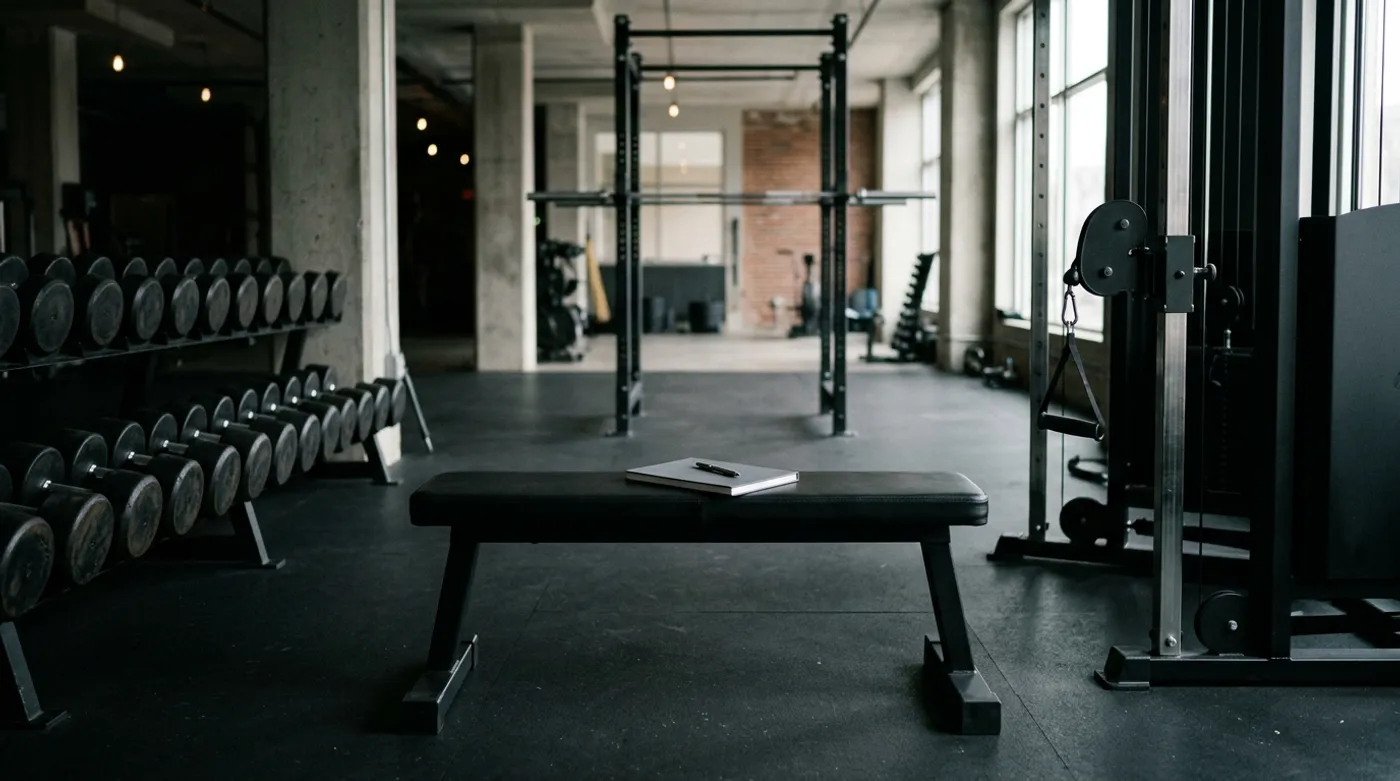 Accessories can occupy later slots without becoming an afterthought: leave enough time to complete the work you planned.
Reorder the same workout for different priorities
Here is an illustrative upper-body session. The exercise list stays the same; the opening priority changes.
| Slot | Pressing strength is the priority | Rowing strength is the priority |
|---|---|---|
| 1 | Chest press | Chest-supported row |
| 2 | Chest-supported row | Chest press |
| 3 | Lat pulldown | Lat pulldown |
| 4 | Lateral raise | Lateral raise |
| 5 | Triceps extension | Triceps extension |
This is a sequencing example, not a complete program prescription. Your sets, effort, frequency, and recovery still need to fit your training.
If two lifts both matter, you can give each the first slot on different training days. You do not need to keep promoting one by permanently demoting the other.
Have a plan for occupied equipment
A busy gym will sometimes decide your next station. Protect the priority where practical, then be flexible with lower-priority work.
If your main station is occupied, ask whether you can wait briefly, use an appropriate alternative, or move an accessory that will not heavily fatigue the muscles you need next. Doing several hard accessory sets just to fill the wait may change the session more than you intended.
When you do change the order, interpret the numbers in context. Fewer reps on an exercise moved from first to fourth do not, by themselves, show that you lost strength.
Give the sequence time to show a pattern
Keep the order reasonably stable for several comparable sessions. Review whether your priority work is progressing, whether later exercises remain productive, and whether you finish without repeatedly dropping the same accessory.
Change one part of the sequence when a pattern gives you a reason. Constant reshuffling makes it harder to tell whether the new order helped.
Use Steady to record your loads and reps as you test the arrangement. A useful exercise order gives your important work enough attention and leaves you with a session you can repeat.
Ready to start applying progressive overload?
Ditch the spreadsheets and complex notes. Join thousands of lifters who use Steady to focus on the workout, track their progress, and automatically know when to add weight.
Download Free for iPhone