How to Shorten a Workout
You can shorten a workout without losing progress by keeping the work that creates the main training stimulus and cutting the time that does not. That usually means keeping your key compound lifts, enough hard sets, and appropriate rest periods, while trimming redundant accessories, unfocused warm-ups, long transitions, and unplanned phone time.
A shorter workout should feel focused, not rushed. The goal is not to turn every session into a circuit or slash rest until performance collapses. The goal is to make the session smaller while protecting the parts that actually make you stronger.
Start by protecting the main lift
Every efficient workout needs a priority. On a push day, that might be bench press. On a lower-body day, it might be squat or Romanian deadlift. On a pull day, it might be a row or pull-up variation.
When time is tight, do the priority exercise first and keep its quality high:
- Warm up enough to move well.
- Keep the working sets you planned.
- Rest long enough that the next set is still productive.
- Log the actual performance so the next workout has a clear target.
If your main lift normally takes 20 minutes, it may still take 20 minutes in the shorter version. That is fine. You shorten the workout around it.
This is the mistake many lifters make: they cut the heavy sets first because those sets take the most time. But those are often the sets carrying the most useful signal. Cut the fluff before you cut the thing the workout is built around.
Trim volume by priority, not by panic
If you need to remove work, remove the least important sets first. A simple hierarchy helps:
- Keep your primary compound movement.
- Keep one or two high-value secondary movements.
- Keep the accessories that address a clear weakness or muscle target.
- Cut duplicate accessories that train the same thing with little added value.
- Cut finishers, pump work, or “just because” sets first.
For example, a full push session might include bench press, incline dumbbell press, shoulder press, cable fly, lateral raise, triceps pressdown, and dips. A shorter version could keep bench press, incline dumbbell press, lateral raise, and triceps pressdown. You still hit chest, shoulders, and triceps. You just removed overlap.
That is different from randomly doing one set of everything. A shorter workout works best when it is narrower, not scattered.
 Shorter sessions depend on rest discipline, not pretending rest does not matter.
Tighten rest without sabotaging performance
Rest time is usually the easiest place to save minutes, but it is also the easiest place to overcorrect.
For heavy compound lifts, rest is part of the set. If you normally need 2 to 4 minutes before another hard squat or bench set, cutting that to 45 seconds will change the workout. You may finish faster, but the later sets will likely drop in load, reps, or technique quality.
The better move is to set a rest range by exercise type:
- Heavy compounds: about 2 to 4 minutes
- Moderate compounds: about 90 seconds to 3 minutes
- Isolation exercises: about 45 to 90 seconds
- Easy warm-up sets: about 30 to 60 seconds
Then actually follow the range. A timed 90-second rest beats an accidental 4-minute scroll. A deliberate 3-minute rest before a heavy set beats a rushed set that turns into junk.
Pair accessories when they do not interfere
Supersets can shorten a workout if the paired exercises do not compete too much. The safest pairings usually hit different muscles or use different joints:
- Lateral raises with triceps pressdowns
- Hamstring curls with calf raises
- Curls with rear delt flyes
- Leg extensions with upper-back work
Be more careful pairing big lifts. Squats plus rows may look efficient on paper, but if both exercises raise fatigue and breathing enough to hurt performance, the superset is costing more than it saves.
A good rule: if the second exercise makes the next important set worse, it is not an efficient pairing. It is just fatigue with better branding.
Use a minimum version of each workout
The most useful time-saving plan is one you decide before you need it. Create a minimum version of each routine: the smallest version that still counts.
For a 60-minute upper-body workout, the minimum version might be:
- Bench press: 3 working sets
- Row: 3 working sets
- Overhead press or pulldown: 2 working sets
- One arm or shoulder accessory: 2 working sets
That is not your ideal session. It is your “I have 35 minutes and still want to train” version.
Having this version ready prevents the all-or-nothing trap. You do not need to choose between the full workout and skipping. You can train the essentials, leave, and keep the habit alive.
How to use this in Steady
In Steady, the simplest way to make shorter workouts repeatable is to keep your routine structure clean and use rest timers intentionally. Your history shows what you actually did, and your timers keep the session from drifting.
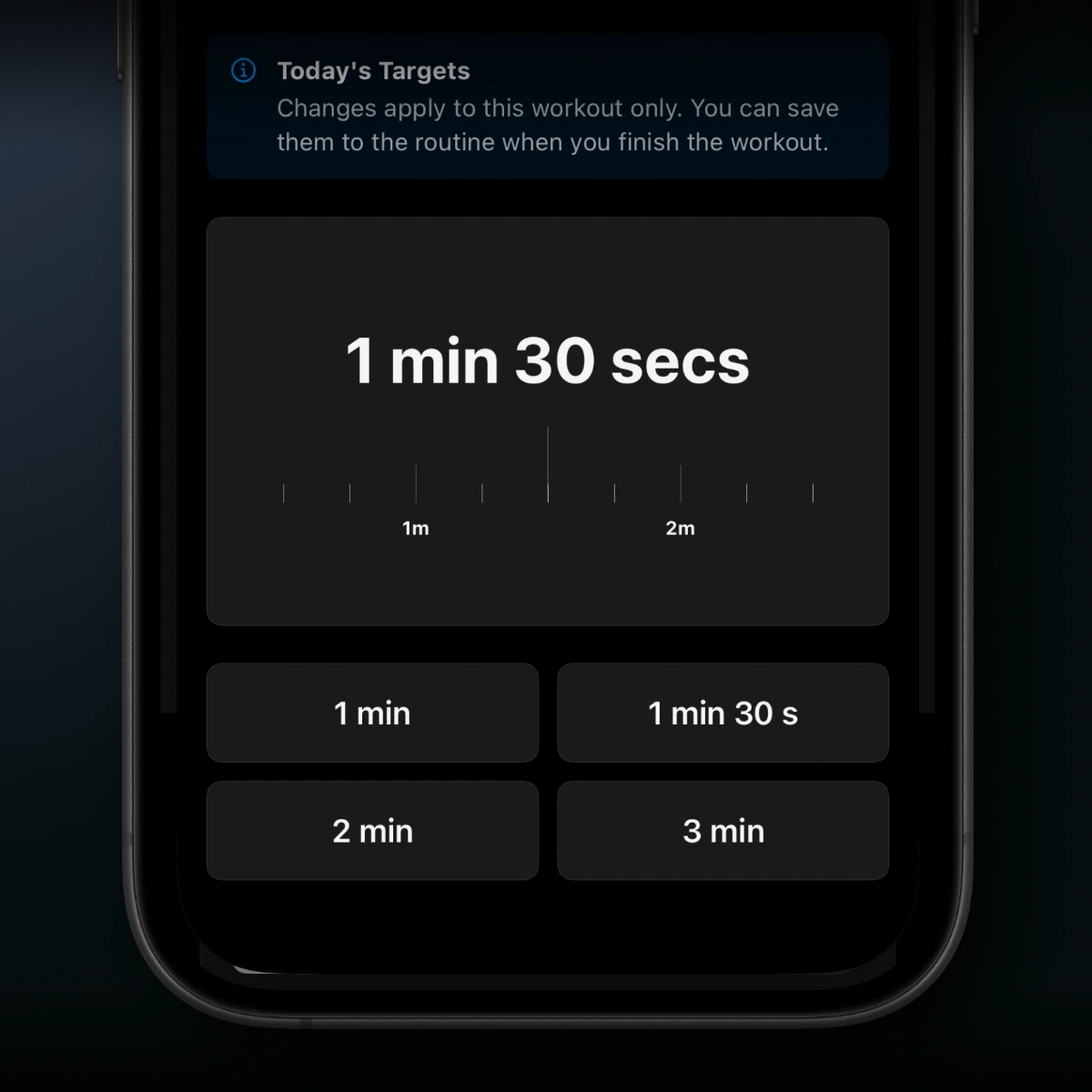 Quick rest selections make it easier to choose the right timer for the next set instead of guessing between exercises.
For time-tight days, keep the main exercises in the routine and treat lower-priority accessories as optional. If you shorten the session, log it honestly rather than trying to make it look like the full workout. That way your next target is based on reality, not on an imaginary perfect session.
This is where a focused workout tracker beats a messy note. You can see the difference between “I cut two accessories because I had 35 minutes” and “my bench strength is actually dropping.” Those are different problems.
Common mistakes when shortening workouts
Cutting warm-ups too aggressively. You can make warm-ups efficient, but skipping the ramp entirely before a heavy lift often makes the first working set worse.
Turning everything into a circuit. Circuits are useful for conditioning. They are not automatically better for strength or hypertrophy if they reduce load, reps, or control.
Removing all accessories. Accessories are not always fluff. If an accessory addresses a weak point, joint tolerance, or muscle group your compounds miss, it may deserve to stay.
Letting the phone decide the workout length. A short workout with planned rests is different from a long workout that disappeared between sets.
The bottom line
To shorten a workout without losing progress, keep the main lift, keep enough hard sets, time your rests, pair accessories intelligently, and define a minimum version of the routine before life gets busy.
Shorter training only works when it is deliberate. Open Steady, follow the plan, log what happened, and leave the gym knowing the important work got done.
Ready to start applying progressive overload?
Ditch the spreadsheets and complex notes. Join thousands of lifters who use Steady to focus on the workout, track their progress, and automatically know when to add weight.
Download Free for iPhone