How to Tell If You Met Your Workout Targets

You met a workout target when the work you performed matches or exceeds the plan under good enough conditions—not simply when you completed the exercise. Compare the prescribed weight, reps, sets, or time with what actually happened, then use form, effort, and the session context to decide whether to progress, repeat, or adjust.
That distinction matters because a log can say “done” while still telling three very different stories: you matched the plan, you fell short for a useful reason, or you outgrew the target. Reading those stories well keeps progression steady without turning every imperfect session into a problem.
Start with the target, not the emotion of the set
Before deciding whether a session was good or bad, name the target you were trying to hit. It might be:
- a fixed load and rep count, such as 60 kg for 3 sets of 8;
- a rep range, such as 8 to 12 reps;
- a duration target for a carry, hold, or conditioning interval; or
- a set-by-set plan, such as one heavier top set followed by lighter back-off work.
The target is your reference point. A personal record can be exciting, but it does not automatically mean the next target should rise. Equally, one missed rep is not automatically a regression. The useful question is narrower: how did today’s performance compare with the job this set was meant to do?
For a 3 x 8–12 dumbbell press, 12, 12, 11 with clean reps may show that a small increase is close. Eight, eight, eight is still a successful session. Eight, seven, six after an unusually short rest or a painful shoulder needs more context before you change the plan.
Read the result in three categories
Most sessions fit one of these categories.
1. On target: keep the plan moving calmly
You are on target when you completed the prescribed work at the intended load, rep range, or duration with acceptable form. If the plan was 3 sets of 10 and you logged 10, 10, 10, that is clear evidence—not a reason to invent extra tests on the spot.
Whether you increase next time depends on the progression rule. With a rep range, you might keep building reps until all sets reach the top. With a fixed target, you might add the smallest practical load only after several solid sessions. The important part is that “on target” is a result to trust.
2. Over target: earn a small next step
You are over target when you did more than the plan called for while technique stayed controlled. That can mean extra reps at the same load, a faster completed duration, or a performance that reaches the top of a planned range.
An over-target result usually supports one modest change: a small weight increase, a higher rep target, or the next planned progression. It does not require a dramatic jump. Small, repeatable increases are easier to interpret than heroic guesses.
3. Short of target: find the reason before changing anything
Falling short means the performed work did not meet the prescription. It is information, not a verdict. Look at the pattern before you decide to reduce a target:
- Did you miss only the final rep of the final set, or did every set fall away?
- Was rest shorter than usual, equipment different, or the gym unusually busy?
- Did technique break down, or did you stop because of pain?
- Is this a one-session wobble or a trend across comparable workouts?
A short result after poor sleep or a rushed session often calls for repetition, not an immediate deload. A repeatable decline across several sessions deserves a closer look at load, volume, recovery, and exercise choice. If pain is the limiting factor, stop treating it as a target problem and address the movement or get qualified help.
Keep the comparison specific enough to be useful
 A target only helps when it gives you a clear reference for what the next session should ask of you.
Avoid turning a whole workout into one score. A squat may be on target while a row is short because your grip was tired. A top set can be right where it should be while back-off work is lower because rest was cut short. Compare like with like: the same exercise, similar setup, similar rest, and the same role for that set.
This is especially important for per-set targets. A heavy top set and two back-off sets are not interchangeable data points. If the top set was clean but the back-offs dipped, the next step may be to preserve the top set and repeat the back-off work rather than averaging everything into one number. For the underlying setup, see Per-Set Targets vs Uniform Targets.
How Progression Performance Insights helps in Steady
Steady’s Progression Performance Insights makes the comparison visible inside the recommendation details. It shows the target beside the performed result, marks the outcome as on target, short, or over target where relevant, and explains the recommendation that follows. You can use it to check the evidence behind a next-step suggestion instead of taking “increase” or “hold” on faith.
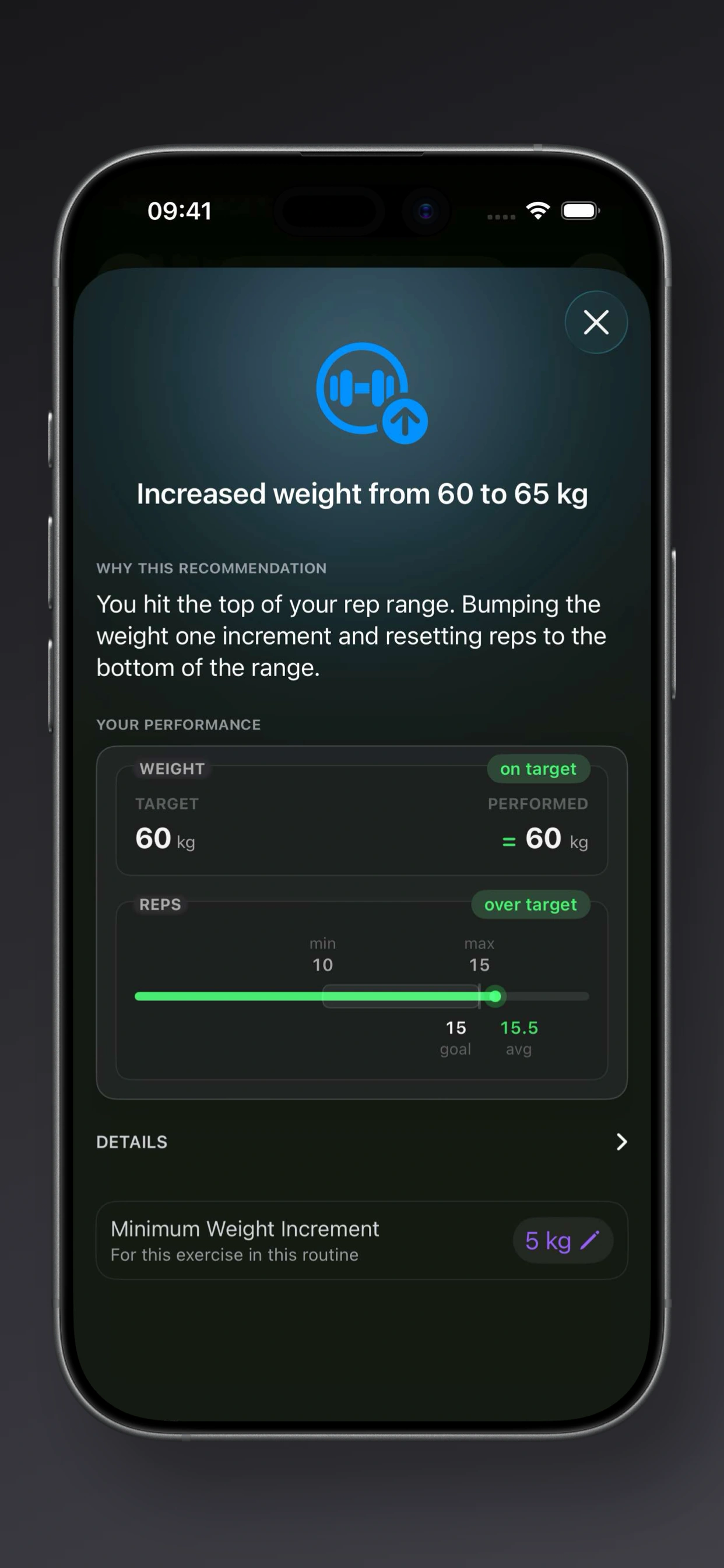 The detail view ties a next-target recommendation back to the session you actually logged.
For example, if you reached the top of a rep range, the explanation can make clear why the next weight is higher and why the rep target resets lower. If your performance was short, the target-versus-performed view helps distinguish a small miss from a bigger pattern. The final choice is still yours: the feature gives you context so you can keep the recommendation, repeat what you performed, or choose a different target when real life calls for it.
This is most useful when you log working sets honestly. Record the weight, reps, and effort you actually completed; do not round a difficult eight up to ten just to make the history look tidy. Honest data makes the next decision easier.
A simple post-workout decision rule
After an exercise, use this quick sequence:
- Compare the performed work with the exact target.
- Check whether form, pain, rest, or an unusual day changed the meaning of the result.
- If you were on target, follow the normal progression rule.
- If you were over target with control, take the smallest sensible next step.
- If you were short, repeat first unless the shortfall is persistent or the session exposed a clear problem.
The best target is not the most aggressive number you can write down. It is the next number that makes the next workout clear, challenging, and repeatable. Steady is built to keep that decision grounded in your real training history—so you can spend less time negotiating with your log and more time training.
Ready to start applying progressive overload?
Ditch the spreadsheets and complex notes. Join thousands of lifters who use Steady to focus on the workout, track their progress, and automatically know when to add weight.
Download Free for iPhone