How to Track PRs Without Maxing Out

You can track gym PRs without maxing out by treating personal records as more than one all-out single. Track the heaviest weight you lift for clean reps, your best rep count at a given load, your best estimated 1RM, your best set volume, and whether the set quality improved. That gives you useful strength data from normal training, without turning every workout into a test day.
Maxing out has a place, especially if you compete in powerlifting or enjoy testing strength directly. But most lifters do not need to test a true one-rep max often. Heavy singles create fatigue, need careful setup, and can make a normal training week revolve around one attempt.
The better approach is to let your regular working sets tell you when you are getting stronger.
What counts as a PR?
A PR, or personal record, is your best recorded performance for a specific exercise under a specific condition. It does not have to mean “the most weight ever lifted for one rep.”
Useful PRs include:
- Weight PR: the heaviest load you have lifted for that exercise
- Rep PR: the most reps you have performed at a given load, or for a bodyweight exercise
- Estimated 1RM PR: the highest calculated one-rep max from a submaximal set
- Volume PR: the most weight moved in one set, usually weight multiplied by reps
- Quality PR: the same load and reps performed with better control, depth, tempo, or fewer reps in reserve
That last one is less precise, but it matters. A cleaner squat at the same weight is progress, even if the spreadsheet cell does not turn green.
If you want the foundation first, read What is 1RM and how to estimate it and How to Track Strength Progress When Your Performance Changes Day to Day.
Why you should not chase maxes every week
Testing a true max is not the same thing as building strength.
A real max attempt asks a lot from your body and your setup. You need enough warm-up sets, enough rest, a good spotter or safeties, and a day where your technique holds under heavy load. Done too often, max testing can steal energy from the volume and practice that actually drive progress.
There is also a psychological cost. If every session becomes a hunt for a new top number, normal training starts to feel like failure. Some weeks your best win is adding one rep. Some weeks it is matching last week with cleaner form. Some weeks it is holding performance while tired.
Those are still useful signals.
 Most PRs become obvious when you review patterns across sessions instead of judging one heavy attempt.
The best PRs to track from normal working sets
You can get a complete picture of progress by watching a few practical records.
1. Heaviest clean set
Track the heaviest load you can lift with acceptable technique. The keyword is clean. A deadlift hitched through the last third of the rep may be a heavier number, but it is not always a better training signal than a slightly lighter set moved well.
For most gym training, a heavy set of 3–6 reps is enough to show whether strength is moving without needing a true one-rep max.
2. Rep PR at the same weight
If you benched 80 kg for 8 reps last month and 80 kg for 10 reps today, you got stronger. That is a PR even though the weight did not change.
Rep PRs are especially useful for hypertrophy work, dumbbell lifts, machines, and exercises where weight jumps are large. They also fit naturally with double progression: fill out the rep range first, then increase the load.
3. Estimated 1RM
An estimated 1RM converts a hard multi-rep set into a projected one-rep max. It is not perfect, but it is useful when the set is hard and the rep count is not too high.
For example, 100 kg for 5 hard reps may estimate a higher 1RM than 105 kg for 2 reps. That tells you something important: your strength may be improving even if your heaviest single or double has not changed.
Use estimated 1RM mostly for compound lifts and lower rep ranges. Above 10–12 reps, the estimate becomes more about endurance and tolerance than maximum strength.
4. Best set volume
Set volume is simple:
weight x reps = set volumeIf you row 70 kg for 10 reps, that set is 700 kg of volume. If you later row 75 kg for 10 reps, or 70 kg for 12 reps, that record moves up.
Volume PRs are useful because they reward productive work, not just heavy attempts. They are not the only thing that matters, but they help you see progress in the middle rep ranges where a lot of muscle-building work happens.
Where this fits in Steady
Steady treats PRs as training feedback, not as a reason to max out constantly. During normal logging, it can recognize different kinds of records depending on the exercise and set: weight, reps for bodyweight work, set volume, duration, and estimated 1RM.
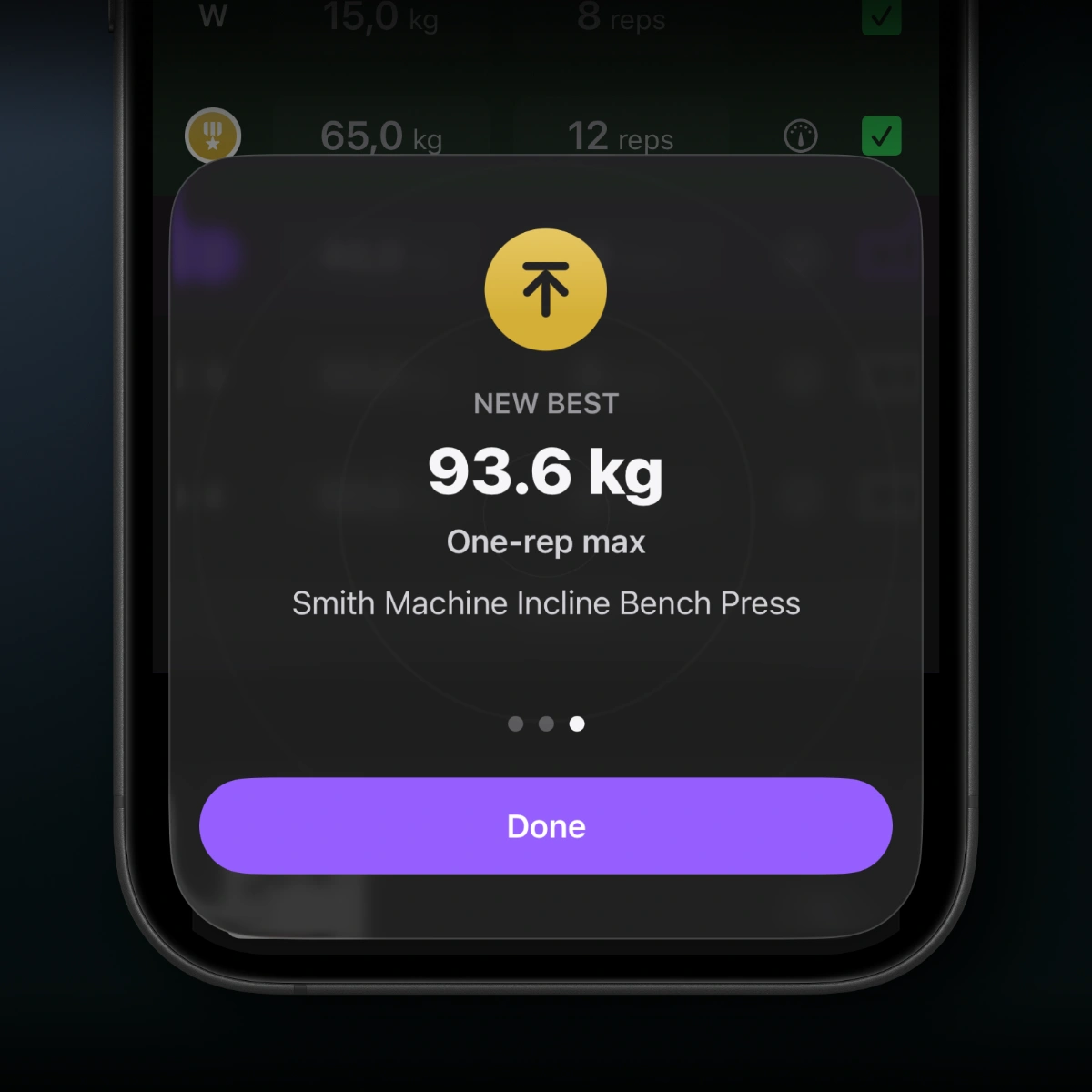 A hard working set can create a useful estimated 1RM PR without requiring a true max attempt.
That distinction matters in real training. A bench press set can be a weight PR, a volume PR, and an estimated 1RM PR for different reasons. A plank or timed hold needs a duration record instead. A bodyweight exercise may be better judged by reps. Good tracking should respect those differences instead of forcing every lift into the same one-number story.
The practical workflow is simple: log the set honestly, mark warm-up sets correctly, and let your history build. Over time, those records make it easier to see whether you are progressing, stalling, or just having a normal up-and-down training week.
How often should you test a true max?
If you are not competing, you can go months without testing a true one-rep max. Many lifters do better testing it only at the end of a focused strength block, after a deload, or when they have a clear reason.
For regular training, use this rule:
- Use working sets to build strength.
- Use estimated 1RM and rep PRs to monitor progress.
- Test a true max only when the result will change your training decisions.
That keeps max testing purposeful instead of impulsive.
Common PR-tracking mistakes
The first mistake is counting sloppy reps as clean records. If depth, control, or range of motion changed, the comparison is not clean.
The second mistake is comparing different conditions as if they are identical. A squat done first in the workout is not the same as a squat done after hard leg presses. A bench set after five minutes of rest is not the same as one after 90 seconds.
The third mistake is ignoring smaller PRs because they are not dramatic. One more rep at the same weight is progress. The same reps at a lower RPE is progress. Better execution is progress. These are the records that keep training moving when giant jumps are no longer realistic.
The bottom line
You do not need to max out to know you are getting stronger. Track PRs from the work you are already doing: heavier clean sets, more reps at the same load, higher estimated 1RM, better set volume, longer duration, and better execution.
That gives you a calmer, more useful view of progress. Steady is built for exactly that kind of logging: focused enough to capture the numbers that matter, simple enough to use between sets, and quiet enough to keep the workout about training instead of chasing notifications.
Ready to start applying progressive overload?
Ditch the spreadsheets and complex notes. Join thousands of lifters who use Steady to focus on the workout, track their progress, and automatically know when to add weight.
Download Free for iPhone