How to Use Double Progression

Double progression is a simple strength-training method where you increase reps first, then increase weight. You pick a rep range, such as 8 to 10 reps, use the same weight until you can hit the top of that range across your working sets with solid form, then add weight and repeat the process from the lower end of the range.
That is why double progression works so well for real gym training: it gives you a clear rule, but it does not force a weight jump before you have earned it.
If you have ever wondered whether today should be “one more rep” or “more weight,” double progression is the system that answers that question.
What double progression means
Double progression means progressing through two variables over time:
- Reps increase while the weight stays the same.
- Weight increases after you reach the top of your target rep range.
For example, you might set dumbbell bench press at 3 sets of 8-10 reps.
Your first few sessions might look like this:
- Session 1: 30 kg x 8, 8, 8
- Session 2: 30 kg x 9, 8, 8
- Session 3: 30 kg x 9, 9, 8
- Session 4: 30 kg x 10, 9, 9
- Session 5: 30 kg x 10, 10, 10
- Session 6: 32 kg x 8, 8, 7
That last session is not a setback. It is the start of the next cycle. You made the exercise harder by increasing the load, so the reps dropped. Now your job is to build them back up again.
Over months, both numbers rise: the reps you can complete and the weight you can use.
Why double progression works
Double progression works because it makes overload gradual.
A lot of lifters treat weight as the only form of progress. If the bar is not heavier, they feel like the workout did not improve. But for hypertrophy and long-term strength, adding a rep with the same load is real progress. It means you produced more work with the same resistance.
This matters because weight jumps are not always small.
Going from 20 kg dumbbells to 22 kg dumbbells can be a 10% increase per hand. Going from a 45 kg lat pulldown to 50 kg may be more than your body is ready to handle cleanly. Double progression gives you room to adapt before taking that jump.
It also keeps technique honest. Instead of rushing heavier weight because you completed one decent set, you prove that you can repeat strong reps across the target sets.
How to set up double progression
Use this simple setup:
- Choose an exercise.
- Pick a rep range.
- Pick the number of working sets.
- Use the same weight until all working sets reach the top of the range.
- Increase weight next time.
- Let reps drop back down and repeat.
A good starting structure is:
- Compound hypertrophy lifts: 3-4 sets of 6-10 reps
- Machine presses and rows: 3-4 sets of 8-12 reps
- Isolation exercises: 2-4 sets of 10-15 reps
- Small isolation work: 2-3 sets of 12-20 reps
The exact range matters less than consistency. If you choose 8-12 reps for a machine row, keep using that range long enough for the pattern to mean something.
When to increase the weight
Increase the weight when you hit the top of your rep range across all target working sets with controlled form.
For a target of 3 sets of 8-10, that means:
- 10, 10, 10 = increase weight next time
- 10, 10, 9 = stay at the same weight
- 10, 9, 8 = stay at the same weight
- 9, 9, 9 = stay at the same weight
The rule is deliberately simple. You are looking for repeatable performance, not one heroic set.
If the exercise uses big jumps, be patient. On dumbbell lateral raises, going from 10 kg to 12 kg can feel enormous. On a barbell squat, adding 2.5 kg may be more manageable. The progression rule stays the same, but the timeline changes by exercise.
 Double progression works best when the next load jump is earned, not guessed.
Which exercises fit double progression best
Double progression is especially useful for exercises where adding weight every session is unrealistic.
It works well for:
- dumbbell presses
- cable rows
- lat pulldowns
- machine chest presses
- leg presses
- Romanian deadlifts
- curls
- triceps extensions
- lateral raises
- leg extensions
- hamstring curls
It can also work for compound barbell lifts, especially for intermediate lifters. But very low-rep strength work often uses a different structure, because the rep range is narrower and the loading decisions are more specific.
For most hypertrophy training, double progression is hard to beat because it is clear, flexible, and easy to repeat.
Common mistakes
The biggest mistake is increasing weight after only one set reaches the top of the range.
If your target is 3 sets of 8-10 and you hit:
- 10, 8, 7
you have not outgrown the weight yet. You had one strong set. Keep the load and build the remaining sets.
Another mistake is letting form change so the numbers look better. Shorter reps, faster tempo, bouncing, and shifting range of motion can all fake progress. The goal is not just more reps. The goal is more comparable reps.
A third mistake is using a range that is too wide. A target like 6-15 reps can work in some contexts, but for most lifters it makes progression feel blurry. Use a tighter range like 8-10, 8-12, or 10-15 unless you have a specific reason not to.
How to track double progression
To use double progression properly, you need to log:
- the exercise
- the weight
- the reps for each working set
- the target rep range
That is enough to know what to do next time.
For example:
- Lat pulldown
- Target: 3 sets of 8-10
- Last session: 55 kg x 10, 10, 9
- Next goal: keep 55 kg and get the final set to 10
The system falls apart when you only remember the first set, average the reps, or write something vague like “good session.” Double progression depends on set-by-set clarity.
This is where a focused workout tracker helps more than a generic notes app. In Steady, you can keep your exercise targets and workout history close to the actual logging flow, so the next step is visible when you are between sets instead of buried in memory.
For the broader tracking system, read How to Track Progressive Overload Without Spreadsheets.
How Steady can put double progression on autopilot
This is exactly the kind of progression decision Steady is built to handle.
For Pro users, Steady’s smart progression feature uses the double progression pattern directly: reps climb inside your configured rep range, and once your performance shows you have reached the top of that range, Steady recommends the next weight jump and resets the rep target back toward the bottom so you can climb again.
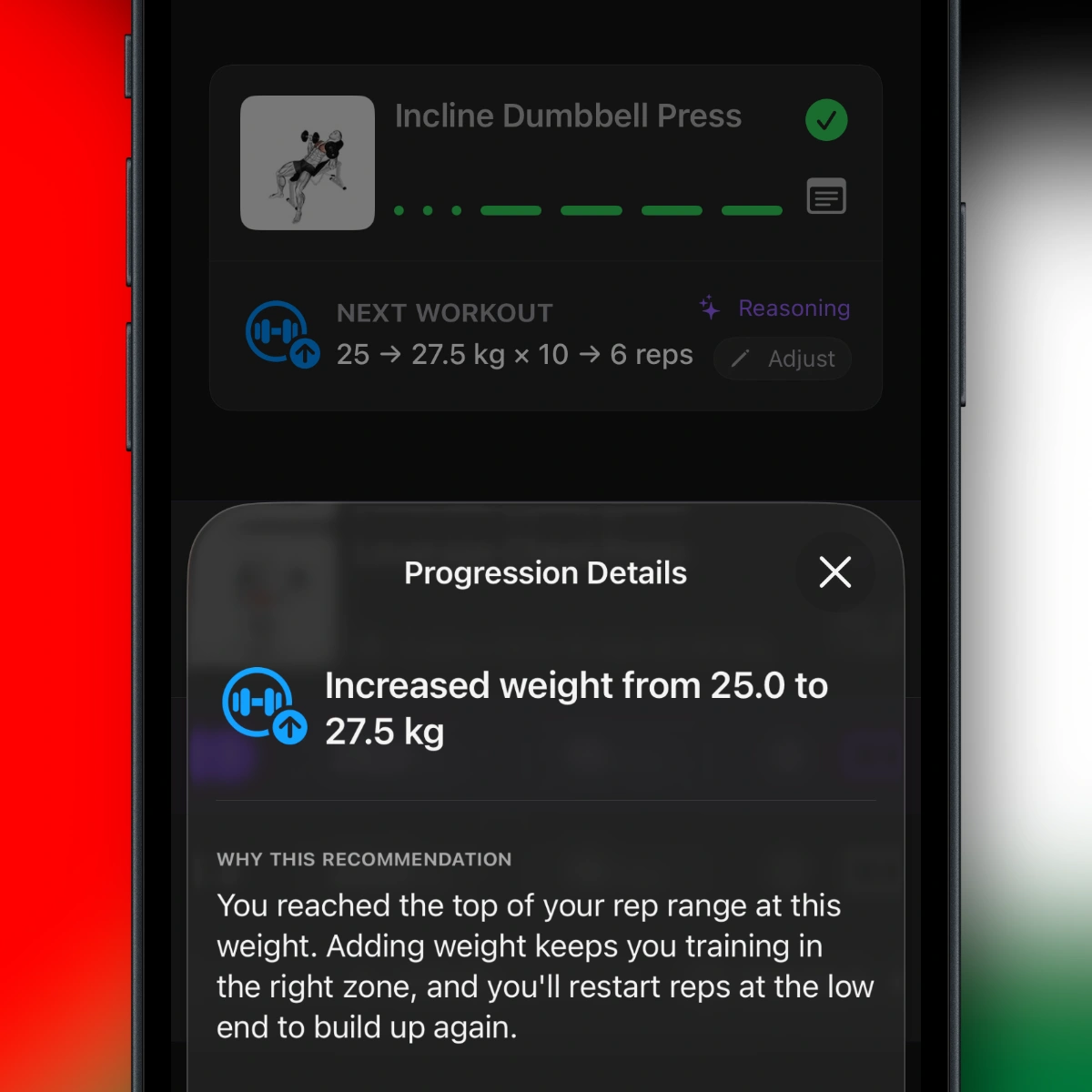 Steady can explain why it recommends a change, such as increasing weight after you reach the top of your rep range.
Here is the practical setup:
- Open the exercise inside your routine.
- Set the working sets and rep range, such as 3 sets of 8-10.
- Open Progression & Increment.
- Choose the Minimum Weight Increment that matches the equipment you use.
- Keep Enable Automatic Progression on for that exercise.
- Make sure Automatic Progression is also enabled in Settings.
That minimum increment matters. If your gym’s dumbbells jump by 2 kg, set the exercise that way. If your barbell work moves in 2.5 kg jumps, use that. Steady’s recommendations are only useful if the next step matches the equipment you can actually load.
During the workout, you still train normally: log each working set, including weight and reps. If you use RPE, Steady can also use effort as a guardrail. For example, if you hit the top of the range but mark the set as max effort, Steady can hold the target instead of rushing the load increase.
After the workout, Steady shows Review your next targets. This is where the autopilot stays under your control:
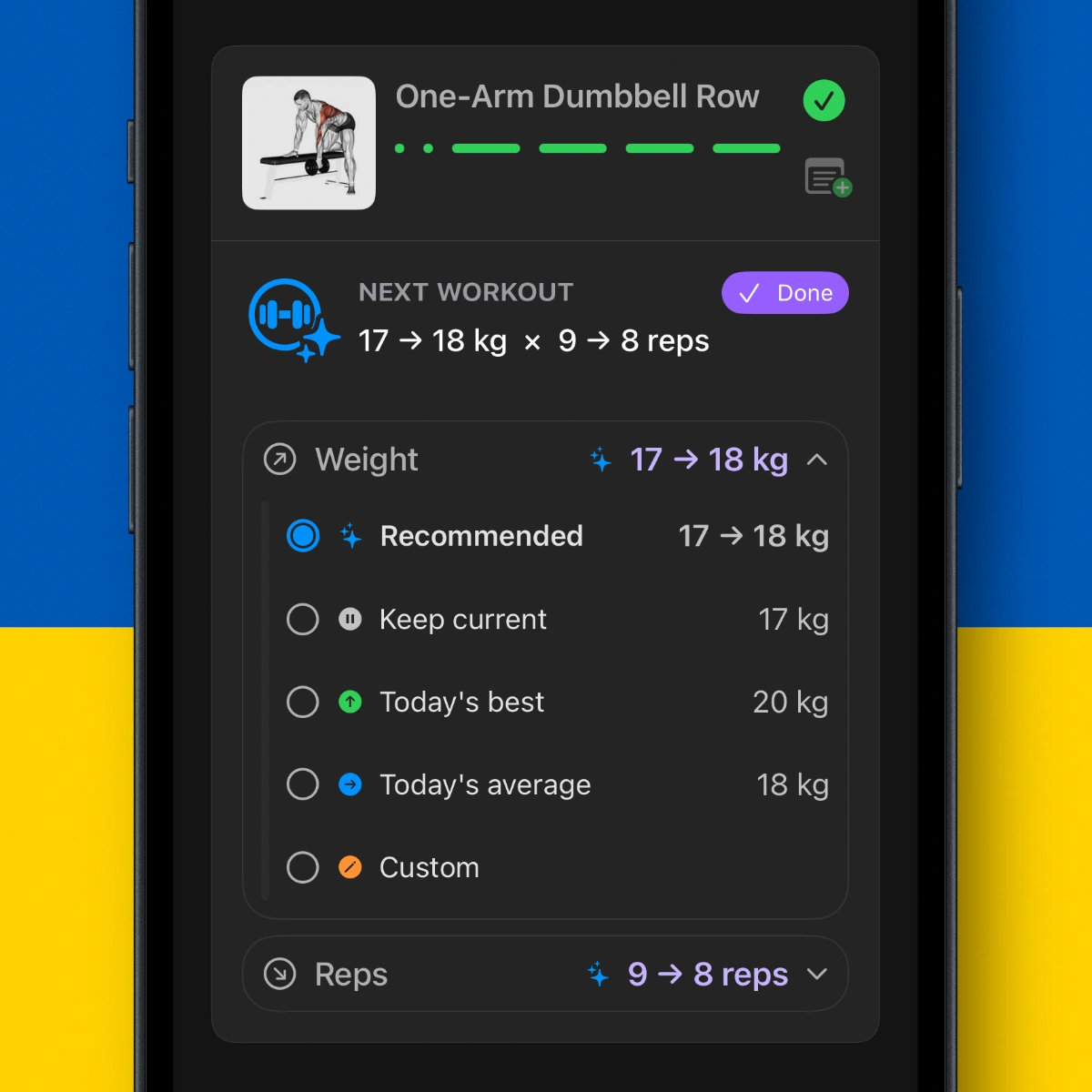 The recommendation is not a black box: you can accept it, keep your current target, or choose a custom value.
- accept the recommended weight or rep change
- keep the current target if the session was messy
- customize the next target manually
- turn routine updates off for that finish if you do not want changes saved
Then Finish & Update Routine applies the selected targets to the next workout.
The result is simple: you still do the lifting, but you do not have to re-run the double progression logic in your head after every exercise. Steady watches the rep range, the weight increment, the completed sets, and the effort signal, then gives you a clean next target to approve.
Double progression is slow in the right way
Double progression will not make every session look dramatic. Some workouts are just one extra rep on one set. That is fine.
The value is that the progress is earned and repeatable. You are not guessing. You are following a rule that tells you when to push reps, when to hold steady, and when to load the bar.
If you want your training log to lead to better decisions, use a clear rep range, track every working set, and let your performance decide the next weight jump. Steady is built for that kind of calm, practical progression: enough structure to guide the workout, without turning your training into spreadsheet maintenance.
Ready to start applying progressive overload?
Ditch the spreadsheets and complex notes. Join thousands of lifters who use Steady to focus on the workout, track their progress, and automatically know when to add weight.
Download Free for iPhone