How to Train During Stressful Weeks

During a stressful week, keep strength training proportional to the capacity you actually have: train normally when your warm-ups and focus settle in, reduce the least important work when they do not, and take a rest day when the session would only add strain. The goal is not to prove that stress cannot affect your training. It is to preserve the parts of the routine you can repeat without turning a difficult week into a bigger recovery problem.
Stress outside the gym is not an excuse or a character test. A deadline, disrupted sleep, family responsibilities, travel planning, or a demanding stretch at work can change attention, pacing, appetite, and how quickly you feel ready for hard work. That does not mean every workout should be cancelled. It means the planned workout is a starting point, not a demand you must meet at any cost.
Start by separating one hard day from a hard week
One flat session is common. You may arrive distracted, need a longer warm-up, or find that the first working set feels heavier than expected. Give the session a little information before changing it: move through your normal warm-up, take enough rest, and see whether familiar loads begin to feel proportionate.
A stressful week is different. It shows up as a cluster: several workouts feel unusually hard, your focus keeps drifting, normal rests no longer feel sufficient, or you are repeatedly cutting sessions short. That pattern deserves a smaller plan for a few days. It does not automatically require a new program or a complete week away from the gym.
The practical question is: what is the smallest adjustment that keeps this session useful?
Use a three-level decision for the session
1. Train as planned when the warm-up catches up
Keep the normal session when your movement feels coordinated, your planned working weight feels challenging but believable, and your attention is good enough to execute the work safely. A stressful morning does not have to decide the whole workout before you touch the first weight.
You might still leave one or two reps further from failure than usual. That is not a failed workout; it is a sensible way to protect the next session while keeping the main work intact.
2. Keep the main work and trim the extras
When the warm-up stays slow or the first hard set takes much more effort than normal, reduce the least important stress first. Keep one or two priority movements, then choose one change:
- Remove a low-priority accessory or finisher.
- Leave more reps in reserve instead of chasing a grinder.
- Use a slightly lighter load for the working sets.
- Take longer rests and stop when the useful work is done.
This is usually better than making five changes at once. If you keep the session recognizable, you can tell what happened when you look back at it.

A reduced session should feel controlled, not like a punishment for being tired.
3. Take a rest day when training would only add strain
A rest day is the right call when you cannot focus enough to train safely, when ordinary movement is noticeably altered by pain, or when fatigue has been accumulating without a rebound. Do not turn sharp, worsening, or joint-focused pain into a recovery puzzle; stop treating it as normal training fatigue and seek appropriate medical guidance.
For ordinary training fatigue, a rest day is not lost momentum. It is a decision that protects the sessions you want to complete later in the week. If the wider pattern continues, compare rest days and deload weeks before trying to make up missed work.
Make the reduced option easy to choose
The best time to decide what a lighter session looks like is before you are exhausted in the gym. Write a simple fallback beside your normal workout: keep the first two exercises, cap the session at a set number of working sets, and skip the optional work. That removes the all-or-nothing choice without building an entirely separate program.
In Steady, Recovery Mode is available from a routine or an active workout when you want to lower a session without rewriting the routine. You choose how much lighter to go and preview the adjusted targets; the program stays the same, auto-progression is paused for that session, and the performance is still logged to your history.
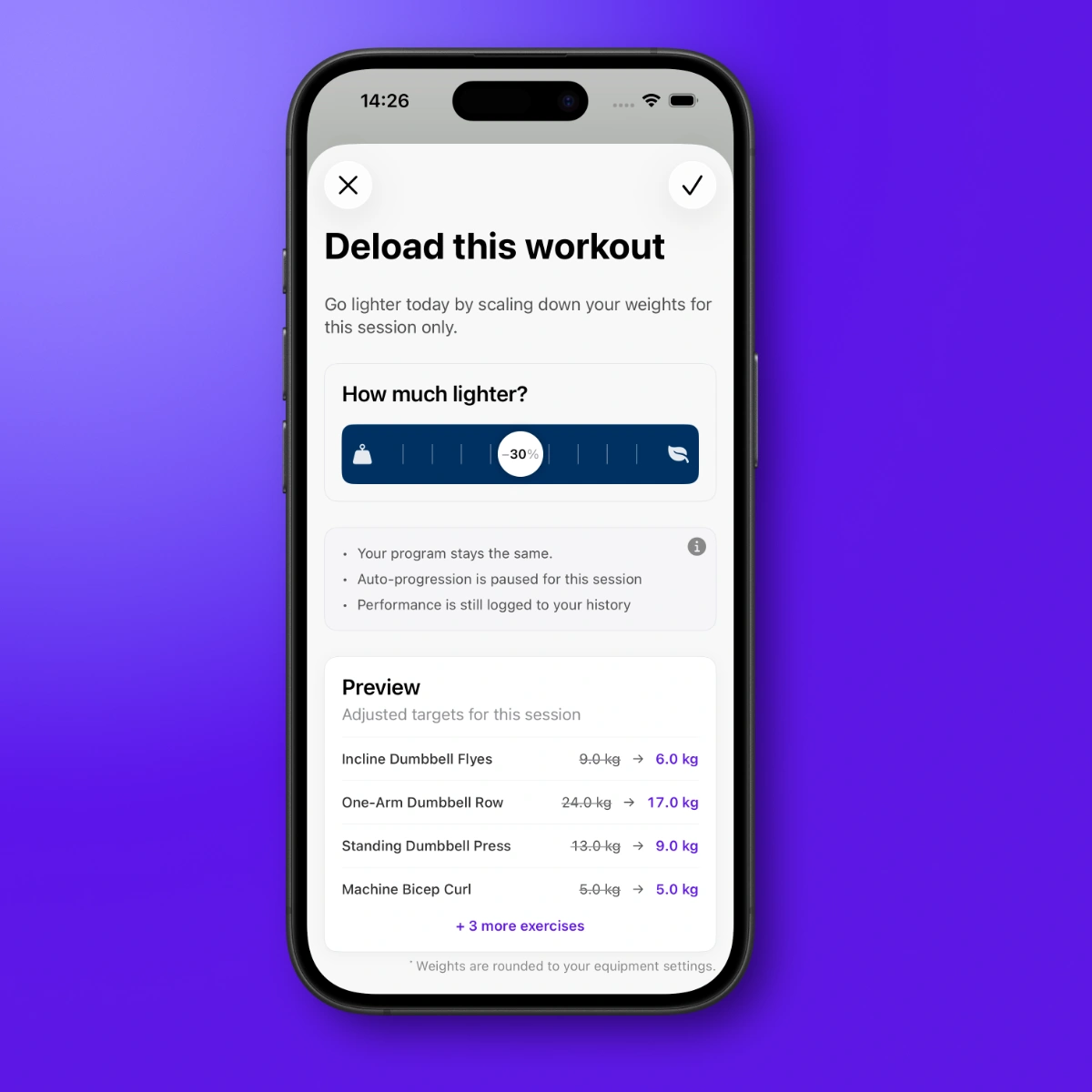
Recovery Mode makes a one-session adjustment visible in your history instead of disguising it as a normal day.
That distinction matters. An intentionally lighter workout is useful context, not proof that you suddenly need to lower every future target. For the immediate decision, see how to adjust a workout on low-energy days.
Judge the week by patterns, not by a single number
Keep a brief note when it explains a result you might otherwise misread: project deadline, poor sleep all week, or long travel day is enough. Then compare the next few similar sessions. If performance returns when the stressful stretch eases, the plan may be fine. If several comparable workouts stay flat despite sensible adjustments, reduce training stress more deliberately rather than adding volume or forcing progression.
This is also why a complete log is more useful than a perfect-looking one. A lighter session, an extra rest day, and a normal workout all tell different parts of the same story. You can see the trend without pretending every week had the same conditions.
Keep the routine, lower the pressure
Stressful weeks are not the time to earn a badge for maximum effort. Keep the main work when it still serves you, scale back early when the signals are clear, and let rest do its job when it is needed. Steady gives you a focused place to record what you actually did, so the next training decision can come from a real pattern rather than guilt or guesswork.
Ready to start applying progressive overload?
Ditch the spreadsheets and complex notes. Join thousands of lifters who use Steady to focus on the workout, track their progress, and automatically know when to add weight.
Download Free for iPhone