How to Use Workout History to Choose Weights

The best way to use workout history to choose weights is to check your last few performances for the same exercise, compare the weight, reps, and effort, then pick a load that gives you a realistic chance to match or slightly beat your previous result. You are not looking for the heaviest possible number every day. You are looking for the next sensible weight based on what your body has actually done recently.
That distinction matters.
Many lifters choose weight from memory: “I think I used 80s last time” or “225 felt okay a while ago.” That works until the details blur together. One hard week, one missed meal, one different exercise order, and the guess gets worse.
Workout history gives you a better starting point. It turns today’s first working set from a blind test into a decision with context.
What counts as useful workout history?
Useful workout history is a clear record of what happened on an exercise in past sessions. At minimum, that means:
- weight used
- reps completed
- number of work sets
- whether the sets were warm-ups or working sets
- any note that explains the result, such as pain, rushed rest, or a machine setup change
You can add RPE, rest times, tempo, and notes when they help, but the foundation is simple. If you know what you lifted and how many reps you actually got, you can make a much better call than memory alone.
This is also why a focused gym log app beats a scattered notes file for most lifters. The value is not just saving data. The value is making the right data easy to see before your next set.
The simple rule: recent history beats old bests
Your all-time best is useful, but it should not be the only number you use to choose today’s weight.
If you benched 225 for 8 reps six months ago but your last three sessions were 205 for 8, 210 for 7, and 210 for 8, the recent numbers matter more today. They describe your current training state. The old best describes what you have done before.
For most workouts, use this priority:
- Look at the last time you performed the exercise.
- Check the last two or three sessions if performance has been inconsistent.
- Use your all-time best only as extra context, not as the automatic target.
This keeps weight selection honest. It also protects you from turning every workout into a test of your best day.
Step-by-step: choosing today’s working weight
Use this quick process before your first working set.
1. Find the same exercise, not just the same muscle group
Compare bench press to bench press, not bench press to dumbbell press. Compare a specific machine row to that same row if the machine setup matters.
Small differences change the result. Handle width, bench angle, cable height, range of motion, and machine resistance curves can all make one exercise look stronger or weaker than another. If you changed the exercise, use history as a rough guide, not a precise target.
2. Check the last working sets
Look at the actual sets, not only the top number.
For example:
- last time: 185 x 10, 185 x 9, 185 x 8
- target range: 8 to 10 reps
That history says 185 is still productive. You probably do not need to jump yet unless those reps were easy and clean. A good goal today might be 185 x 10, 10, 9 before moving up next time.
If the last session was 185 x 10, 10, 10 with solid execution, a small increase is more defensible.
 The best weight decision usually comes from the last few honest sets, not from a vague memory of what felt heavy.
3. Notice whether performance was rising, flat, or dropping
One session can mislead you. A short trend is more useful.
Ask:
- have reps been climbing at the same weight?
- did the same weight suddenly drop?
- have you repeated the same result several times?
- did you recently add volume, change rest times, or move the exercise later in the workout?
If reps are rising, keep building or add weight when the target is clearly earned. If performance is flat, look for a small improvement before changing everything. If performance is dropping, today’s goal may be to stabilize rather than force a heavier load.
4. Choose the smallest useful jump
The best increase is usually the smallest one that makes the exercise meaningfully harder without wrecking the target.
For many lifts, that means:
- 2.5 to 5 lb per side on barbell lifts
- the next pair of dumbbells when rep targets are clearly met
- the smallest plate or pin jump available on machines
- no load increase yet if reps are still below the top of the range
Bigger jumps can work on lower-body compound lifts or for newer lifters, but they are not automatically better. Progression is not more serious because the jump is larger. It is better when the next target is realistic enough to repeat.
When to keep the same weight
Keeping the same weight is not failure. It is often the right call.
Repeat the same load when:
- you have not reached the top of your rep range
- your last session was hard but productive
- form degraded near the end
- you slept poorly or feel unusually fatigued
- the previous increase was recent and still needs consolidation
For hypertrophy work especially, adding reps at the same load is real progress. Going from 3 sets of 8 to 3 sets of 10 at the same weight is not standing still. It is a clear improvement.
If you are unsure when to move up, read How to Know When to Increase Weight, Reps, or Both.
When to reduce weight
Sometimes the smartest choice is to take weight off the bar.
Reduce the load when:
- warm-ups feel unusually heavy
- your target reps are out of reach from the first set
- technique is breaking down early
- pain changes the movement
- you are returning after missed workouts
- you are intentionally deloading
A small reduction keeps the session useful. It also keeps your workout history clean. Logging a controlled 10% reduction with solid reps tells you more than forcing a messy number because it is what you hoped to lift.
How to use this in Steady
Steady is built around this exact decision: what should I try today based on what happened before?
In an exercise’s statistics, Steady shows progress charts, personal records, rep-range breakdowns, and recent performance history. During training, Smart Weight Suggestions can use recent workout history to recommend practical loads for different rep targets, so you can spend less time guessing between sets.
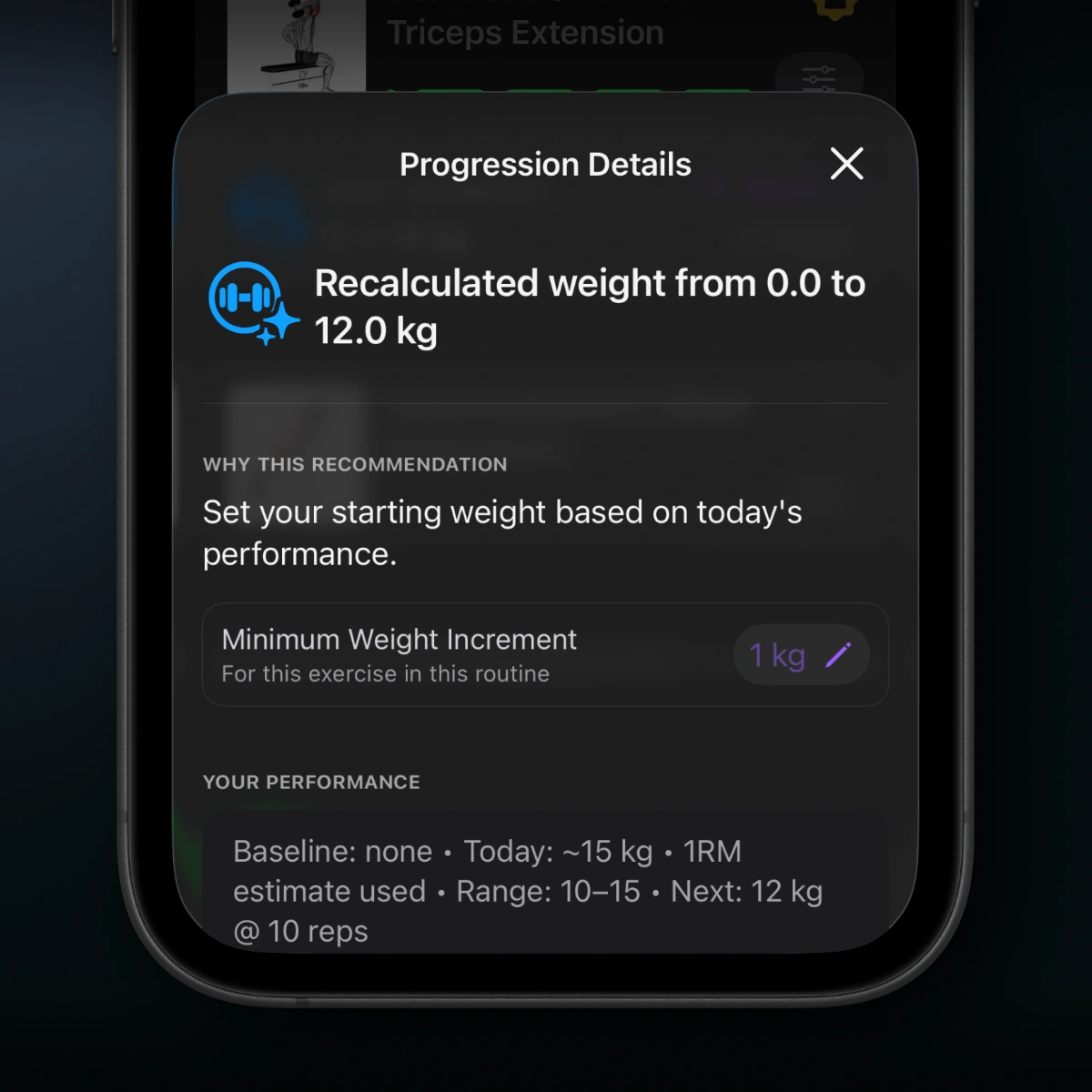 Smart Weight Suggestions turn recent performance into a concrete starting point for today’s set.
You still make the final call. If the gym is crowded, your sleep was poor, or a warm-up feels off, adjust. The point is not to outsource judgment. The point is to start from useful history instead of a half-remembered number.
That is why Steady keeps the tracker focused: log the set, review the history, choose the next target, keep training.
Common mistakes
Mistake 1: chasing the best number every session
Your best set is not always today’s target. If you try to match a peak performance on a low-energy day, you may turn a normal workout into a frustrating one.
Use bests for context. Use recent history for today’s decision.
Mistake 2: ignoring exercise order
If you move an exercise later in the workout, expect performance to change. A row done after heavy deadlifts is not the same as a row done fresh.
When the order changes, compare carefully.
Mistake 3: forgetting rest times
Shorter rest usually means lower performance. If your last session had three-minute rests and today you are rushing with 90 seconds, the same weight may feel harder.
Rest does not need to be perfect, but it should be close enough that your comparison means something.
Mistake 4: treating one bad day as a trend
One weaker workout is information, not a verdict.
If performance drops once, look for obvious causes. If it drops across several sessions, then consider changing load, volume, exercise selection, or recovery.
A practical example
Suppose your target on incline dumbbell press is 8 to 10 reps.
Your last three sessions:
- 70s x 8, 8, 7
- 70s x 9, 8, 8
- 70s x 10, 9, 8
Today, the smart choice is probably 70s again. Try to reach 10, 10, 9 or 10, 10, 10 before moving to 75s.
Now compare that with:
- 70s x 10, 10, 10
- 75s x 8, 8, 7
- 75s x 8, 8, 8
Here, 75s still look right. The goal is not to jump again. The goal is to build reps at the new load until the next increase is earned.
Bottom line
Workout history helps you choose weights by replacing guesswork with a recent, exercise-specific reference point. Check what you did last time, look for the short trend, then pick the smallest useful progression that fits today’s target.
That is a better way to train than chasing random numbers or starting every session from memory. With Steady, the history stays close to the workout itself, so each set gives your next session a clearer starting point.
Ready to start applying progressive overload?
Ditch the spreadsheets and complex notes. Join thousands of lifters who use Steady to focus on the workout, track their progress, and automatically know when to add weight.
Download Free for iPhone