Strength Training With a Physical Job

You can build strength while working a physically demanding job, but the job has to count as part of your total fatigue. The practical answer is to keep lifting consistent, make hard sessions fit the days you can recover from, and adjust the target before a rough workday turns a normal workout into a grind.
Construction, warehouse, nursing, hospitality, landscaping, delivery, and trades work can mean a lot of walking, lifting, carrying, gripping, bending, or time on your feet. That activity is not the same as a planned strength workout, but it still uses recovery resources. Ignoring it is how a sensible gym plan becomes too much.
Treat work fatigue as context, not an excuse
A physical job does not automatically mean you need to train lightly or stop progressing. Many people get strong while doing demanding work. It does mean that a plan copied from someone with a desk job may not fit your week at the same volume, intensity, or schedule.
Think in patterns instead of labels. A quiet work week may leave you ready for a hard lower-body session. A week of overtime, heavy carrying, or long shifts may make the same session feel very different. Neither outcome says anything dramatic about your discipline or potential. It tells you what stress was already on the system.
Pay attention to a few useful signals:
- warm-ups that feel unusually slow or unstable
- a repeated drop in reps or bar speed across comparable sessions
- soreness that is still getting worse rather than settling
- grip, low-back, or joint irritation that changes how you move
- sleep and appetite falling apart alongside training performance
One tired day is normal. Several comparable sessions moving in the wrong direction is a reason to adjust the dose.
Put demanding sessions where they fit best
The best training split is the one you can recover from repeatedly. Start by identifying the part of the work week that is most physically expensive, then protect the gym sessions that need the most freshness.
For example, someone who does heavy lifting on Monday and Tuesday may prefer their hardest lower-body work later in the week. Someone whose job is busiest every weekend may get more from training hard midweek and using the weekend for easy work or rest. This is not a rigid rule; it is a way to avoid scheduling your two hardest stressors on top of each other by accident.
You do not need to turn your job into a second workout plan. Just ask one honest question before scheduling a hard session: will tomorrow’s work make today’s training harder to recover from, or will today’s training make tomorrow’s work less safe and capable? If the answer is yes, move the hard work, reduce it, or leave more room before the next session.
Change one variable before changing everything
When work has already been demanding, keep the purpose of the workout and reduce the least important stress first. That gives you useful training without creating a confusing pile of changes.
 A short note about an unusually physical shift can make a lower-performance session much easier to interpret later.
Use this order when you need an adjustment:
- Keep the main movement, but leave more reps in reserve. A controlled set that ends earlier is often more useful than a forced final rep.
- Trim optional volume. Drop the last accessory set or a redundant finisher before cutting the part of the session you most want to maintain.
- Use a slightly lighter load. This is especially useful after a day of heavy lifting, long standing, or poor sleep.
- Take more rest. Rushing because you are tired can turn normal loads into poor-quality reps.
- Move the session if possible. A rest day is a training decision, not a missed opportunity to prove toughness.
Avoid changing load, sets, exercise selection, and rest all at once. If every variable moves, your next log cannot tell you what actually helped.
Build a floor for hard weeks
The weeks that test consistency are rarely the weeks with a perfect schedule. Give yourself a minimum version of each session before you need it: one main movement, a few controlled working sets, and a clear stopping point. That is not a new program or a punishment. It is a fallback that keeps training connected to real life.
The goal on a hard work week is not to make up for the job with an even harder gym session. It is to preserve the work that matters and come back able to train again. Our guide to minimum workouts for busy weeks is a useful starting point when time and energy are both limited.
There is also a difference between normal fatigue and pain. Muscle tiredness, a modest performance dip, and a need for extra rest are training-management problems. Sharp pain, numbness, swelling, or pain that changes your movement is a reason to stop treating the issue as ordinary fatigue and get appropriate medical guidance.
Log the context that changes the decision
You do not need a diary after every shift. A brief note earns its place when it explains a result you may otherwise overreact to: 10-hour delivery shift, two days of heavy lifting at work, or slept poorly after night shift is enough.
Then compare like with like. Do not judge your progress from one session after an exhausting day. Look at the next few comparable workouts. If performance rebounds when work is lighter, your training may be fine. If it stays down despite reasonable recovery, reduce volume, hold the load steady, or consider a more deliberate recovery period.
Use Recovery Mode when the plan needs a lighter day
Steady can help when you want to keep the routine but lower the stress for one session. Recovery Mode is available from a routine or an active workout. You choose how much lighter to make the session, preview the adjusted targets, and the session is still logged to your history while auto-progression is paused for that workout.
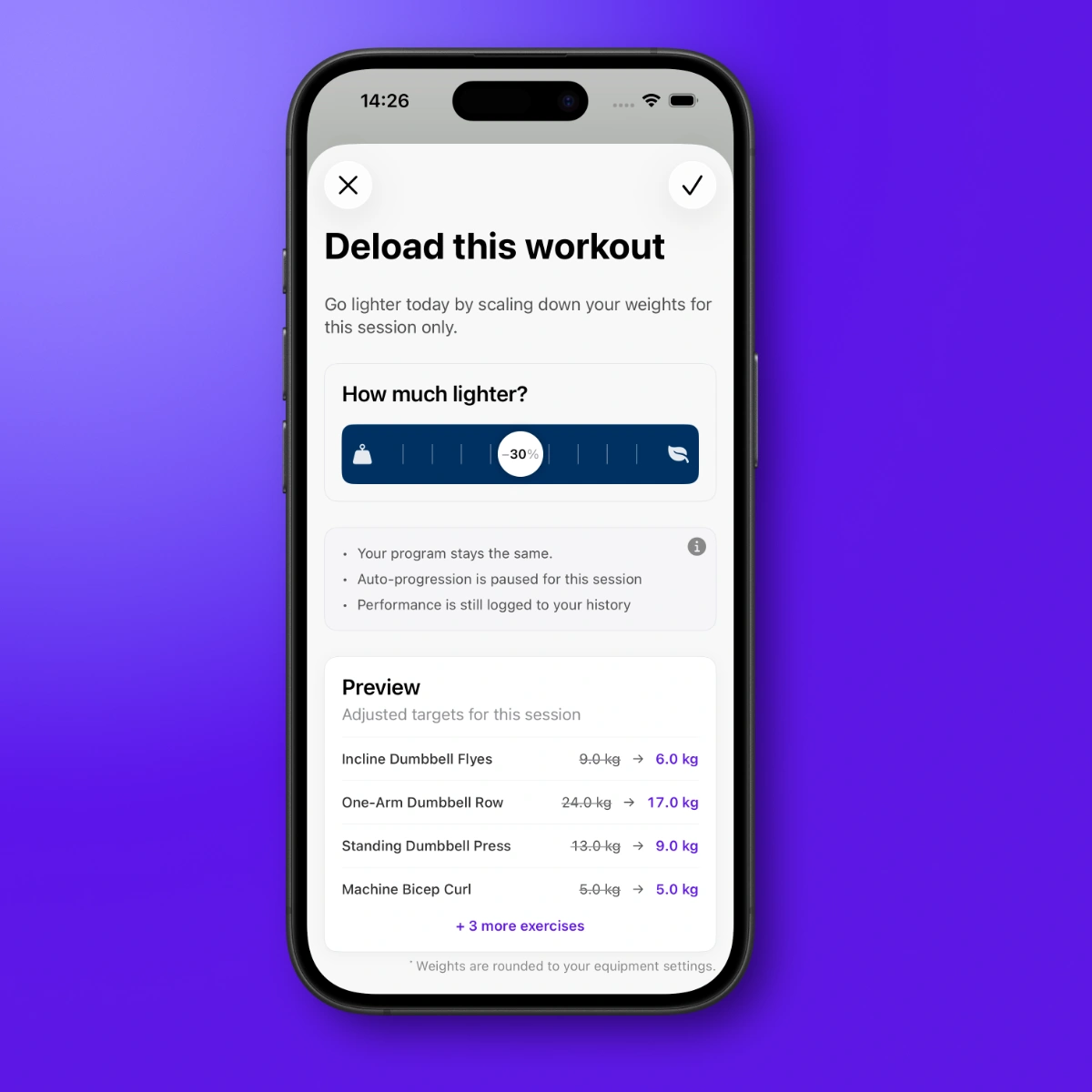 Recovery Mode makes a lighter session intentional without rewriting the routine you plan to return to.
That is useful after an unusually physical shift because it keeps today’s result honest. You are not pretending the original target happened, and you are not turning one difficult day into a full program reset. For more on making a same-day adjustment, read How to Adjust a Workout on Low-Energy Days.
The bottom line
A physical job and strength training can work together when you respect the total workload. Put your hardest sessions where recovery is most available, reduce one variable when work is unusually demanding, and judge progress over patterns rather than one tired day.
Steady keeps that process simple: log the work you actually completed, add the small piece of context that matters, and make the next sensible decision from a clear history. Consistency is not doing the maximum every day. It is training in a way you can repeat.
Ready to start applying progressive overload?
Ditch the spreadsheets and complex notes. Join thousands of lifters who use Steady to focus on the workout, track their progress, and automatically know when to add weight.
Download Free for iPhone