What Are Effective Reps? A Practical Guide

Effective reps are the repetitions near the end of a hard set, when the target muscle has to work hardest because you are close to failure. The idea is useful for understanding hypertrophy, but it is not a cue to count a secret number of magic reps or take every set to failure. For most lifters, the practical takeaway is simpler: make your working sets genuinely challenging, then track them consistently.
If a set ends with several clean reps still available, it may be useful practice, but it probably is not delivering the same growth stimulus as a set finished close to your limit. That does not mean easy work is worthless. It means your progress is built mostly on the sets where the final reps demand real effort.
What “effective reps” actually means
The phrase comes from a useful observation: as a set gets harder, more high-threshold muscle fibers need to contribute. The last few repetitions of a challenging set are therefore often the most stimulating ones for muscle growth.
That does not mean only the last few reps matter. Earlier reps create fatigue, require control, and are what make those later reps challenging. Think of effective reps as a way to describe the hard end of a well-performed working set—not as a separate rep category you must log.
For a set of 10 on a leg press, the first several reps may feel smooth. If the final two or three require steady bracing, controlled speed, and real focus while your form stays intact, the whole set has done its job.
Effective reps vs. hard sets
For day-to-day training, hard sets are the more useful unit.
A hard set is a working set performed close enough to failure that it asks for meaningful effort. A simple practical range is about 0 to 4 reps in reserve (RIR):
- 0 RIR: You could not complete another clean rep.
- 1–2 RIR: Very hard, but you likely had one or two good reps left.
- 3–4 RIR: Challenging, with a little more room to work.
- 5+ RIR: Usually too easy to rely on as a main hypertrophy set, unless it has another purpose such as technique practice or a warm-up.
This is why training volume is usually tracked as hard working sets rather than a total count of “effective reps.” Hard sets are easier to repeat, compare, and plan without pretending you can measure every fiber recruited on every rep.
How close to failure should you train?
You do not need the same answer for every exercise.
For big compound lifts such as squats, presses, rows, and deadlifts, stopping with 1 to 3 RIR is often a strong balance. You get a hard enough set to drive adaptation without turning every session into a technical gamble. For stable machine and isolation movements, going a little closer—often 0 to 2 RIR—can make sense because the consequences of a missed rep are usually smaller.

The final reps should look controlled and repeatable, not rushed or distorted.
The best range is the one that lets you train hard, recover, and return with credible performance next time. If your form changes sharply, your range of motion shrinks, or your next planned sets collapse, you probably pushed past the point where more effort was useful.
Three mistakes the effective-reps idea can create
Treating every set like a failure test
Training close to failure is not the same as failing constantly. A few hard final reps are useful; a failed rep with compromised position is not automatically better. Leave room when safety, technique, or the rest of the workout calls for it.
Chasing a sensation instead of a standard
A burn, a pump, or heavy breathing can be part of a tough set, but none proves the set was productive. Use the exercise, load, reps, range of motion, and your proximity to failure together. A controlled set of leg presses at 2 RIR tells you more than a dramatic-looking set that ends early.
Trying to count exact effective reps
You cannot reliably identify a precise fourth-from-last “growth rep” in real time. That level of precision creates busywork, not better training. Use a repeatable effort range instead.
A simple way to log the idea
Record the weight and reps for every working set. Then add an effort rating only when it changes what you should do next time:
- If you reached the planned reps with 3–4 RIR, you may be ready to add a rep or a small amount of load.
- If you reached them with 1–2 RIR and clean form, repeat the plan or make a modest progression.
- If the set was a grind at 0 RIR sooner than expected, hold the target or adjust the next session rather than forcing an increase.
In Steady, the set-effort control shows RPE and its matching RIR together, so you can record the difficulty of a hard set without turning the workout into a spreadsheet.
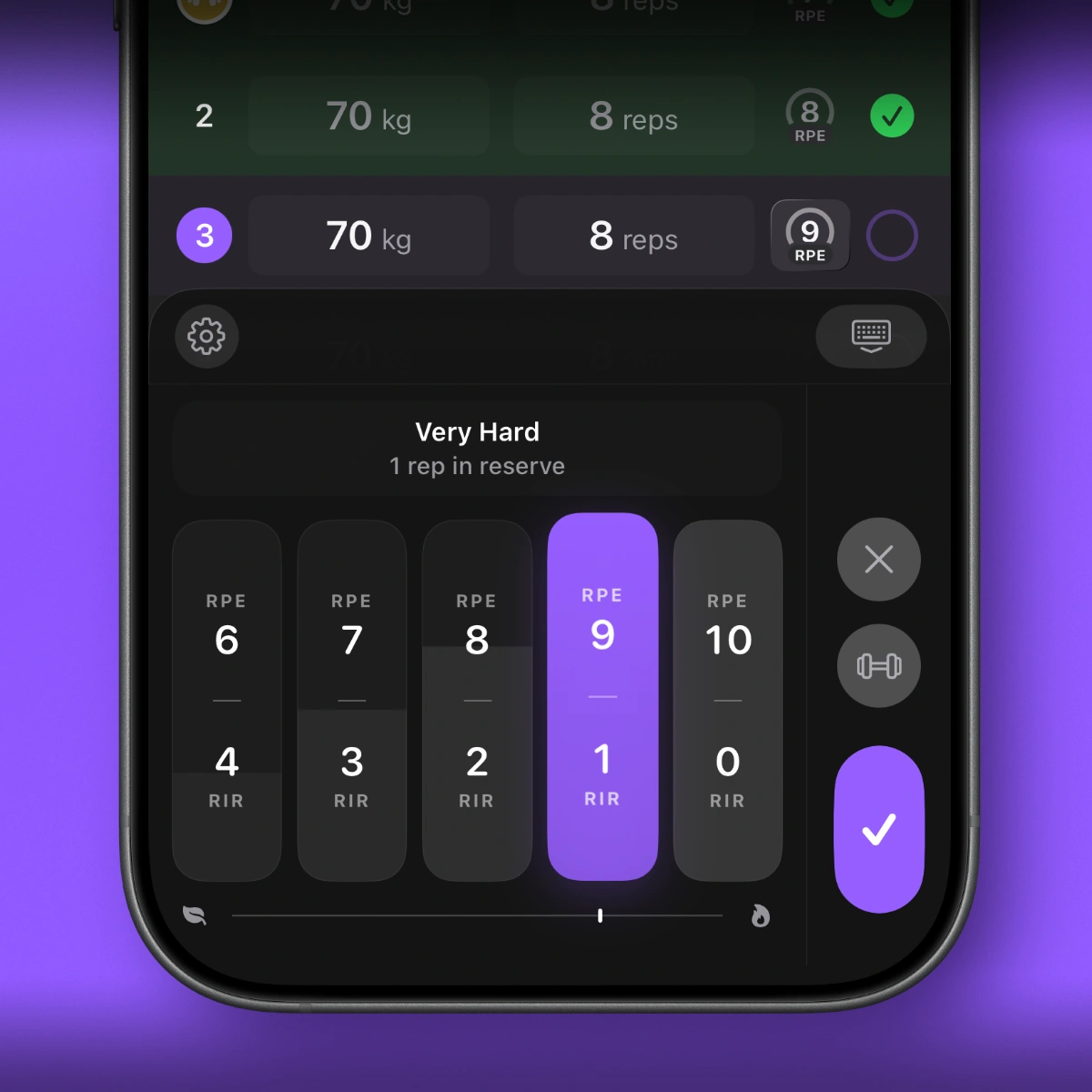
An RPE 9 corresponds to roughly one good rep left in reserve—the kind of hard, controlled effort that is often useful for a working set.
If RPE is new to you, start with a simple RPE workflow. The goal is not to rate every movement perfectly. It is to preserve the context that makes your next decision better.
The practical takeaway
Effective reps are a helpful explanation for why hard, well-controlled sets build muscle. They are not a reason to chase failure, inflate your volume, or track every rep like a lab experiment.
Train your working sets with intent, finish most of them close enough to failure to be meaningful, and keep a clear record of what happened. Steady gives you one calm place to log the work and the effort behind it—so your next session can be based on evidence rather than a vague memory of how hard it felt.
Ready to start applying progressive overload?
Ditch the spreadsheets and complex notes. Join thousands of lifters who use Steady to focus on the workout, track their progress, and automatically know when to add weight.
Download Free for iPhone