Rep tempo: what it means and how to track it

If you’ve ever watched two people do the same set of ten reps in completely different ways — one bouncing the bar off their chest, the other lowering it like it’s made of glass — you’ve already seen rep tempo in action. The weight on the bar was the same. The work being done was not.
Rep tempo is the speed at which you perform each phase of a rep — usually written as a four-number sequence like 3-1-1-0. Each digit is a number of seconds: how long you take to lower the weight, pause at the bottom, lift it back up, and pause at the top. Lifters use it to make a set harder without adding weight, lock in form, and target specific training adaptations.
What the four-number notation means
The standard tempo notation reads in this order:
- Eccentric — lowering the weight (going down on a squat, lowering on a bench press)
- Bottom pause — held at the stretched position
- Concentric — lifting the weight (standing up, pressing back up)
- Top pause — held at the contracted position
So 3-1-1-0 means: 3 seconds down, 1 second pause at the bottom, 1 second up, no pause at the top. A 4-0-1-0 tempo on a squat means a 4-second descent, no pause at the bottom, a 1-second drive back up, and straight into the next rep.
You’ll occasionally see an X in the third slot — that means explosive, as in “lift as fast as possible while maintaining control.” A 2-0-X-0 deadlift means 2 seconds down, no pause, lift as explosively as you can.
Why tempo matters
Most lifters never think about tempo, and that’s part of the problem. Without a deliberate cadence, reps drift faster as the set gets harder, momentum starts doing the work, and the muscle gets less of the stimulus you’re actually trying to deliver.
Controlling tempo gives you four real benefits:
- More time under tension. A 3-1-1-0 set of 10 reps takes ~50 seconds; a sloppy 1-0-1-0 version takes ~20. Same reps, vastly different stimulus.
- Better form. Slower eccentrics force you to control the descent instead of dropping into it — a meaningful difference on squats, RDLs, and pull-ups especially.
- Less momentum, more muscle. Pauses at the bottom kill the stretch reflex, so the working muscle has to start the lift cold.
- A built-in progression lever. When adding weight isn’t an option, slowing the eccentric is one of the cleanest ways to make a set harder without changing anything else.
Common tempo prescriptions
Different goals call for different cadences. A few that show up often in real programs:
- Hypertrophy:
3-1-1-0or4-0-1-0— slower eccentrics for time under tension. - Strength:
2-0-X-0— controlled descent, explosive concentric. Standard for heavy compound work. - Eccentric-focused work:
5-0-1-0or even6-0-1-0— use it sparingly, because the extra fatigue can add up quickly. If you are returning from an injury, follow the tempo and loading plan set by a qualified clinician or coach. - Pause work:
2-2-1-0— bottom pause kills momentum on bench, squat, and overhead press.
If your program doesn’t specify, a default of 2-0-1-0 (controlled down, no pause, lift normally) is a sensible baseline for almost any working set.
How to actually count tempo without a metronome
You don’t need an app or a clicking timer. The two methods that work in practice:
- Mississippi count — silently count “one Mississippi, two Mississippi, three Mississippi” on the descent. Imperfect, but close enough.
- Breath counting — exhale through the concentric, inhale on the eccentric, and let your breathing pace the rep. Useful once you’ve internalized roughly how long each phase should take.
If you want to actually calibrate, film a set on your phone and watch it back. Most people who think they’re doing a 3-second eccentric are doing a 1.5-second eccentric.
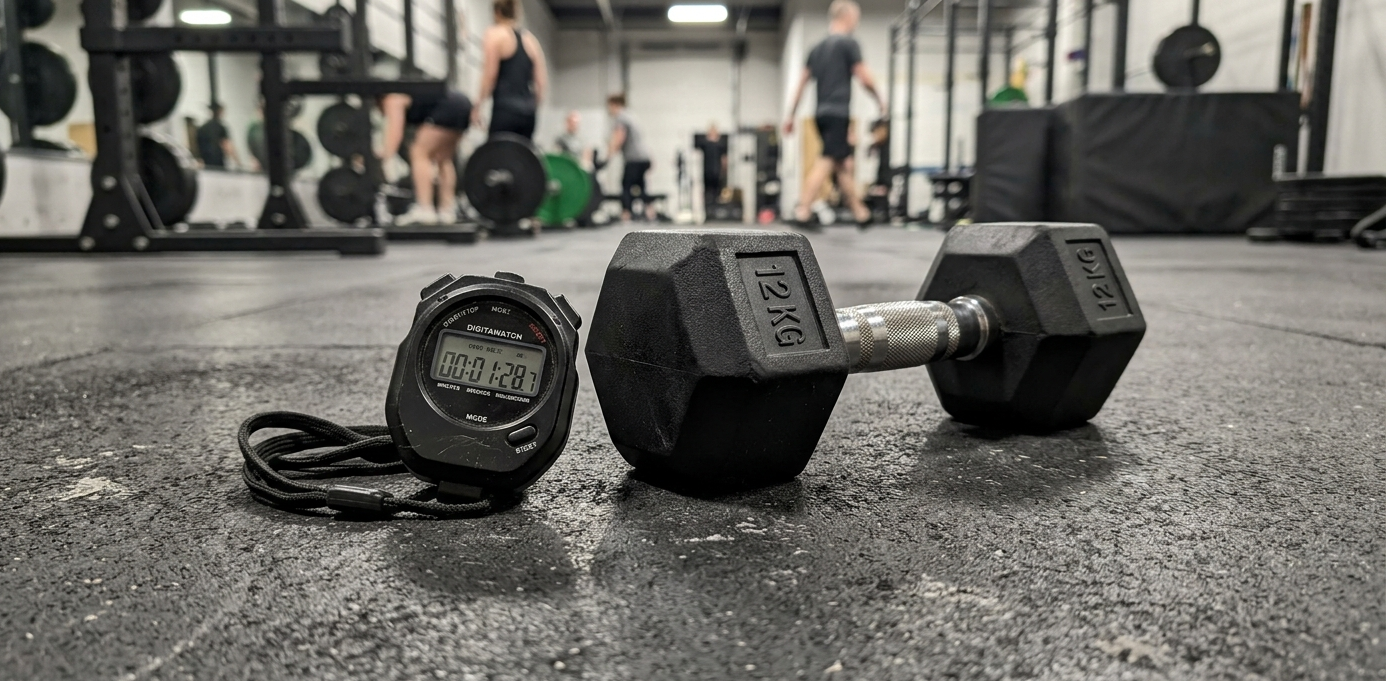
Tempo is just rest time’s twin — both are about controlling the clock inside the set, not just between sets.
How to track tempo in your workout log
The simplest approach: log the prescribed tempo on the routine, not on every set. If your hypertrophy block calls for a 3-1-1-0 on dumbbell rows, write that once at the top of the exercise and only note deviations. There’s no value in re-typing “3-1-1-0” forty times a week.
When tempo does belong in the per-set log:
- A set where you couldn’t hold the prescribed cadence — note it. That’s a sign of fatigue or load creep.
- A set where you deliberately changed the tempo (e.g. dropped to a 2-0-1-0 to hit a target rep count) — note it.
- The first session of a new tempo prescription — log how it felt so you can compare next week.
In Steady, the per-set notes field is built for this. You don’t need to add custom fields or columns; just type “couldn’t hold 3-sec descent on the last 2 reps” on the set where it happened. Next week, when you repeat the workout, that note shows up next to the set so you know what to push on.
Should everyone track tempo?
Honestly — no, not actively. For most lifters following a sensible program, the right move is to pick a default cadence (something like 2-0-1-0), apply it consistently, and stop thinking about it. Tracking tempo per-set is overkill unless you have a specific reason to.
The cases where tempo deserves real attention:
- You’ve hit a strength plateau and adding load isn’t working — manipulating tempo gives you a fresh stimulus without changing the program.
- You’re rehabbing or returning from injury — use a prescribed tempo only when it is part of the plan from your qualified clinician or coach.
- Your form falls apart at heavier weights — a forced pause or slow eccentric can help you identify and address where control is breaking down.
- You’re a fast, twitchy lifter who unconsciously rushes everything — explicit tempo prescriptions force you to actually feel the rep.
For everyone else: pick a tempo, hold to it, log only what’s worth logging. The point of tempo isn’t to add another column to your spreadsheet — it’s to make sure each rep is doing what you think it’s doing.
If you’re already using Steady, the per-set notes field is the right place for the rare tempo observation worth keeping. And if you’re still tracking workouts in a notes app or on paper, it might be time to switch — small details like tempo are exactly what gets lost when your log isn’t built for the gym.
Ready to start applying progressive overload?
Ditch the spreadsheets and complex notes. Join thousands of lifters who use Steady to focus on the workout, track their progress, and automatically know when to add weight.
Download Free for iPhone