What to Do When Reps Drop Between Sets

If your reps drop between sets, do not panic. A small drop is normal because fatigue builds as the exercise continues. The right response depends on the size of the drop: keep going if performance falls slightly, rest longer if the drop is sudden, reduce the load if form breaks down, and adjust your targets only when the pattern repeats across multiple workouts.
A rep drop is information, not automatically failure.
For example, if you planned dumbbell press for 3 sets of 10 and finished 10, 9, 8, that can be a productive workout. If you finished 10, 5, 4, something needs attention. The difference is whether the drop reflects normal fatigue or a mismatch between the target, load, rest time, and your current recovery.
Why reps drop between sets
Reps usually drop because the first set created fatigue that the next rest period did not fully clear.
That fatigue can come from:
- the load being heavy relative to your current strength
- the first set being too close to failure
- rest periods being too short
- the exercise being demanding or unstable
- poor sleep, stress, or recovery outside the gym
- doing the exercise later in the workout than usual
This is especially common on compound lifts, dumbbell presses, pull-ups, rows, squats, and any movement where setup and stability matter. Your muscles are not the only thing getting tired. Grip, bracing, coordination, and confidence under the load all affect later sets too.
How much of a rep drop is normal?
A drop of one to three reps across work sets is usually normal, especially when the first set is hard.
Common examples:
- 10, 9, 8
- 8, 8, 7
- 12, 10, 10
- 6, 5, 5 on heavier strength work
Those patterns are not automatically bad. They often mean the load was challenging and your later sets reflected real fatigue.
A bigger drop deserves a closer look:
- 12, 7, 5
- 10, 6, 4
- 8, 4, 3
That does not mean the workout is ruined. It means you should ask what changed: did you rush the rest period, overshoot the first set, choose too much weight, or train with poor recovery?
 A sharp rep drop is often a rest-time problem before it is a strength problem.
What to do during the workout
Start with the least dramatic fix.
Rest longer before the next set
If your second set drops more than expected, add 30 to 90 seconds before the next set. This is the fastest way to test whether the issue was recovery between sets.
For hypertrophy work, many lifters do better with about 90 seconds to 3 minutes. For heavy strength work, 3 to 5 minutes is often more realistic. If you are resting 45 seconds after a hard compound set and wondering why reps collapse, the problem is probably not the program.
Stop chasing the first set
Do not turn every later set into a desperate attempt to match set one.
If set one was 10 reps and set two is clearly going to be 8 with good form, take the 8. Clean reps still count. Grinding ugly reps just to make the line look even can add fatigue without adding much useful stimulus.
This is where RPE and RIR help. A set of 8 at 1-2 reps in reserve is often better than a forced set of 10 with form falling apart.
Reduce the load if form breaks down
If your reps drop and technique gets worse, reduce the weight for the remaining set.
That is not quitting. It is matching the load to the work you can still perform well. A controlled back-off set often gives better training than another max-effort attempt with shorter range of motion, unstable setup, or sloppy tempo.
Keep the load if the drop is expected
If you planned hard sets and the drop is modest, keep the load and finish the exercise.
For many exercises, a pattern like 10, 9, 8 or 8, 7, 7 is perfectly reasonable. You do not need to adjust mid-workout every time the numbers move.
Should you change the next workout?
Only change the next workout when the pattern tells you something.
Use this simple decision rule:
- Small drop, good form: repeat the same load and try to add one rep next time.
- Small drop, high effort: repeat the load and aim for the same or slightly better reps.
- Large drop caused by short rest: keep the load, but rest longer next time.
- Large drop with bad form: reduce the load or lower the target.
- Large drop repeated for several sessions: adjust the exercise target, load, or working-set count.
Progressive overload does not require every set to match. It requires your training to trend upward over time. One messy set is noise. A repeated pattern is data.
If you keep seeing the same issue, the next step might be a better target range. Instead of forcing 3 sets of 10, you might use 8-10 reps or set-specific targets like 10, 9, 8. That gives your workout room to reflect normal fatigue without making every later set look like a miss.
When per-set targets make more sense
Uniform targets are clean and easy to follow, but they are not always the most honest way to describe a hard exercise.
Per-set targets make more sense when:
- the first set is meant to be the hardest
- later sets are expected to drop slightly
- you use top sets and back-off sets
- the exercise is unstable or fatigue-sensitive
- you want each set to have a clear job
For example, a dumbbell shoulder press target of 10, 9, 8 may be more useful than pretending all three sets should hit 10. The workout becomes clearer because the expected drop is built in.
If you want a deeper comparison, read Per-Set Targets vs Uniform Targets.
How to use this in Steady
In Steady, the useful move is to log what actually happened set by set, not just the best set. That gives you a more honest view of fatigue, recovery, and progression.
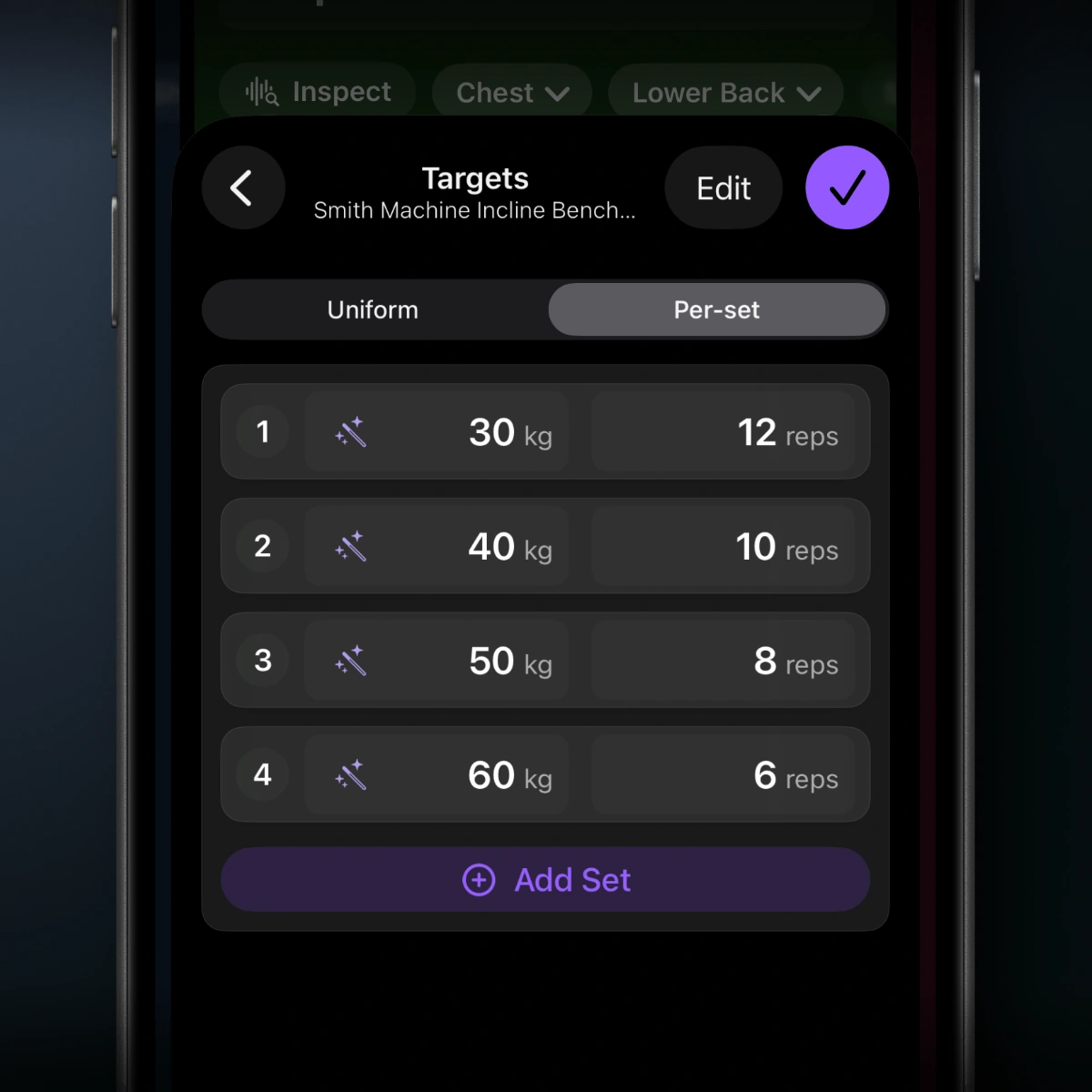 Per-set targets are helpful when a lift is supposed to change from set to set instead of repeating one identical goal.
If your reps dropped because the set was brutally hard, logging RPE or RIR adds context. If your reps dropped because the target was unrealistic, per-set targets can make the next session clearer. If the drop was just normal fatigue, your history will show that too.
The point is not to make logging complicated. It is to avoid guessing later.
Common mistakes
The biggest mistake is overreacting to one set. A worse-than-expected third set does not mean you need a new program.
Other common mistakes:
- Resting too little, then blaming strength. Short rest can make later sets collapse.
- Taking the first set too close to failure. That often steals reps from everything after it.
- Changing weight too quickly. If form is good and the drop is small, repeat before reducing.
- Ignoring exercise order. Moving an exercise later in the workout can explain lower reps.
- Only tracking the best set. The full set pattern tells a better story.
The bottom line
Reps dropping between sets is normal when training is hard. Treat it as feedback. Small drops with good form usually mean you should keep going. Large drops mean you should check rest time, effort, load, and recovery before changing the program.
The more consistently you track each set, the easier this becomes. Steady is built for that kind of clear gym logging: weight, reps, effort, targets, and history without the clutter of social feeds or aggressive upsells. Log the pattern, make the smallest useful adjustment, and let the next workout confirm whether it worked.
Ready to start applying progressive overload?
Ditch the spreadsheets and complex notes. Join thousands of lifters who use Steady to focus on the workout, track their progress, and automatically know when to add weight.
Download Free for iPhone