Compound vs Isolation Exercises: How to Balance Both
Compound exercises move multiple joints and train several muscles at once — squats, deadlifts, presses, rows, pull-ups. Isolation exercises move a single joint to target one muscle directly — curls, lateral raises, leg extensions, tricep pushdowns. A good routine leans heavily on compounds for the bulk of your strength and muscle gains, then uses isolation work to address weak points and add focused volume.
Most lifters either do too much of one or the other. Beginners often pile on isolation work because it feels like “real” bodybuilding. Strong intermediates sometimes drop isolation entirely because compounds feel more productive. Both miss the point: the two categories do different jobs, and a smart routine uses both.
The Core Difference
A compound exercise moves more than one joint and recruits multiple muscle groups working together. A back squat bends your hips, knees, and ankles at the same time and loads your quads, glutes, hamstrings, lower back, and core in one rep.
An isolation exercise moves a single joint and targets a single muscle group. A bicep curl bends only the elbow and primarily loads the biceps. The supporting musculature is along for the ride, not driving the lift.
That structural difference is what makes them feel different — and what makes each one useful for a different reason.
Why Compounds Carry the Load
Compound lifts are the foundation of most well-built routines for a few reasons:
- Efficient use of training time. Squats and deadlifts let you train several muscle groups in one movement, which is useful when your session is short.
- More muscle worked per set. One set of rows trains your lats, mid-back, rear delts, biceps, and grip together. Whether that is enough for any one muscle depends on your technique and goals.
- Practice with coordinated movement. Everyday tasks often involve several joints and muscles working together, so compounds are a useful way to build and practice that coordination.
- A larger recovery cost. Heavy compound work can be more demanding on the whole body. That is a reason to plan it thoughtfully, not a reason to assume it is automatically better for every goal.
If you only had time for two or three lifts per session, you’d pick compounds. They give you the most return on your time and energy.
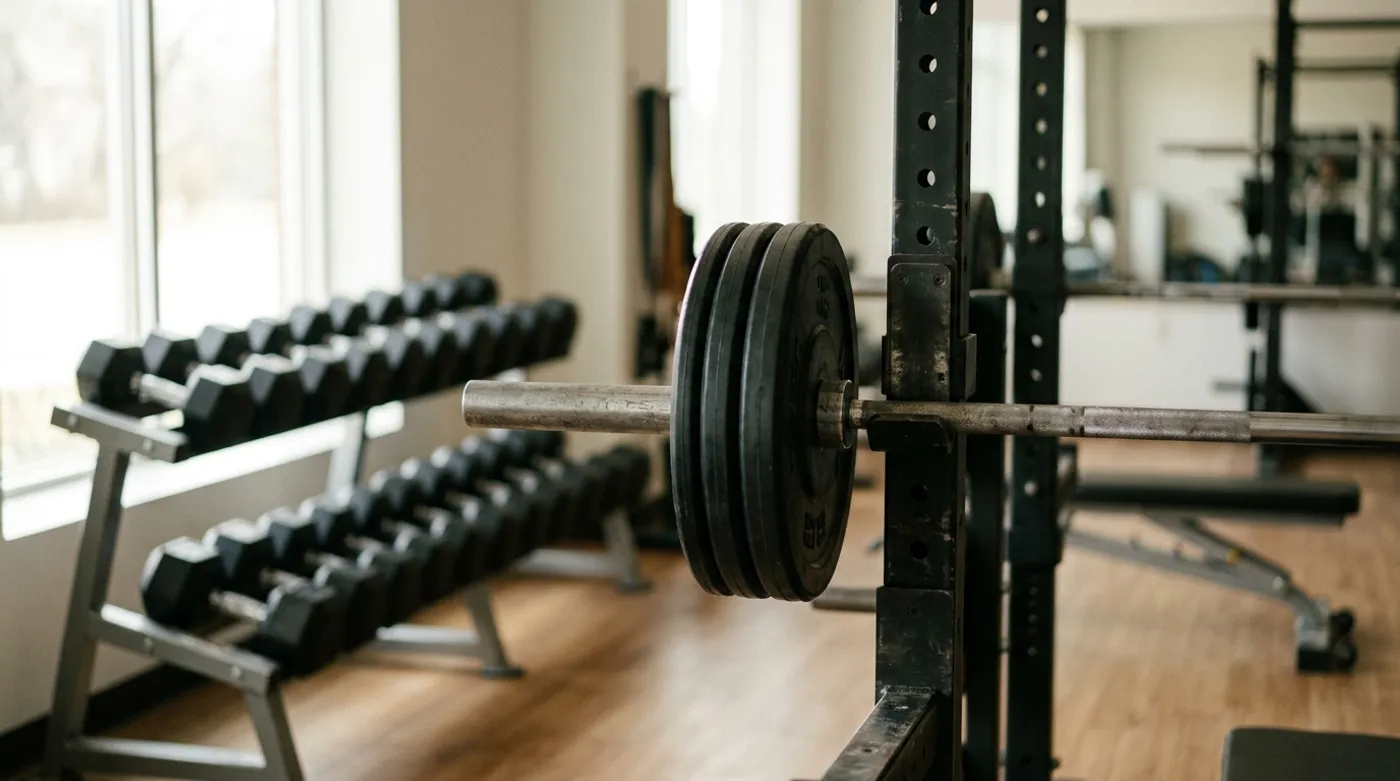
 A heavy compound like the barbell back squat is the kind of lift the rest of the session is built around.
Why Isolation Still Matters
If compounds are so efficient, why bother with isolation work at all? Three reasons:
1. Fixing weak links. Compounds train muscles in groups, but the weakest muscle in the group sets the ceiling. If your triceps cap out before your chest on bench press, your bench will stall. Direct triceps work raises that ceiling.
2. Targeting muscles that compounds underwork. Side delts, calves, biceps, and forearms get a fraction of the stimulus from compounds that they get from direct work. If you want them to grow, you have to train them directly.
3. Adding volume without adding fatigue. A set of lateral raises is much less systemically taxing than a set of overhead presses. When you’ve already done your heavy compound work, isolation lets you add productive volume without crushing your recovery.
Isolation work isn’t a substitute for compounds. It’s a complement.
A Simple Framework: Compounds First, Isolation Second
The most reliable structure for almost any session is:
- Start with the heaviest compound for the muscles you’re training that day, while you’re freshest. Squat, deadlift, bench, overhead press, row, pull-up.
- Follow with a secondary compound if it fits. Front squat after back squat, incline press after flat bench, RDL after deadlift.
- Finish with isolation work for muscles that need extra attention or didn’t get enough from the compounds.
A push session might look like:
- Bench press — 3 working sets
- Overhead press — 3 working sets
- Incline dumbbell press — 3 working sets
- Lateral raises — 3 working sets
- Tricep pushdowns — 3 working sets
Two heavy compounds, one secondary compound, two isolation movements to round it out. That’s a balanced session that respects what each category does well.
How Much of Each?
A reasonable starting point for many lifters is roughly 60–70% compound work, 30–40% isolation. Treat that as an exercise-selection guide, not a physiological target: the right mix shifts with your goals, schedule, recovery, and which muscles need direct work.
- Strength-focused (powerlifting, athletic performance): heavier on compounds, often 70–80% of total sets
- Hypertrophy-focused (building muscle, looking the part): it can be closer to 50/50, especially for muscles that need more direct work
- Beginners: start with a few well-practiced compounds, then add isolation where it helps rather than trying to do everything at once
Track your sets per muscle per week (we covered this in How Many Sets Per Muscle Group Per Week) and you’ll quickly see whether your ratio matches your goals.
Common Mistakes
Doing isolation first. Pre-fatiguing your biceps with curls before pulling means you’ll fail your rows because your arms gave out, not your back. Compounds first, almost always.
Skipping isolation entirely. “I just do the big lifts” sounds principled but leaves visible weak points — small side delts, soft arms, undertrained calves. The big lifts don’t fix everything.
Doing isolation as if it were a compound. Three sets of lateral raises with the heaviest dumbbell you can swing isn’t isolation — it’s a sloppy compound. Isolation work pays off when the form stays clean and the target muscle does the work.
Using too many exercises. Eight isolation exercises per session isn’t more thorough — it’s just diluted. Two or three well-chosen isolation movements after your compound work usually beats a buffet.
Tracking Both Categories Together
One practical issue with mixing compounds and isolation: progress looks different across the two.
A compound lift’s progress is loud — you add 5 kg to your squat and you know it. Isolation progress is quieter — you’re adding a rep here, holding form on a heavier dumbbell there. If your tracker only shows total weight per set, isolation progress can feel invisible.
A clean way to handle this:
- Track all your working sets, including isolation, with weight and reps
- Check trends over weeks, not sessions — isolation lifts respond on a longer timescale
- Don’t compare absolute weights between exercises; compare each lift to its own past
In Steady, every working set is logged the same clean way — compound or isolation — and your history per exercise stays separate, so you can see the slow climb on your lateral raises without it getting drowned out by your squat numbers.
The Bottom Line
Compounds first, isolation second. Lean on compounds for the bulk of your strength and muscle gains; use isolation to fix weak points and add focused volume. Roughly 60–70% of your sets should be compound work for most lifters, more if you’re strength-focused, less if you’re hunting hypertrophy on stubborn muscles.
The two aren’t competing — they’re doing different jobs. A routine that uses both honestly will outperform one that bets everything on either side.
Ready to start applying progressive overload?
Ditch the spreadsheets and complex notes. Join thousands of lifters who use Steady to focus on the workout, track their progress, and automatically know when to add weight.
Download Free for iPhone