How Many Sets Per Muscle Group Per Week?

For most lifters, 10 to 20 hard sets per muscle group per week is the range where muscle growth happens reliably. Smaller muscles often do well at the lower end; larger muscles that get worked indirectly by other lifts can tolerate more.
The exact number isn’t magic. It’s a window — wide enough to fit different schedules, recovery capacities, and training ages, but narrow enough that you can’t just guess. The right point inside that window, though, depends on you: how long you’ve been training, and how each individual muscle handles volume. Here’s how to think about it — and where the app can take the math off your plate.
What Counts as a “Set”
When researchers talk about weekly volume, they mean hard working sets — sets taken within a few reps of failure. That definition matters, because if you count everything, the number becomes meaningless.
A hard set is:
- A working set taken to within 0 to 4 reps of failure (RIR 0–4)
- Performed with a weight that’s actually challenging for the rep range
- Done with real intent, not cruise control
Warm-up sets don’t count. Half-effort back-off sets don’t count. If you could have done 8 more reps, it wasn’t a hard set.
The Volume Landmarks
Training science uses three landmarks to frame weekly volume per muscle. They come out of interpreting a body of weightlifting and hypertrophy research with hundreds of total subjects across studies — not from any single coach or program:
- MEV — Minimum Effective Volume. The fewest hard sets per week that still produce growth. For most intermediate lifters, this is around 8–10 sets.
- MAV — Maximum Adaptive Volume. The sweet spot where you’re growing the fastest. Usually 12–18 sets, depending on the muscle and the person.
- MRV — Maximum Recoverable Volume. The most you can do and still recover and progress. Above this, performance drops and you stop growing. Often 20–25 sets, sometimes more for back, less for smaller muscles.
The practical takeaway: start near MEV if you’re unsure, push toward MAV as you recover well and want more growth, and back off before you hit MRV. More is not always better — it’s only better up to a point.
How Many Sets Per Muscle — Practical Ranges
These are starting bands for a training cycle, assuming sets are taken close to failure:
| Muscle group | Typical weekly set range |
|---|---|
| Chest | 10–16 |
| Back (lats + upper back combined) | 12–20 |
| Quads | 10–18 |
| Hamstrings | 8–14 |
| Glutes | 8–16 |
| Shoulders (side delts especially) | 10–20 |
| Biceps | 8–14 |
| Triceps | 8–14 |
| Calves | 8–16 |
| Abs | 6–12 |
The bands are wide on purpose. Where you land inside one depends on training age, recovery, and how that specific muscle tolerates volume — and those things are different for each lifter. Treat the table as the room you have to work with, not the answer.
Remember that compound lifts distribute work across multiple muscles. A set of bench press is one chest set, but it’s also partial volume for front delts and triceps. Rows hit back and biceps. Squats hit quads, glutes, and some hamstrings. Count accordingly — don’t double-count, and don’t pretend indirect work is the same as direct work.
Steady Does the Math For You
Counting hard sets accurately is one job. Knowing whether your count is on target — for your training history, that specific muscle’s tolerance, and the program you’re running — is another. Doing it by hand for ten muscles every week is the part most lifters skip, and it’s where progress quietly stalls.
Steady’s Muscle Activation view does both. It logs every working set as you complete it and credits indirect work appropriately — a set of bench press counts fully toward chest and partially toward triceps and front delts, with diminishing weight as those secondaries pile up across the week. Then it grades each muscle’s weekly total against a target tailored to you.
The grade is plain English, per muscle: barely getting trained, on a maintenance dose, actively growing, getting extra focus, or being overworked. You see it for the week you just finished — and for the week your program will deliver next, so you can rebalance before you train, not after.
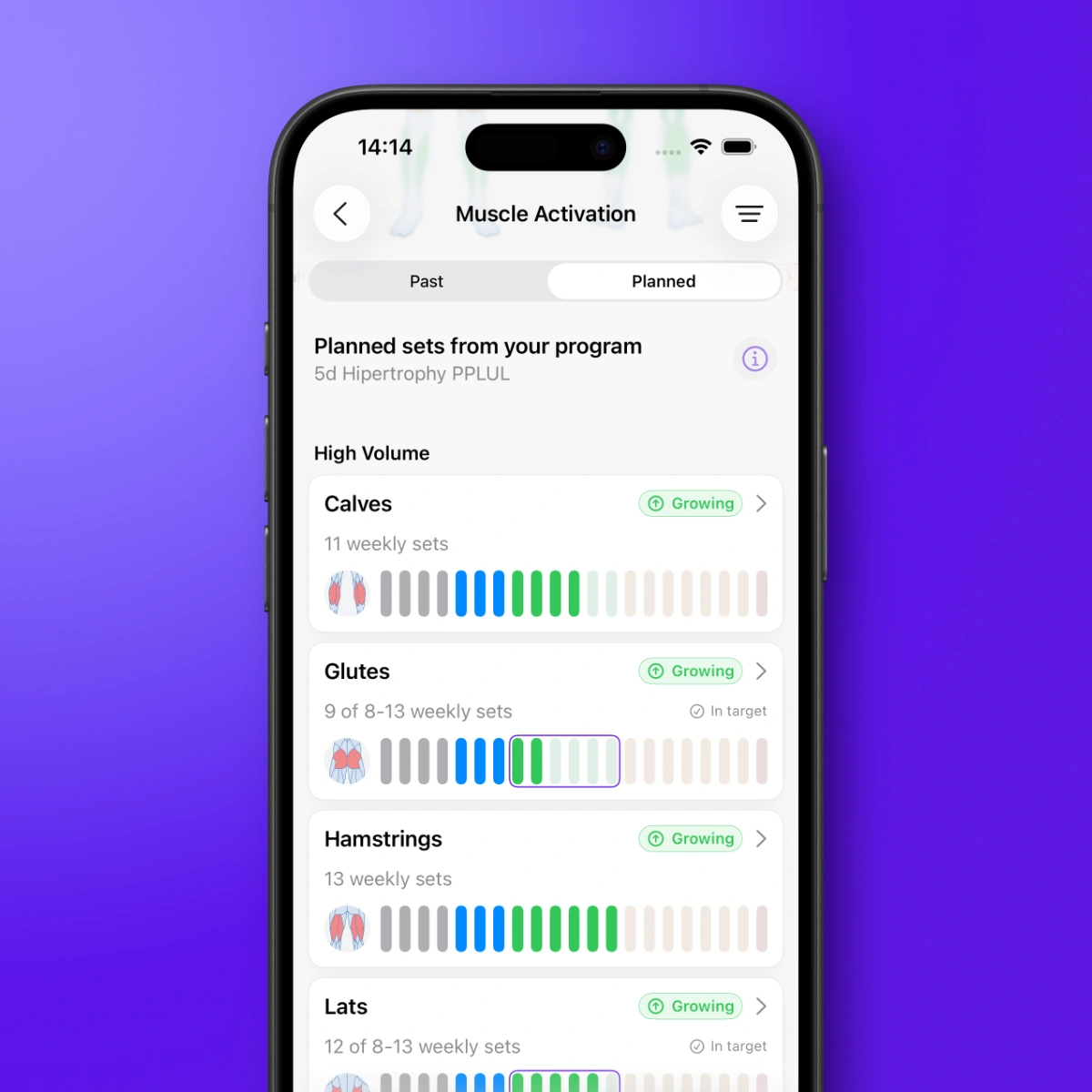 Steady grades each muscle’s weekly volume against a target tailored to you — no spreadsheets, no guessing.
The targets behind those grades come from the same body of research the volume landmarks above are drawn from, applied per-muscle and personalized — so 14 sets of back stops being a question you have to answer alone. (If you’d rather not log uniform sets across an exercise, per-set targets give you finer control — the math still works the same.)
Splitting Volume Across the Week
Research consistently shows that training a muscle at least twice a week produces more growth than hitting it once, at the same total volume. Three times can be better still, especially once your weekly sets climb past 15 or so.
A useful rule of thumb: no more than 6–10 hard sets per muscle in a single session. Past that, the quality of each set drops, and you recover poorly. If you’re doing 16 sets of back in a week, two sessions of 8 beats one session of 16.
This shapes your split more than most people realize:
- 3-day full-body: every muscle trained 3×/week, so each session only needs 3–5 sets per muscle to reach 10–15 weekly
- 4-day upper/lower: each muscle trained 2×/week, so ~6–8 sets per session gets you to 12–16 weekly
- 5–6 day push/pull/legs: each muscle trained 2×/week with more room per session, enabling higher volumes if you can recover
If you haven’t settled on a split yet, we’ve written about how to build a 3-day routine and how to build a 4-day upper/lower program — both lay out how volume lands across the week.
Start Low, Add Gradually
A common mistake is to copy an advanced bodybuilder’s 25-set chest week and wonder why you feel destroyed and aren’t growing. Volume tolerance is trainable. The higher you go, the more recovery capacity you need — and that capacity builds over months, not days.
A simple progression:
- Pick a starting number near MEV for each muscle — usually 8–10 sets per week.
- Run it for 3–4 weeks and see how recovery, performance, and soreness trend.
- Add 1–2 sets per muscle per week if you’re still recovering and progressing.
- Back off when sets stop feeling productive — reps drop, joints nag, motivation sags. That’s your signal you’re near or past MRV.
- Take a deload week every 4–8 weeks to let fatigue clear.
The goal is to stay in the zone where you’re growing and recovering — not to “win” at volume.
Signs You’re Doing Too Much
Overreaching on volume doesn’t usually look like injury. It looks like:
- Working weights creeping down instead of up
- Every session feeling heavy from the first warm-up
- Sleep getting worse, appetite getting weird
- Small aches in elbows, knees, shoulders that linger
- Motivation to train quietly draining
If three or more of those are true, cut volume by 30–40% for a week, then rebuild. You’ll often come back stronger than you left.
Signs You Could Do More
On the other side — if you’re recovering fast, working weights are moving up predictably, and you finish sessions feeling like you could train again in a few hours — there’s probably room to add volume. Add gradually. One or two extra sets per muscle per week is meaningful over a month.
Tracking Volume Without Spreadsheets
Whatever else you do, log every working set as you complete it. Weekly counts only mean something if you actually know what you did, and trying to remember whether you hit 14 or 18 sets for back last week is a losing game — undercounting is the norm.
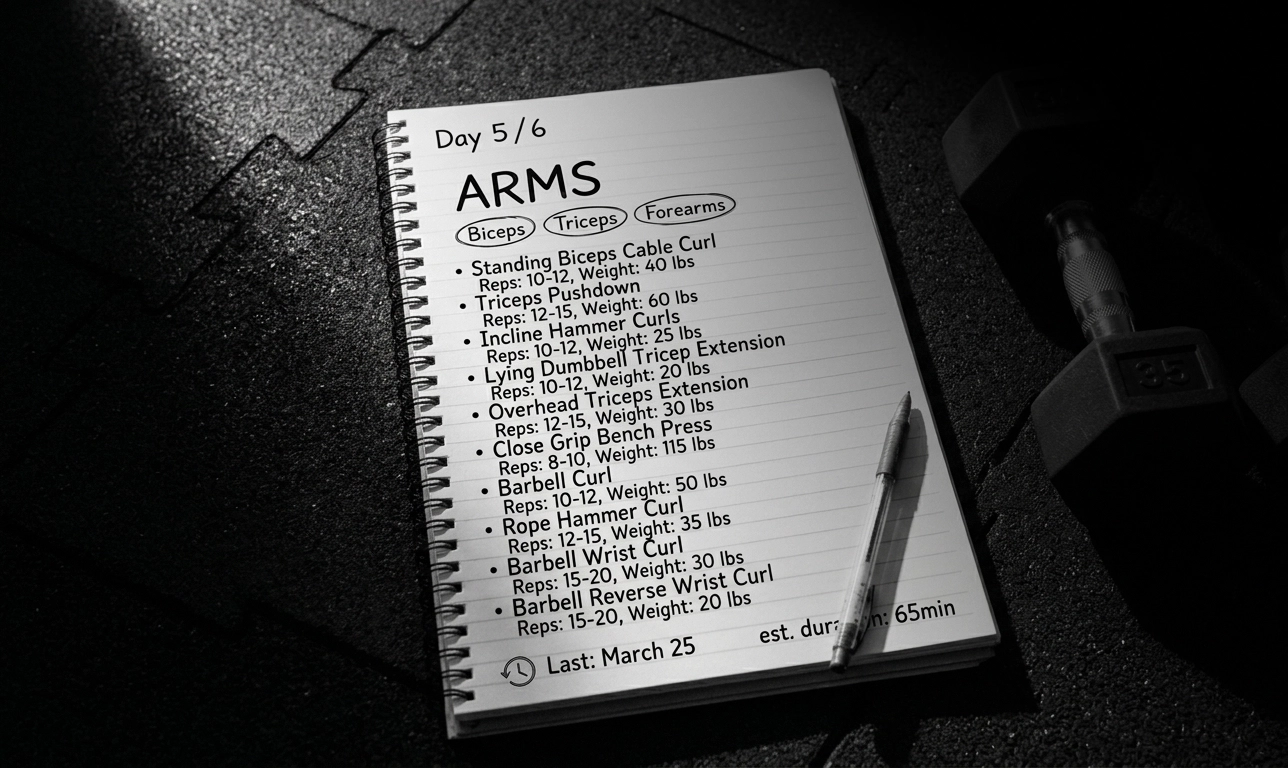 Logging every working set turns weekly volume from a guess into a number you can plan against.
A workout tracker — Steady, a notebook, anything in between — turns the math above from a guessing game into a small, informed decision.
The Bottom Line
Ten to twenty hard sets per muscle group per week, spread across at least two sessions, is where most people grow. Start on the lower end, add slowly, and cut volume before you crash. The lifters who make the most progress aren’t the ones doing the most — they’re the ones doing enough, consistently, for long enough to compound.
Volume is a tool, not a trophy. Use the smallest dose that keeps you growing.
Ready to start applying progressive overload?
Ditch the spreadsheets and complex notes. Join thousands of lifters who use Steady to focus on the workout, track their progress, and automatically know when to add weight.
Download Free for iPhone