Home Gym vs Commercial Gym for Strength

A home gym is better for strength when convenience is the thing that keeps you training. A commercial gym is better when broader equipment, heavier loading, or the training environment helps you make more progress. Neither setup is automatically superior: the best one is the place where you can train hard, progress your core movements, and show up often enough for months to matter.
The comparison gets muddled because people treat equipment access and training quality as the same thing. They are not. A commercial gym gives you more options; it does not give you a better workout by default. A garage gym removes the commute; it does not automatically make a barbell, a bench, and a few dumbbells enough for every goal.
What a home gym does exceptionally well
The biggest advantage is not saving money or avoiding crowds. It is reducing friction. When the rack is twenty steps away, a 45-minute session does not need to become a two-hour outing. That changes how often many people train.
A home gym is especially strong when you:
- have an unpredictable work or family schedule;
- prefer early-morning, late-night, or short sessions;
- want to repeat a simple strength-focused routine; or
- dislike waiting for equipment and the social energy of a busy gym.
You do not need a huge setup to get strong. A rack or stands, barbell, plates, bench, adjustable dumbbells, and a way to pull can cover the major movement patterns for a long time. The constraint can even be useful: fewer choices make it easier to learn a handful of movements and progress them patiently.
The limitation shows up when your training needs become more specific. Small weight jumps, a cable station, leg-curl options, cardio equipment, or a long list of machine variations are expensive and space-hungry to recreate at home. If an exercise is central to your progress, make sure your setup can load it safely and repeatedly—not just occasionally.
What a commercial gym does exceptionally well
A commercial gym gives you an equipment menu that a typical home setup cannot match: multiple cable angles, machines that let you work close to failure safely, specialty bars, cardio options, and enough stations to change an exercise without redesigning the whole session.
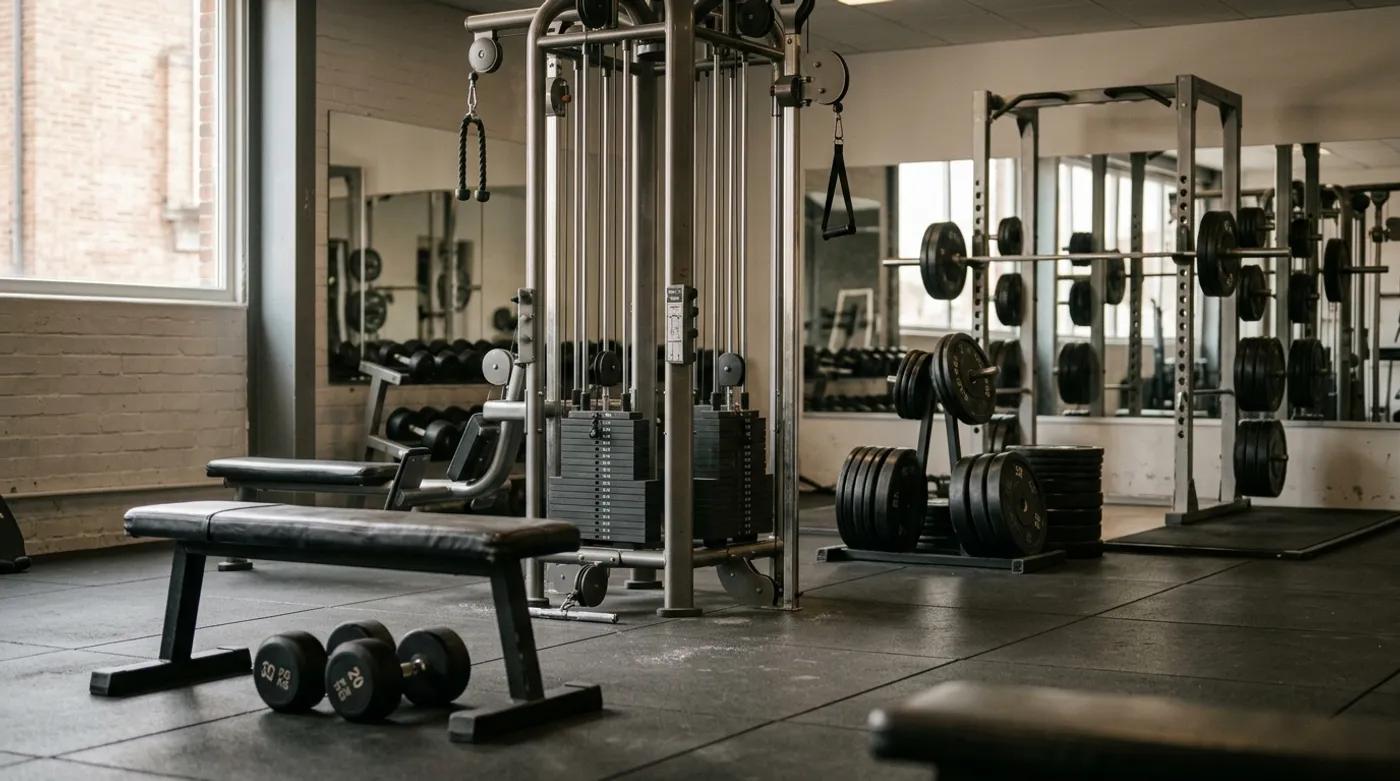
A broader equipment menu is useful when it solves a real training problem—not when it simply creates more decisions.
That matters most for lifters who want more exercise variety, train a mix of strength and hypertrophy, or need alternatives that are easier on a particular joint. A machine can make hard sets more practical when a free-weight version would need a spotter. Cables can keep an accessory movement available when dumbbell jumps are too large. You can read more about using each tool well in Free Weights vs Machines.
The trade-off is friction. Commute time, peak-hour waits, music, crowds, and the small effort of getting out the door can all turn a planned session into a skipped one. A gym membership is only useful if its advantages are large enough to overcome that cost in real life.
Choose based on your bottleneck, not your ideal setup
Ask one honest question: what usually stops your training from being productive?
If it is time and consistency, home often wins. The ability to train for 30 minutes without a commute can beat access to every machine you do not have time to use.
If it is equipment and progression, a commercial gym often wins. You may need more loading options, safer ways to push hard, or enough variation to keep a long training phase moving.
If it is motivation, the answer is personal. Some people focus better in a gym where training is the only job. Others train more consistently at home because there is no audience, commute, or opening-hours constraint. Choose the environment that makes starting feel ordinary, not heroic.
A hybrid approach is often the practical answer
You do not have to defend one side forever. A modest home setup can handle your dependable basics while a commercial gym supplies the sessions that need more equipment. For example, you might do two barbell-focused sessions at home and one machine- and cable-heavy session at the gym each week.
The key is to give each location a purpose. Do not make the home session a random backup and the gym session a random collection of machines. Keep the main lifts and progression rules clear, then choose the place that makes each part easiest to execute.
If you move between settings, make your exercise list match the equipment you actually reach. Customize Your Exercise Library for Your Gym explains how to keep those choices practical instead of scrolling through movements that are unavailable today.
How to tell whether your setup is working
Review the last six to eight weeks, not one unusually good workout. Your setup is doing its job if you can answer yes to most of these:
- Did you complete most of the sessions you planned?
- Can you make a clear progression choice for your main movements?
- Are equipment limitations occasional inconveniences rather than weekly dead ends?
- Does the setup fit your schedule without creating constant negotiation?
Track the same basics wherever you train: exercise, load, reps, and a note when the setting changed the plan. That makes a home dumbbell press comparable to your past home dumbbell presses, without pretending it is identical to a commercial-gym machine press. Steady keeps that history in one focused workout log, so the location does not erase the pattern.
The bottom line
Choose a home gym when convenience lets you train more consistently. Choose a commercial gym when its equipment and environment solve problems your home setup cannot. The better choice is not the more impressive room—it is the one that lets you accumulate months of clear, repeatable training.
Ready to start applying progressive overload?
Ditch the spreadsheets and complex notes. Join thousands of lifters who use Steady to focus on the workout, track their progress, and automatically know when to add weight.
Download Free for iPhone