How to Choose Your Starting Weight on a New Exercise
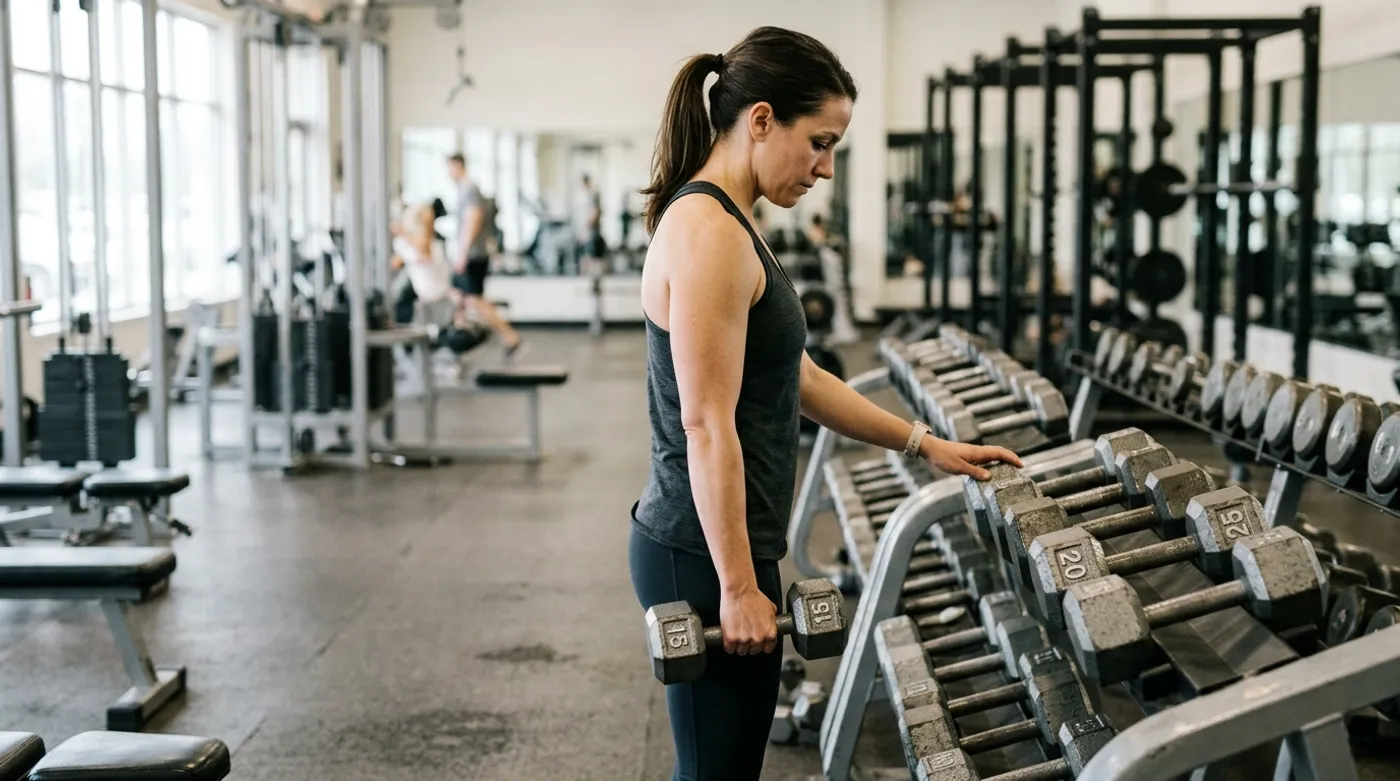
You’re about to do an exercise you’ve never done before, and the only honest question is: how heavy? Start with a weight you are confident is light, take one to three short practice sets of three to five smooth reps, and add load in small steps. Then choose a first working weight that lets you complete your planned rep range with clean technique and roughly two to four reps in reserve (RIR). If your program has no target yet, keep the first session around RPE 6–8—challenging, but clearly shy of a grind. Log what you find so the next session starts with a useful reference.
The trap most lifters fall into is treating the first session of a new exercise as a benchmark — a number to brag about or to “set the bar.” It isn’t. It’s a calibration session. The goal isn’t to hit your peak; it’s to find a load you can build on for the next several weeks of progressive overload.
Why Starting Light Is Actually the Right Move
A new exercise is new for two reasons: it may load you in a less familiar position, and you have not yet practiced its movement pattern under load. Familiarity often improves quickly, but the first session should prioritize learning the pattern over proving strength.
When you start too heavy:
- Form breaks down, often subtly. Range of motion shortens, you compensate with another muscle, you bounce reps that should be controlled.
- You generate noisy data. A first-session number set with sloppy form isn’t a useful baseline — it’s a lie that you’ll spend the next month trying to “beat.”
- Heavy unfamiliar loading can reveal a technique or tolerance problem before you recognize it.
A conservative first attempt is easy to correct within the session. If you have sharp, persistent, or concerning pain—or an injury or health condition that affects loading—stop and get individualized guidance from an appropriate clinician or qualified coach.
The Ramp-Up Method
This is the practical version of “find your starting weight.” A five-rep check set is a way to learn where to go next; it does not automatically determine the right load for a set of 8, 10, or 15 reps.
- Pick a clearly manageable starting weight. For dumbbells, choose a conservative pair; for a barbell, use the empty bar or light plates; for a machine, begin low on the stack.
- Do three to five controlled reps. Keep the range of motion and setup you plan to use for the working sets. If the effort feels very easy, that is useful information—not a failure.
- Add the smallest practical increment. The available jumps differ by gym and equipment, so use the next sensible option rather than chasing a fixed number.
- Reassess after each short set. Stop increasing once you have a load that should let you complete the planned rep range with clean reps and about two to four RIR. RPE 7–8 usually means roughly two or three reps in reserve, but it is only an estimate—especially on an unfamiliar movement.
That is your first working weight. If the program calls for 8–12 reps, use the working set—not just a five-rep probe—to judge whether the load fits. Do not turn day one into a max test.
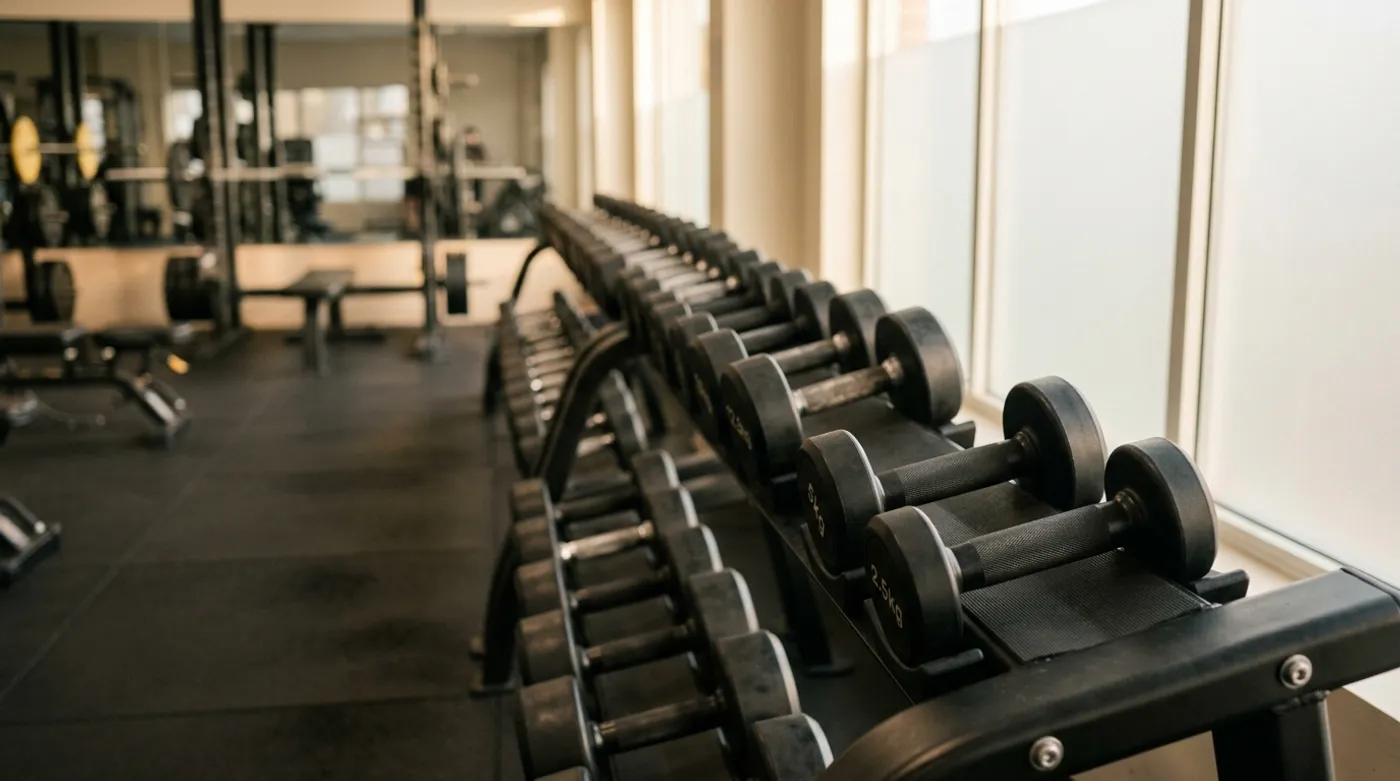
Most well-stocked dumbbell racks make ramping easy — you can step up in 5 lb increments without thinking about it. Barbell exercises take a little more planning with plates, but the logic is the same.
How to Estimate a First Attempt If You’re Pressed for Time
If you genuinely cannot take several ramp-up sets—because the gym is busy or the exercise comes late in the session—use a related lift only as a loose anchor:
- Choose a clearly lighter, more conservative option than your known comparable lift.
- Take one controlled check set in the rep range you plan to train.
- Adjust down if technique changes or the effort is unexpectedly high; adjust up only if the set is clearly far below the intended effort.
There is no reliable conversion formula between exercises. Leverage, range of motion, equipment, and stability demands all change the answer. Even when time is short, one controlled check set is a better safeguard than copying a number from another movement.
What “Too Heavy” and “Too Light” Look Like
The number on the dumbbell isn’t the signal — your reps are. Watch for these patterns:
Too heavy for today’s first working set — at least one of:
- The first rep is already a struggle.
- Your form changes during the set: range of motion shortens, you generate momentum, or you lose the setup you intended to practice.
- You reach the planned reps only by grinding, or finish much closer to failure than intended.
- Pain or discomfort is new or escalating.
Probably too light — all of:
- You complete the top of your planned rep range with far more reps in reserve than intended.
- Form and speed stay controlled throughout.
- You could comfortably do several more reps with the same setup.
If you are somewhere between—challenging but clean, with roughly two to four reps left in the tank at the end of the planned work—you have a sensible place to start.
Log It So Next Session Is Dialed In
This is where calibration pays off. The whole point of a calibration session is that the next session starts dialed in, not at zero. So write down what mattered:
- The working weight.
- Reps achieved at that weight.
- A note on effort and setup: “RPE 7 with 3 RIR,” “seat 4,” or “could use the next increment.”
That last note is useful because it tells future-you whether to repeat the load or make a small adjustment. Do not assume every session needs more weight; changes in recovery, setup, and rep quality matter too.
This is the part where Steady earns its place in the gym. You log the set, the reps, the weight, and a one-line note; next session, you can review the past workout instead of guessing. No app store of pre-built programs to navigate. No social feed. Just the context you recorded last time.
Common Mistakes
- Treating the first session as a benchmark. It is calibration. Treat the early sessions as a learning curve, not a personal-record attempt.
- Skipping the warm-up because “it’s just a new exercise.” A few controlled practice reps help you check the setup and movement before the working sets.
- Copying a friend’s weight. Leverage and experience differ. The same dumbbell row weight that’s a warm-up for a 200-lb experienced lifter is a working set for a 140-lb beginner.
- Stopping at one heavier set when you still had cleaner reps. Two or three ramp sets is normal. Don’t talk yourself out of finding your real starting weight just because you found a weight that “feels okay.”
- Pushing to failure on day one to “see what you can do.” You do not need to find a true limit to establish a useful starting point. Leave room to learn the movement and compare the next session.
The Punchline
Starting weight is not a single magic number. Use a few light practice sets, judge the load in the rep range you actually plan to train, and keep the first working set a few reps shy of failure. Logging what you find is how the next session stops being a guess.
Steady is built around exactly this loop: log the weight, reps, and a useful note, then review the past session before deciding what to repeat or adjust. No clutter and no social feed in the way. Steady is free on iOS and Apple Watch.
Ready to start applying progressive overload?
Ditch the spreadsheets and complex notes. Join thousands of lifters who use Steady to focus on the workout, track their progress, and automatically know when to add weight.
Download Free for iPhone