How to Tell If a Weight Is Heavy Enough

The simplest way to tell if a weight is heavy enough is this: you can complete your target reps with clean form, but the last few reps clearly slow down and you finish with about 1–3 reps left in reserve. If you could do five more reps, it is probably too light. If your form breaks or the first rep already feels like a grind, it is too heavy for that set.
That answer matters because most lifters make load selection more emotional than it needs to be. They chase the number from last week, copy someone nearby, or keep adding weight because the first two reps felt fine. A useful working weight is not the heaviest thing you can move once. It is the heaviest thing you can move well for the reps your program calls for.
What “Heavy Enough” Actually Means
A weight is heavy enough when it creates a training stimulus without wrecking the quality of the set. That means three things are true at the same time:
- The target reps are possible. If your program says 8 reps, you can get 8 without shortening the movement or cheating the last reps.
- The set feels challenging near the end. Reps 1–3 may feel smooth, but the final reps should require attention.
- You stop before the set turns messy. You are close enough to failure to train hard, but not so close that every set becomes a max-effort test.
In practical terms, this usually lands around RPE 7–9, or about 1–3 reps in reserve. For most hypertrophy and general strength work, that range is heavy enough to drive progress while still letting you repeat quality sets across the workout.
If you are new to an exercise, be more conservative. A load that feels like RPE 7 today gives you room to learn the movement and build next week. If you already know the exercise well, RPE 8–9 can make sense for your hardest working sets.
The Rep-Speed Test
You do not need a velocity tracker to notice useful rep speed. Just pay attention to whether the reps change.
A good working weight usually looks like this:
- The first reps move smoothly.
- The middle reps still look the same, but need more focus.
- The last one or two reps slow down without breaking your technique.
- You finish knowing you had another rep or two, but not many.
That is different from a weight that is too light. If every rep moves at the same easy speed and you finish the set feeling like you barely started, the load probably is not challenging enough for a working set.
It is also different from a weight that is too heavy. If rep 2 already looks worse than rep 1, the load is teaching compensation instead of strength. You may still complete the set, but the data is noisy: you did the reps, but not in a way worth building on.
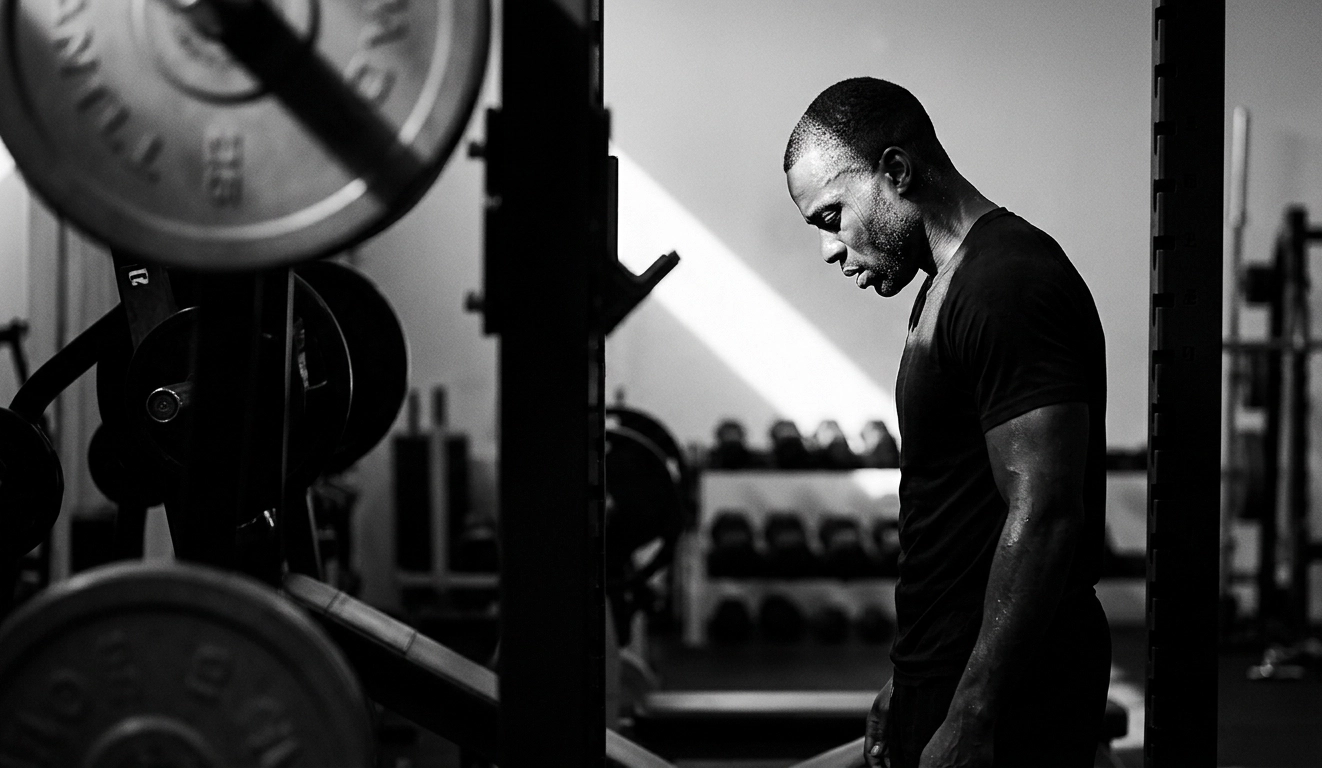
When a set is heavy enough, you usually feel the work before your form falls apart. That pause after the set is useful feedback: hard, repeatable, and still controlled.
Use Reps in Reserve, Not Guesswork
Reps in reserve, or RIR, means how many good reps you think you could still perform at the end of a set. It turns “that felt hard” into something you can use next time.
Here is a simple way to read it:
- 4+ reps in reserve: probably too light for a working set, unless it is a warm-up or a technique set.
- 3 reps in reserve: useful for early sets, new movements, and days when you want clean practice.
- 2 reps in reserve: a strong default for most working sets.
- 1 rep in reserve: hard enough for serious work, but still controlled.
- 0 reps in reserve: true failure; useful sometimes, expensive if you do it constantly.
If your program says 3 sets of 8, a strong first target is finishing each set with 1–3 reps in reserve. If set 1 feels like you had 5 reps left, add weight next time or on the next set if the exercise is safe to adjust. If set 1 is already 0 RIR, reduce the load before your remaining sets turn into survival.
Match the Load to the Goal
“Heavy enough” depends on what the set is for.
For strength work in lower rep ranges, the load should feel heavy from the first rep, but it still should not break your setup. A set of 3 at RPE 8 might move slowly, but every rep should look intentional.
For hypertrophy work in moderate rep ranges, the early reps often feel manageable. The signal shows up late: the muscle is working, the rep speed slows, and you need real focus to keep the same range of motion.
For technique work, the weight can be intentionally lighter. In that case, “heavy enough” means heavy enough to make the movement honest, not heavy enough to test your limit.
This is why a single rule like “always train to failure” is too blunt. A set can be productive without being maximal. In fact, many lifters progress better when most sets are hard-but-repeatable and only a few sets occasionally push closer to failure.
When to Add Weight
Add weight when you are hitting the target reps cleanly and consistently with too much in reserve.
A useful rule:
- Hit the top of your rep target with clean form.
- Finish the set with at least 2–3 reps in reserve.
- Repeat that across your planned sets.
- Increase by the smallest practical jump next time.
For dumbbells, that might mean moving up one pair. For a barbell, it might mean adding small plates. For machines, it may be one pin. The smaller the jump, the easier it is to keep the set in the right effort zone.
If the next jump is too large, use reps first. For example, move from 8 reps to 9 or 10 with the same weight before adding load. That approach is basically double progression, and it works because it respects both strength and rep quality.
How to Use This in Steady
Steady gives you a clean place to log the numbers that actually answer this question: weight, reps, and effort. If you record RPE after a set, you are also recording the RIR signal that tells future-you whether the load was too light, about right, or too aggressive.
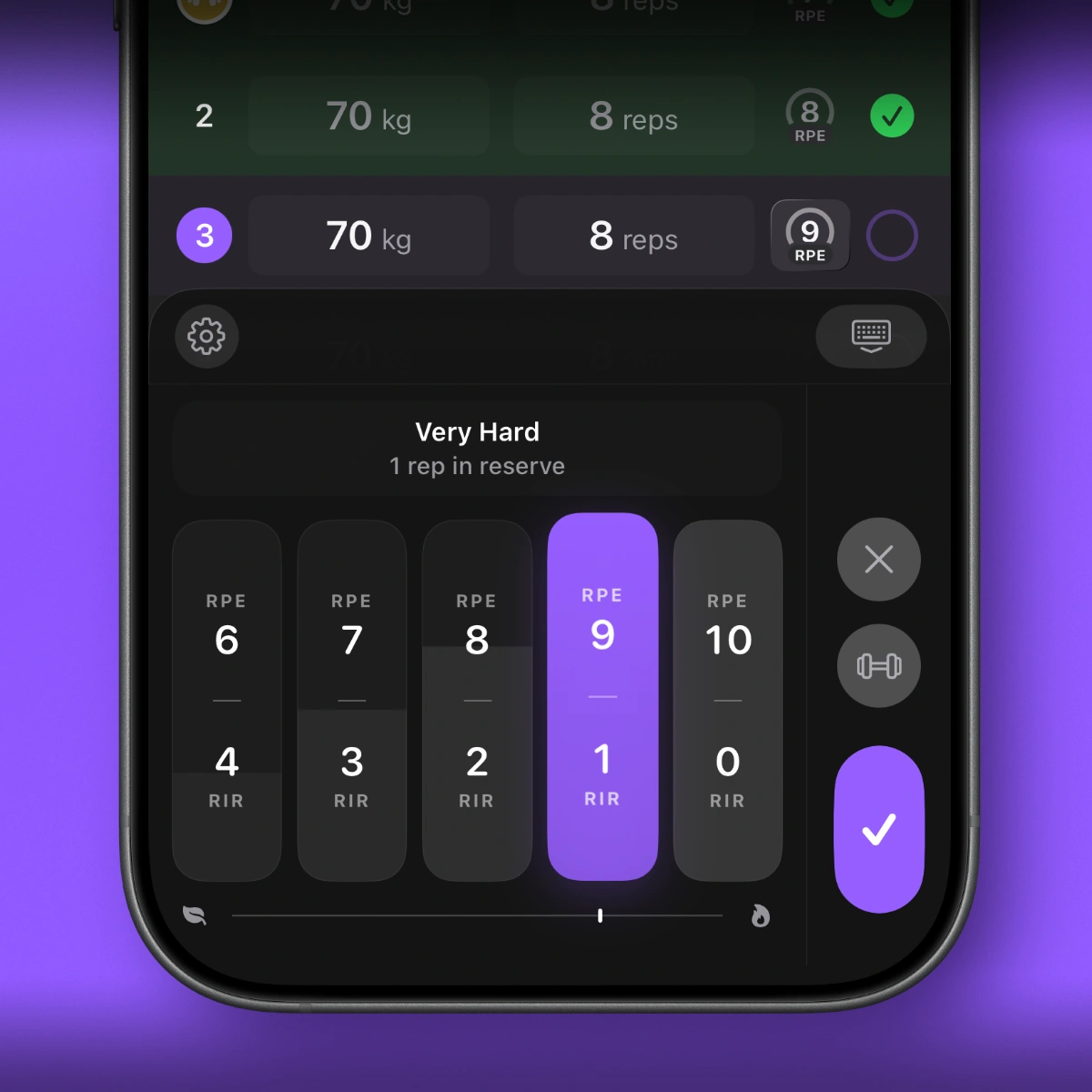 Logging RPE turns a hard set into useful context for the next workout, not just another number in the log.
The pattern is simple. If you logged 8 reps at RPE 6, you probably had plenty of room and can consider adding weight or reps. If you logged 8 reps at RPE 8, you were right in the productive zone. If you logged 8 reps at RPE 10, the set was maxed out and the next session may need a hold, smaller jump, or cleaner execution before adding load.
That is the difference between tracking and guessing. You are not just asking, “Did I lift more?” You are asking, “Did I lift enough, cleanly enough, with the right amount left in the tank?”
Common Mistakes
The most common mistake is judging the whole set by the first rep. Almost any reasonable working weight feels fine at the start. The better question is what happens near the end.
Another mistake is treating form breakdown as proof that the set was productive. A hard set is not automatically a good set. If the target muscle stops doing the work, the weight is not heavy in the useful sense. It is just too much for the way you are trying to train.
Finally, do not ignore day-to-day performance. Sleep, stress, food, soreness, and exercise order all change how heavy a weight feels. If last week’s load suddenly feels like RPE 10, that does not mean you got weaker overnight. It means today’s set needs today’s decision.
The Bottom Line
A weight is heavy enough when it challenges the target reps, keeps your form honest, and leaves about 1–3 good reps in reserve. That is the zone where most productive lifting lives: hard enough to create a reason to adapt, controlled enough that you can repeat it.
Steady is built for that kind of training. Log the weight, reps, and effort, then use the next workout to make a better decision instead of starting from memory. Steady is free on iOS and Apple Watch.
Ready to start applying progressive overload?
Ditch the spreadsheets and complex notes. Join thousands of lifters who use Steady to focus on the workout, track their progress, and automatically know when to add weight.
Download Free for iPhone