Should You Log Missed Reps?

Yes, you should log missed reps and failed sets. A missed rep is useful training data: it tells you that the target was too high for that moment, your fatigue was higher than expected, your setup broke down, or the next progression step needs to be smaller. Do not hide it from your workout log. Record what actually happened, then use the pattern to make a better decision next time.
That does not mean every missed rep is a disaster. Lifters miss reps for normal reasons all the time: poor sleep, shorter rest, an ambitious weight jump, a hard previous exercise, or simply getting closer to failure than planned. The problem is not missing once. The problem is pretending the miss did not happen, because then your next workout starts from a false picture.
What Counts as a Missed Rep?
A missed rep is any planned rep you could not complete with the form standard you intended to use.
That includes:
- Stopping at 7 reps when the target was 8.
- Failing the final rep and needing to rack or bail safely.
- Completing the rep only by cutting range of motion.
- Turning the rep into a different movement just to finish it.
- Stopping early because form was about to break.
The last one matters. If you planned 10 reps but stopped at 8 because the next rep would have been ugly, that is still useful data. In many cases, it is better data than forcing a messy rep and logging it as completed.
Why Missed Reps Belong in Your Log
Missed reps help separate emotion from evidence.
If you only log successful sets, your training history becomes too clean. It shows the numbers you wanted, not the numbers you actually earned. That makes progression harder to judge because the log loses the moments where your plan met resistance.
A missed rep can answer questions like:
- Was the weight jump too large?
- Did the target rep range move too fast?
- Did the set reach true failure or just a hard stopping point?
- Did performance drop across sets more than usual?
- Is this a one-off bad session or a trend?
That last question is the key. One missed rep usually means “pay attention.” Repeated misses on the same exercise usually mean “adjust something.”
 The moment after a hard set is when the log should capture reality, not the version you hoped would happen.
How to Log a Missed Rep
Keep the entry simple. You do not need a long confession in your notes.
For most exercises, log:
- The weight you used.
- The reps you actually completed.
- The effort level, if you track RPE or RIR.
- A short note only if the reason matters.
For example:
- Target: 100 kg x 8
- Actual: 100 kg x 6
- Effort: RPE 10, or 0 reps in reserve
- Note: “Short rest after previous set” or “form broke at rep 7”
That is enough. You now know that 100 kg for 8 was not available under those conditions. You also know whether the miss came from effort, context, or execution.
Avoid writing only “failed.” That word is too vague. A missed rep because you were too aggressive is different from a missed rep because you rested 45 seconds, skipped warm-ups, or changed exercise order.
Missed Rep vs Failed Set
A missed rep and a failed set are related, but they are not always the same thing.
A missed rep means you did fewer clean reps than planned. A failed set usually means you reached the point where another clean rep was not possible.
Here is the practical difference:
- 8 target reps, 7 clean reps, stopped with form fading: missed the target, not necessarily true failure.
- 8 target reps, 7 clean reps, attempted rep 8 and could not complete it: missed the target and reached failure.
- 8 target reps, 8 reps completed with major cheating: target completed on paper, but the set quality failed.
Your log should reflect the training reality. If the eighth rep was a half-rep with your hips twisting and the target muscle gone, calling it “8” may make the workout look better, but it makes the data worse.
What to Do After One Miss
Do not overreact to one missed rep. Treat it as a signal, not a verdict.
After one miss, ask:
- Did I sleep, eat, and rest normally?
- Was the exercise in the same place in the workout?
- Did I use the same form standard?
- Was the progression jump unusually large?
- Did I miss by one rep or by several?
If the miss was small and the context was clearly worse, repeating the same target next time often makes sense. If the miss was large, or the set hit RPE 10 early, reduce the target or make a smaller jump.
This is where day-to-day performance tracking matters. A single bad set can happen inside a good trend. Several comparable misses in a row are different.
When a Miss Means You Should Adjust
A missed rep deserves an adjustment when it repeats or when it exposes a target that is obviously too aggressive.
Adjust when:
- you miss the same target across two or more comparable sessions
- the first working set is already at RPE 10
- later sets collapse much more than usual
- you are missing reps while also losing form quality
- the next weight jump is too large for the rep range
The adjustment does not always need to be a deload. Sometimes the best move is simply to hold the same weight, rebuild reps, or use double progression. For example, if 32 kg dumbbells for 10 reps is not happening yet, stay at 30 kg until the top of the range is cleaner.
For barbell lifts, smaller plates can help. For machines, one pin may be too big on some stacks, so adding reps before load may be more productive. For exercises where technique breaks quickly, a missed rep may be a form cue before it is a programming issue.
How to Use This in Steady
In Steady, the useful part is that you can log the set as it actually happened: performed weight, performed reps, and RPE when you want the effort context. The app’s RPE/RIR mapping treats RPE 10 as no reps in reserve, RPE 9 as about 1 rep in reserve, RPE 8 as about 2 reps in reserve, and so on.
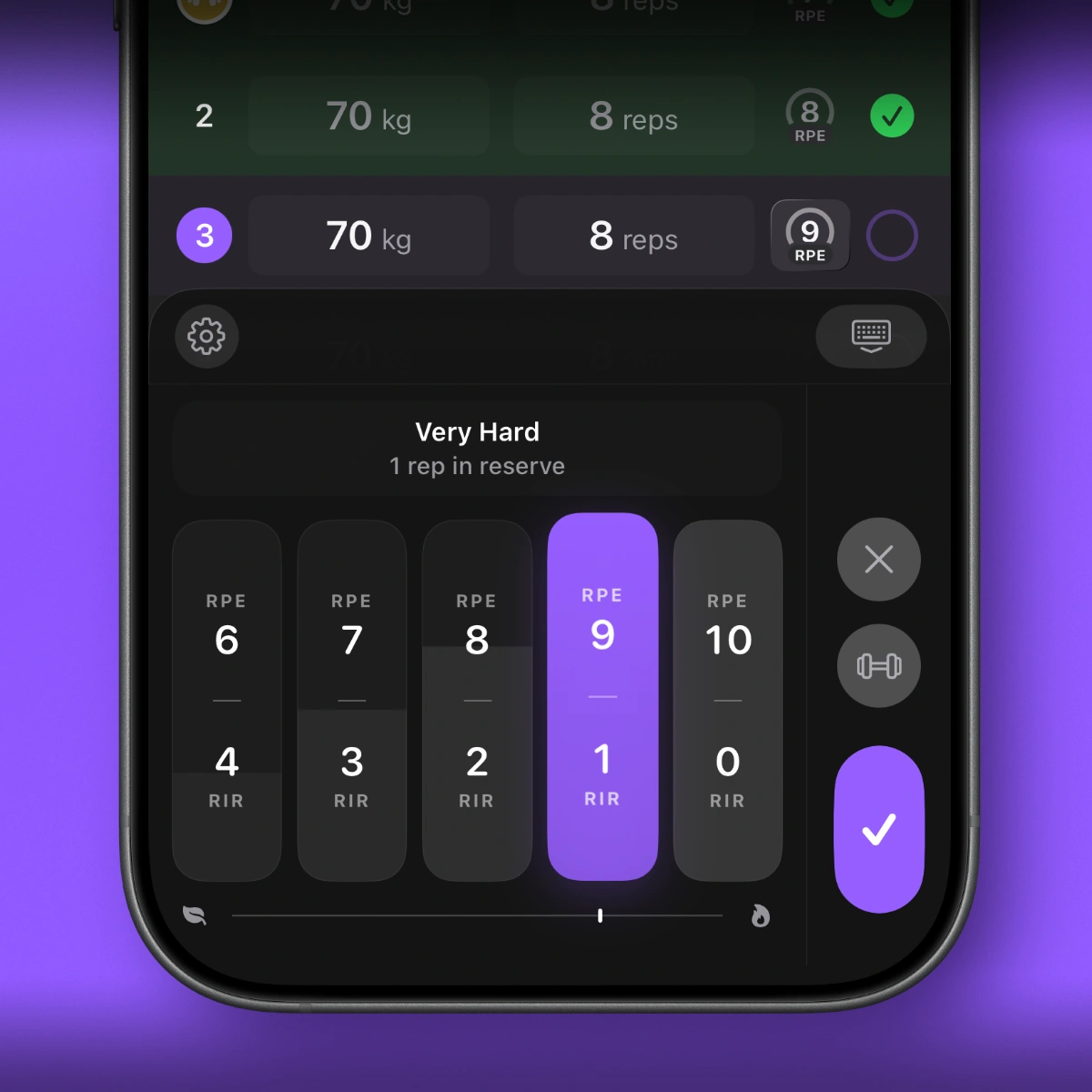 RPE and RIR make a missed target easier to interpret: did you stop with reps left, or did you hit the wall?
That distinction changes the next decision. Six reps at RPE 8 after a target of eight may mean you stopped conservatively or had a strange setup. Six reps at RPE 10 means the target was maxed out under today’s conditions.
If you use Steady’s progression tools, this context matters because the app can compare performed set details against the target. A clean log gives you a better review. A polished but inaccurate log just teaches the next workout the wrong lesson.
The Bottom Line
Log missed reps because they make your training history honest. Record the reps you completed, the load you used, and the effort level if it helps explain what happened. Then look at the pattern before changing the plan.
One missed rep is feedback. Repeated misses are a programming signal. Steady is built for that kind of practical logging: simple enough to use between sets, detailed enough to help your next workout make sense. Steady is free on iOS and Apple Watch.
Ready to start applying progressive overload?
Ditch the spreadsheets and complex notes. Join thousands of lifters who use Steady to focus on the workout, track their progress, and automatically know when to add weight.
Download Free for iPhone