What Is a Rest-Pause Set?

A rest-pause set is a high-effort set followed by one or more very short rests — often 10 to 20 seconds — and brief follow-up efforts with the same weight. You stop the initial effort at technical failure or just before it, rack the weight safely, breathe, and then perform a few more controlled reps.
It’s an intensity technique: a time-efficient way to accumulate more challenging reps without lowering the weight or adding full sets. It is an option, not a requirement for muscle growth or progress.
Here’s the simplest way to picture it. You press a weight for 8 controlled reps and stop when a ninth would no longer be clean. After a 15-second pause, you may perform 3 more controlled reps, pause again, and do 2 more. The result is 8 + 3 + 2 at one weight, with planned short rests.
How a rest-pause set works
The mechanics are straightforward:
- Pick a weight you’d normally use for around 6–10 reps.
- Do the initial set with controlled form, stopping at technical failure or with a rep or two in reserve.
- Rest very briefly — 10 to 20 seconds. Stay at the station; just breathe.
- Do another mini-set with the same weight. You’ll get fewer reps — maybe 2–4.
- Repeat the short pause and mini-set one or two more times.
- End the set when you cannot complete another clean rep with the planned range of motion.
A typical rest-pause set looks like 10 + 4 + 2 or 8 + 3 + 2 + 1 — one continuous effort, broken only by those short breaths.
The short rest is the whole point. It is long enough to restore a little capacity for another controlled effort, but not long enough for full recovery. That makes the technique demanding, so use it deliberately rather than assuming more fatigue is always better.
How long should the pause be?
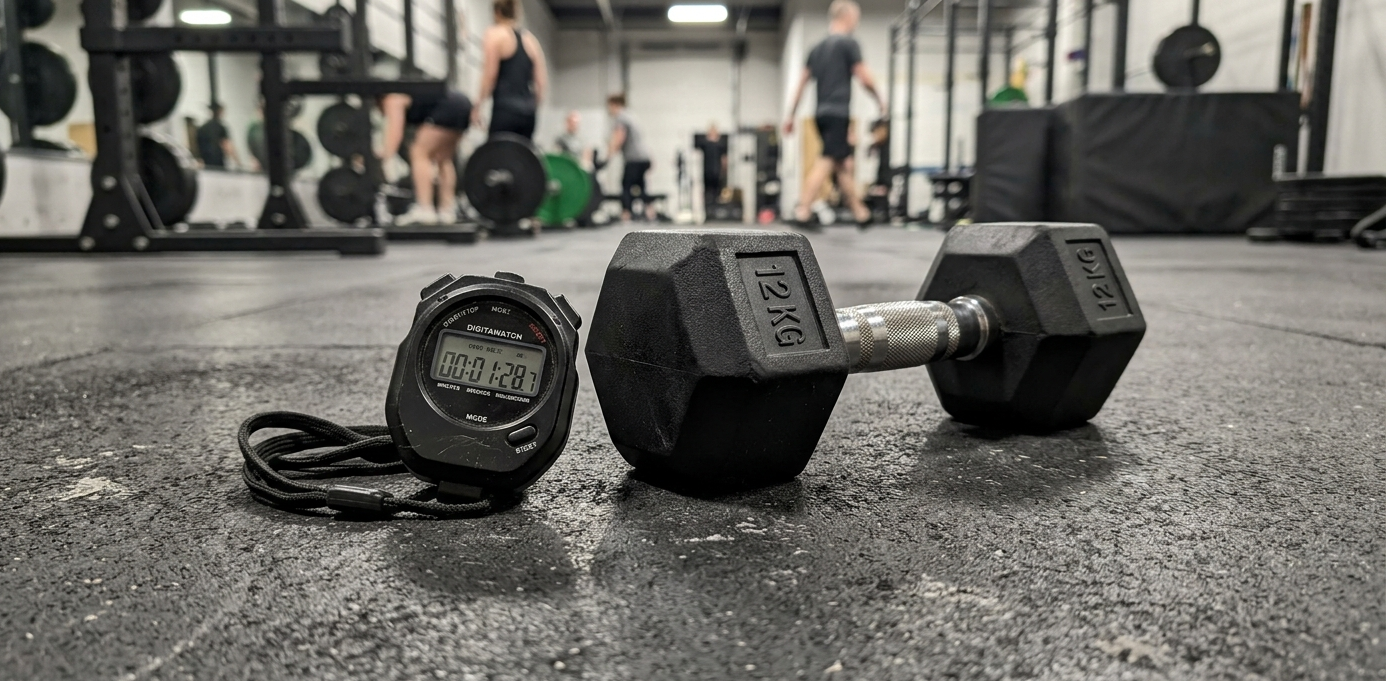 The pause is short and deliberate — long enough to catch a breath, short enough that you’re still working in the fatigued range.
Ten to 20 seconds is a common starting range, not a rule. The useful pause is one you can repeat consistently while keeping the mini-sets controlled. Longer pauses can be useful in other methods, but they change the stimulus and should be logged as such.
A practical default: 15 seconds, or roughly 5–7 deep breaths. Heavier compound work can lean toward 20 seconds; lighter isolation work toward 10. The exact number matters less than keeping it consistent so you can compare sessions and actually see progress.
Rest-pause vs other intensity techniques
Rest-pause is one of several ways to push a set past the comfortable zone. It helps to know how it differs:
- Rest-pause — same weight, short pauses, more reps. Useful when you want more challenging reps without adding full sets.
- Drop set — reduce the weight immediately and keep going with little or no rest. It lets you continue after the initial load becomes limiting.
- Superset — pair two exercises back to back. Best for time efficiency and pairing muscle groups.
The common thread is that all three extend effort beyond a normal straight set. Rest-pause is the one that keeps the load heaviest, which makes it especially useful when you don’t want to give up the weight on the bar. If the goal is simply pushing a set hard, it pairs naturally with the ideas in should you train to failure.
When to use rest-pause
Rest-pause can earn its place when you want more challenging reps without more full sets or more gym time. It’s a good fit when:
- You’re short on time but still want a hard, productive session.
- An exercise is stable and safe to push — machines, cables, and many dumbbell movements.
- You’ve already built a base of normal training and want to add intensity, not replace fundamentals.
- You want to overload a muscle on the last exercise of its block.
It’s a poor fit when:
- The exercise is technically demanding or risky near failure — heavy barbell squats, deadlifts, and barbell bench press without safeties. Repeated near-failure mini-sets can make form harder to control and complicate safety.
- You’re a beginner still learning movement patterns — straightforward progressive overload will do more for you right now.
- You’re already accumulating a lot of fatigue and recovery is shaky.
Use it as a sharp tool on a few exercises, not a default on everything. If every set is a rest-pause set, none of them are special — and your recovery will tell you.
Best exercises for rest-pause sets
Movements that are stable, easy to start and stop, and safe to take near failure:
- Machine presses (chest, shoulder, leg press)
- Cable movements (rows, pushdowns, curls, lateral raises)
- Most dumbbell isolation work
- Hamstring curls and leg extensions
- Calf raises
Generally avoid it on free-weight squats, deadlifts, and barbell bench unless you have a spotter or safety bars. This is the same logic behind why machines make it easier to train hard safely.
How to track a rest-pause set
This is where rest-pause sets quietly get messy. Tracking does not make the technique work by itself, but it lets you judge whether it still fits your plan and whether your performance is changing. “13 reps split as 8 + 3 + 2 with a 15-second pause” is not something you’ll remember accurately three sessions from now.
A few practical rules:
- Log each mini-set’s reps, not just the total.
8 + 3 + 2and5 + 5 + 3both total 13, but they’re very different sets. - Keep the pause length fixed. If the rest creeps from 15 to 40 seconds, your “progress” is just more rest, not more capacity.
- Compare like with like. Progress is the same weight and pause yielding more total reps, or the same rep total at a heavier load.
This is exactly the kind of detail a focused workout tracker should make effortless. In Steady, you can log each set’s reps and weight cleanly, then review your history to see whether last week’s 8 + 3 + 2 became this week’s 9 + 4 + 2 — real progression on an intensity technique, not a guess. No social feed, no clutter, just the numbers that tell you whether the technique is working.
Common mistakes
- Letting the pause drift without recording it. A longer rest changes what you can do next, so keep it consistent when comparing sessions.
- Using it on everything. It’s a finisher and an intensity tool, not a default rep scheme.
- Going too heavy. Pick a weight you genuinely control for the first mini-set; rest-pause amplifies effort, it doesn’t fix a too-heavy load.
- Not tracking the breakdown. Without the per-mini-set numbers, you can’t tell if you’re progressing or just shuffling reps around.
- Ignoring recovery. Rest-pause adds real fatigue. Treat it like the high-intensity work it is and don’t bury every muscle in it every session.
Frequently asked questions
How many reps should a rest-pause set total?
There’s no fixed number — it depends on the load, exercise, starting effort, and pause length. Use a repeatable setup that lets you keep the mini-sets controlled; consistency session to session matters more than chasing a particular total.
How many pauses should I take?
Usually one to three. Stop when you can no longer perform controlled reps with the intended range of motion, or earlier if the technique is no longer serving your plan.
Is rest-pause better than a drop set?
Neither is “better” — they do different jobs. Rest-pause keeps the load heavy and adds reps; a drop set drops the load and chases deep fatigue. Pick based on the goal of that exercise.
Can beginners use rest-pause sets?
They can, but they usually shouldn’t prioritize it. Simple progressive overload delivers more for a beginner than intensity techniques. Add rest-pause once your base is solid.
How often should I use rest-pause sets?
Sparingly — often on one or two exercises per session, commonly near the end of a muscle’s work. Adjust that to your experience, total training load, and recovery; using it everywhere can outpace recovery.
Final thoughts
A rest-pause set is a time-efficient way to add challenging reps without lowering the weight or adding full sets — provided you choose a stable exercise, keep the pause consistent, and record what you actually did. The technique is simple; managing its fatigue cost is the important part.
That’s the real takeaway: log each mini-set, hold the pause steady, and let your history show how the work is changing. Steady is built to make that kind of clear, honest tracking the easy path — so you can decide whether the technique still fits your training.
Ready to start applying progressive overload?
Ditch the spreadsheets and complex notes. Join thousands of lifters who use Steady to focus on the workout, track their progress, and automatically know when to add weight.
Download Free for iPhone